The lights go out. Your unit is charged and sitting in the corner. Now you’re deciding what gets plugged in first and whether the fridge will still be cold by morning.
Here’s the short version. A 2000Wh power station will comfortably carry a fridge, ceiling fans, LED lighting, Wi-Fi, phones and a laptop through an overnight outage, with room to spare. What it won’t do is run anything with a heating element for long, or a non-inverter air conditioner at all.
The number that trips people up isn’t the 2000. It’s the unit after it. 2,000Wh and 2,000W are different limits, and either one can stop you cold.
What can a 2000Wh power station run?
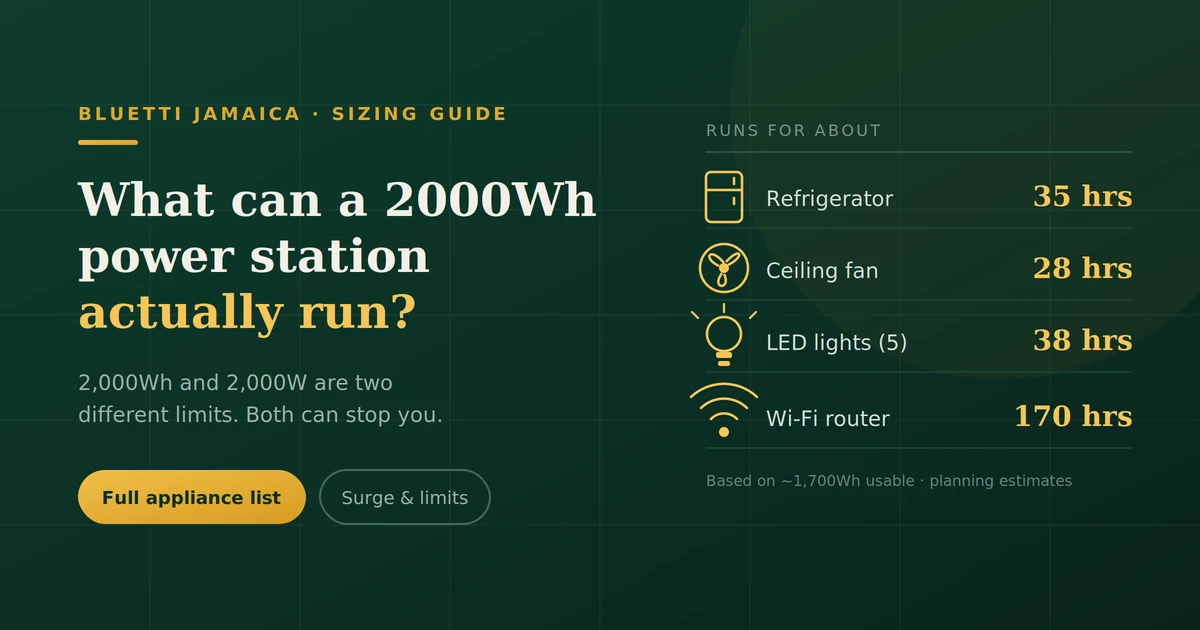
A 2,000Wh unit delivers roughly 1,700Wh of usable energy after conversion losses. That’s enough for a typical fridge plus household essentials for a full night, or a single fridge for well over a day on its own.
Comfortably, and for hours:
- Refrigerator or chest freezer
- Ceiling and pedestal fans
- LED lighting throughout the house
- Router, modem, phones, tablets
- Laptop, TV, fans, small kitchen appliances in short bursts
- CPAP machine overnight
- Water pump (short cycles)
Briefly, and at a cost:
- Microwave, blender, coffee maker minutes, not hours
- Power tools within the output limit
- Inverter split AC a few hours, not overnight
Not realistically:
- Electric kettle, stovetop, clothes dryer, water heater
- Older non-inverter air conditioners
2,000Wh and 2,000W are not the same number
This is where most guides go wrong, and it’s the single most useful thing to understand. Three separate ratings decide what a power station can do, and each one stops you in a different way.
Capacity (watt-hours) how long
Watt-hours measure the size of the tank. A 2,000Wh battery holds 2,000 watt-hours of energy, minus what’s lost converting DC to AC and running the unit itself. Plan on about 85% reaching your appliances.
This number answers “how long,” not “what.”
Continuous output (watts) how many at once
Watts measure the size of the tap. A unit with a 2,000W inverter can supply 2,000 watts at any instant, regardless of how much energy is in the battery.
Plug in a 1,200W microwave and an 800W kettle together and you’ve hit the ceiling even on a full battery. The unit shuts down to protect itself.
Note that Wh and W often differ on the same product. A common configuration pairs roughly 2,000Wh of capacity with a 2,200W inverter.
Surge watts whether it starts at all
Anything with a motor draws a brief spike on startup, often 3–5× its running wattage. A fridge that runs at 120W may pull 600W for a second. A ½ HP water pump can spike past 2,500W.
If that spike exceeds the unit’s surge rating, the appliance won’t start no matter how much capacity you have. Check your largest motor against the surge rating before anything else.
The practical summary: capacity decides how long, continuous output decides how many at once, surge decides whether it starts. All three have to clear.
Appliance runtime on a 2000Wh power station
Based on roughly 1,700Wh usable. Cycling appliances use average draw rather than nameplate watts the reasoning behind that is covered in our guide to calculating solar generator runtime.
| Appliance | Running watts | Average draw | Realistic runtime |
|---|---|---|---|
| LED bulb (9W) | 9W | 9W | 180+ hrs |
| Router + modem | 10W | 10W | ~170 hrs |
| Phone charging | 15W | 15W | 100+ charges |
| Ceiling fan | 60W | 60W | ~28 hrs |
| Laptop | 65W | 65W | ~26 hrs |
| CPAP (no humidifier) | 40W | 40W | ~42 hrs |
| Refrigerator (18 cu ft) | 120W | ~48W @ 40% duty | ~35 hrs |
| Chest freezer | 150W | ~55W @ 35% duty | ~30 hrs |
| LED TV (43″) | 80W | 80W | ~21 hrs |
| Water pump (½ HP) | 800W | ~60W (short cycles) | Days of normal use |
| Microwave (1,000W) | 1,000W | 1,000W | ~1.7 hrs total run time |
| Inverter split AC (9,000 BTU) | 600–900W | ~450W once cooled | ~3.5 hrs |
| Electric kettle | 1,500W | 1,500W | ~68 minutes |
| Clothes dryer | 3,000W+ | Exceeds output |
A realistic overnight outage
Twelve hours, 6pm to 6am, running the things a Jamaican household actually needs:
| Load | Average draw | Hours | Watt-hours |
|---|---|---|---|
| Fridge | 48W (40% duty) | 12 | 576Wh |
| Two ceiling fans | 120W | 8 | 960Wh |
| LED lights (5) | 45W | 5 | 225Wh |
| Router | 10W | 12 | 120Wh |
| Phones (3) | 45W | 3 | 135Wh |
| Total | 2,016Wh |
That’s slightly over what 1,700Wh usable will carry. Drop one fan and you’re comfortably inside it with energy to spare by morning.
This is the useful lesson from the whole exercise: fans, not the fridge, are what empty a power station in Jamaica. People assume refrigeration is the expensive load. It isn’t the compressor cycles, so it averages under 50W. Two fans running steadily for eight hours cost nearly twice as much.
What a 2000Wh unit won’t do
Heating elements. That’s the whole answer, and it’s worth internalising because it rules out an entire category at once.
Anything that makes heat electrically kettle, stovetop, iron, water heater, clothes dryer, toaster oven — converts electricity directly into heat with no efficiency trick available. There’s no cycling, no duty cycle, no clever mode. A 1,500W kettle draws 1,500W for as long as it’s on.
| Appliance | Why it doesn’t work |
|---|---|
| Electric kettle | ~68 min total; drains a third of the battery per boil cycle |
| Electric stovetop | Typically exceeds continuous output |
| Clothes dryer | 3,000W+; exceeds output entirely |
| Water heater | Continuous high draw; empties the unit in under an hour |
| Non-inverter AC | High running draw plus surge; usually won’t start |
Use gas for cooking and boiling during an outage. A gas stove and a kettle on the hob cost you nothing from the battery, and that single habit change is worth more than a larger power station.
Inverter split AC units are the borderline case. They’ll run expect around three hours but they’ll consume in one evening what your fridge uses in a day and a half. If overnight cooling is the goal, 2,000Wh isn’t the answer.
Running several appliances at once
Add up the running watts of everything plugged in simultaneously, and keep the total under the continuous output rating. Simple in principle the catch is the loads you forget, because they switch themselves on.
The classic failure: you’re running the microwave at 1,000W, the lights at 50W and a fan at 60W. Total 1,110W, well inside a 2,000W limit. Then the fridge compressor kicks in with a 600W surge, and the unit trips.
Safe to combine: fridge, fans, lights, router, phone charging, laptop, TV. Total draw stays under 400W.
Run one at a time: microwave, kettle, blender, coffee maker, power tools, air fryer. Anything over 800W gets the stage to itself.
The habit: before starting a high-draw appliance, pause and think about what else might switch on by itself. Fridges and water pumps don’t ask permission.
Recharging it in Jamaica
From a wall outlet, most 2,000Wh units refill in 2–3 hours. From solar, plan on the array’s rating minus roughly 25% for heat, angle and cable losses, across about 5 peak sun hours in Jamaica.
400W array × 5 hrs × 0.75 = 1,500Wh per day
600W array × 5 hrs × 0.75 = 2,250Wh per day
So 400W of panel won’t quite refill a fully drained 2,000Wh unit in one day. 600W will, with margin.
What that means for hurricane season: plan for consecutive overcast days, not one clean recharge. If a storm knocks out JPS for three days and you’re harvesting 40% of normal on the cloudy ones, a 400W array leaves you steadily falling behind. This is the calculation most people skip, and it’s the one that matters when it counts.
Solar recharge pros and cons
- Independent of the grid, which is the entire point during a multi-day outage
- No fuel, no noise, no fumes indoors
- Slower than wall charging, and weather-dependent
- Extra cost and something to set out and pack away
Is 2,000Wh the right size for you?
It fits if you want essentials covered through overnight and next-day outages fridge, fans, lights, connectivity and you cook with gas. For most Jamaican households, this is the sensible middle.
Size down if you only need phones, lights, a router and a laptop. A 500–1,000Wh unit does that for considerably less.
Size up or go expandable if you want air conditioning, run a well pump frequently, work from home on outage days, or plan for multi-day storm outages. Expandable systems let you start here and add battery capacity later, which usually beats buying twice.
The honest test: write down what you’d actually run for twelve hours, total the watt-hours, and see whether it lands under 1,700. If it’s close, go bigger. Nobody regrets headroom during hurricane season.
FAQs
How long will a 2000Wh power station run a fridge?
Roughly 35 hours for a typical household fridge, because the compressor cycles rather than running continuously. Hot weather and a full fridge shorten that.
Can a 2000Wh power station run an air conditioner?
An inverter split AC will run about three hours. Older non-inverter units usually won’t start at all because of the surge. It’s not the right tool for overnight cooling.
Will it run a microwave?
Yes, in short bursts about 1.7 hours of cumulative run time. Run it alone rather than alongside other high-draw appliances.
How many appliances can I plug in at once?
As many as fit under the continuous output rating, typically around 2,000W. Essentials like a fridge, fans, lights and Wi-Fi together draw under 400W, so you have plenty of margin.
How long does it take to recharge?
Two to three hours from a wall outlet. From solar, around 600W of panel will refill it in a day of good Jamaican sun; 400W won’t quite manage a full recharge.
Is 2000Wh enough for a hurricane outage?
For overnight essentials, yes. For a multi-day outage you’ll need solar to keep pace, sized for cloudy days rather than perfect ones.
Does it matter whether appliances are plugged into AC or USB?
Yes. Charging phones and running small devices from the DC and USB ports skips the inverter and wastes less energy than using the AC sockets with an adapter.
Check your own numbers
Take ten minutes with the labels on your appliances and the tables above. Most people find two things: the fridge costs far less than they expected, and the fans cost far more.