The power’s gone again. You’re standing in the kitchen with a torch, looking at the box that says 2,048Wh, trying to work out whether the fridge survives until morning.
Learning how to calculate solar generator runtime takes about two minutes once you know which numbers matter. The catch is that the formula everyone quotes online capacity divided by watts gives you a number that’s usually wrong for the appliances you actually care about. Fridges, water pumps and inverter air conditioners don’t draw power steadily. They cycle. Miss that, and you’ll either buy twice the unit you need or half of it.
How to Calculate Solar Generator Runtime
Here’s the honest method.
The basic solar generator runtime formula
Start here, then refine it:
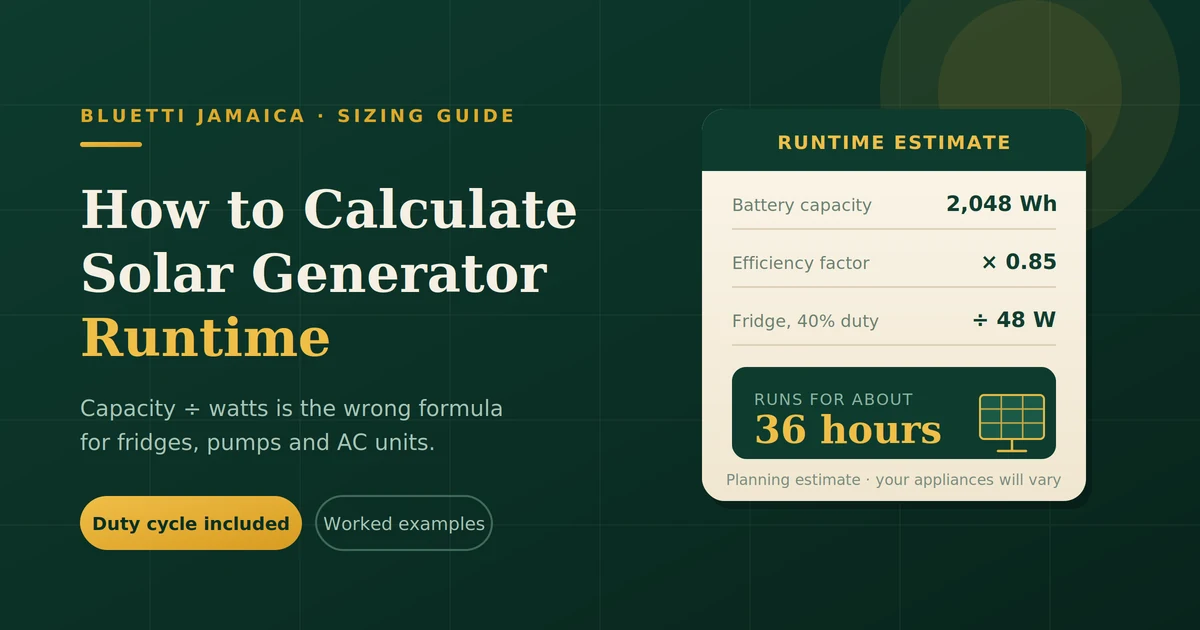
Runtime (hours) = Battery capacity (Wh) × 0.85 ÷ Load (watts)
The 0.85 accounts for real-world losses between the battery and your appliance. Skip it and your estimate will be optimistic by roughly an hour in every seven.
Quick example: a 2,048Wh unit running a 100W load.
2,048 × 0.85 = 1,741Wh usable
1,741 ÷ 100W = 17.4 hours
That’s your starting number. It’s accurate for a steady load like a fan or a set of lights. For a fridge, it’s badly pessimistic and the next few sections explain why.
Why you never get the full rated capacity
Rated watt-hours describe what the battery cells hold, not what reaches your appliance. Between the two sits an inverter, some standby electronics and a bit of heat. Expect 80–90% of the rated figure to actually do useful work.
Inverter efficiency the biggest single deduction
Your battery stores DC. Your fridge runs on AC. The inverter converts one to the other, and the conversion costs something typically 10–15% on a good pure sine wave unit. That loss leaves as heat, which is why the fan kicks in under load.
Running DC devices directly from the USB or 12V ports skips this step entirely. Charging phones and running a 12V fan off the DC outputs is measurably more efficient than plugging their adapters into the AC sockets.
Usable vs rated capacity
LiFePO4 batteries what BLUETTI and most current units use tolerate deep discharge well, so you can generally use most of the rated capacity. But the battery management system holds back a reserve to protect cell life. Plan on usable capacity, not nameplate.
Standby drain
The unit itself consumes power just being switched on often 5–15W with the inverter active and nothing plugged in. Over a 12-hour overnight outage that’s 60–180Wh gone before a single appliance runs. Switch the AC inverter off when you’re only using DC ports.
Step 1 Find what your appliances actually draw
Look at the label on the back or underside of the appliance. You’ll find either watts directly, or volts and amps multiply those together for watts. A pump marked 230V / 4.3A draws roughly 990W.
Two things to understand about that number:
- Running watts what it uses in normal operation.
- Surge watts the brief spike when a motor starts, often 3–5× the running figure for compressors and pumps.
Nameplate ratings tend to state the maximum draw under worst-case conditions, not typical operation. A fridge labelled 150W may pull 110W in practice.
If you want real numbers rather than estimates, a plug-in energy meter costs little and settles the argument. Leave it on your fridge for 24 hours and it tells you exactly what that appliance costs you per day the single most useful measurement in this whole exercise.
Step 2 Account for duty cycle
This is where most runtime calculations fall apart. A 120W fridge does not draw 120W for 24 hours. Its compressor runs until the box is cold, shuts off, and restarts when the temperature drifts up typically running 30–50% of the time, higher in Jamaican heat. Your real figure is average draw, not peak draw.
Cycling loads
Fridges, freezers, water pumps and inverter air conditioners all cycle. Convert them like this:
A 120W fridge at 40% duty cycle averages 48W. Over 12 hours that’s 576Wh not the 1,440Wh the naive calculation suggests. Nearly a 3× difference, which is why people so often buy more capacity than they need for refrigeration alone.
Sensible planning figures in a hot climate:
| Appliance | Running watts | Typical duty cycle | Average draw |
|---|---|---|---|
| Fridge (18 cu ft) | 100–150W | 35–45% | 40–65W |
| Chest freezer | 100–200W | 30–40% | 35–75W |
| Water pump (½ HP) | 700–1,000W | 5–10% | 40–90W |
| Inverter split AC (9,000 BTU) | 600–900W | 50–70% once cooled | 350–600W |
Note the air conditioner. Even with cycling, it’s in a different league which is the honest answer to whether a portable unit will run your AC overnight.
Continuous loads
Lights, routers, fans, laptops and TVs draw steadily. Use their actual watts with no duty-cycle adjustment. These are easy to calculate and easy to underestimate in total, because five small things running all night add up.
Surge loads
Surge is a separate check from runtime, and failing it stops everything. If your pump surges to 2,800W and your unit’s surge rating is 2,400W, it trips on startup regardless of how much battery capacity you have. Check your largest motor load against the surge rating before you look at anything else.
Step 3 Worked example: an overnight outage
A realistic 12-hour outage, 6pm to 6am, for a household running essentials:
| Load | Watts | Hours / duty | Watt-hours |
|---|---|---|---|
| Fridge | 120W @ 40% duty | 12 hrs | 576Wh |
| Ceiling fan | 60W | 8 hrs | 480Wh |
| LED lights (4 × 9W) | 36W | 5 hrs | 180Wh |
| Router / modem | 10W | 12 hrs | 120Wh |
| Phone charging (2) | 30W | 3 hrs | 90Wh |
| Total energy needed | 1,446Wh |
Now apply the efficiency factor to find the capacity required:
A 2,000Wh-class unit covers this comfortably with roughly 300Wh spare. A 1,000Wh unit gets you about seven hours enough to protect the food, not enough to be comfortable. Substitute your own appliances into that table and you have your answer.
Solar generator runtime by capacity and load
Realistic runtimes using the duty-cycle figures above, with the 0.85 efficiency factor applied:
| Rated capacity | Fridge only (~48W avg) | Essentials (~95W avg) | Essentials + fan (~155W avg) | Recharge from 400W of panels |
|---|---|---|---|---|
| 500Wh | ~8.8 hrs | ~4.5 hrs | ~2.7 hrs | ~2 hrs |
| 1,000Wh | ~17.7 hrs | ~8.9 hrs | ~5.5 hrs | ~3.5 hrs |
| 2,000Wh | ~35 hrs | ~17.9 hrs | ~11 hrs | ~7 hrs |
| 3,000Wh | ~53 hrs | ~26.8 hrs | ~16.4 hrs | ~10 hrs |
| 5,000Wh | ~88 hrs | ~44.7 hrs | ~27.4 hrs | Two days |
How solar panels change the equation
Once panels are connected, runtime stops being a countdown. It becomes a daily balance: if you harvest more than you spend, you never run out. Miss the balance and you’re just delaying the same problem.
Peak sun hours vs daylight hours
Jamaica gets roughly 11–13 hours of daylight, but peak sun hours the equivalent hours of full-strength sun sit around 5 to 5.5 per day annually, less in heavy cloud. Peak sun hours are what you calculate with.
The panel derate
Panels rarely hit their rated output. Between heat, panel angle, dust, cable losses and charge controller efficiency, plan on 70–80% of the rating:
Compare that to the 1,446Wh our example household used overnight. Close, but not comfortable daytime usage isn’t counted yet. For genuine self-sufficiency through a multi-day outage, that household wants 600W or more of panel.
Matching panels to draw
Work out your daily watt-hours first, then size the array to replace them with margin. A rough starting point: panel watts ≈ daily watt-hours ÷ 3. For 1,500Wh/day, that’s roughly 500W of panel.
Jamaican conditions that shorten real runtime
Heat is the main one. High ambient temperatures make your fridge cycle more often pushing duty cycle toward 50% rather than 35% while simultaneously reducing panel output, since panels lose efficiency as they get hot. Both effects work against you at the same time of year.
Other local factors worth building into your plan:
- Salt and dust on panels near the coast can cost 10–20% of output between cleanings.
- Partial shade from a single tree branch can disproportionately reduce a panel string’s output, not just the shaded portion.
- Hurricane season means planning for several overcast days in sequence, not one clean sunny recharge. Size for the worst three-day stretch, not the average day.
- Ventilation a unit running in a closed cupboard will throttle or shut down on thermal protection.
A practical sizing rule of thumb
Three steps, in order:
- Calculate your daily watt-hours using duty cycles, as above.
- Add 30% headroom for heat, battery ageing and the loads you forget on the first pass.
- Check surge capacity separately against your largest motor pump, fridge compressor or AC unit.
Oversizing buys peace of mind and longer life, since a battery worked gently ages slower. It costs more upfront and adds weight.
Buying expandable lets you start smaller and add battery modules later. It costs slightly more per watt-hour but spreads the spend.
If you’re choosing between the two and the budget is tight, expandable usually wins because almost everyone underestimates their load on the first calculation.
FAQs
How long will a 2,000Wh solar generator run a fridge?
Roughly 30–40 hours for a typical household fridge, once you account for the compressor cycling rather than running continuously. Hot conditions and a full fridge shorten that.
How do I know what size solar generator I need?
Add up the watt-hours your appliances use over the outage length you’re planning for, divide by 0.85, then add about 30%. Check the surge rating against your largest motor separately.
Can a solar generator run an air conditioner?
An inverter split AC can run on larger units, but expect a few hours rather than overnight a 9,000 BTU unit averages 350–600W once the room is cool. Older non-inverter units draw far more and surge harder.
How long does it take to recharge from solar panels?
Divide usable capacity by realistic panel output about 75% of the array’s rating. A 2,000Wh unit with 400W of panels takes roughly 7 hours of good sun.
Does running it at full load damage the battery?
It won’t damage a LiFePO4 unit, but sustained high loads generate heat and reduce efficiency. Running at a moderate load is gentler and gets more usable energy out of the same battery.
Will it run my water pump?
Usually yes on capacity pumps run in short bursts, so daily consumption is modest. The real question is surge: a ½ HP pump can spike above 2,500W on startup, so check that against the surge rating first.
Work out your own number
Take ten minutes with the appliance labels in your kitchen and the table above. Most people are surprised twice first by how little the fridge really costs them, then by how quickly the small continuous loads add up.
If you’d rather have it checked, send your appliance list and how long you need to stay running, and we’ll size it properly. You can see the range of units and panel options at BLUETTI Jamaica, including expandable systems if you’d prefer to start with essentials and grow.