No roof to put panels on. Nowhere obvious to store a 20kg box in a flat where the living room is also the dining room. And a neighbour on the other side of a thin wall.
Choosing a power station for a small apartment works differently from choosing one for a house, and most buying guides don’t account for that. The load list is shorter, solar usually isn’t an option, and where the thing physically lives matters as much as what’s inside it.
Here’s how to size one properly for a flat.
How to choose a power station for a small apartment
Most apartments need less capacity than a house typically 500 to 1,500Wh covers the essentials. There’s no well pump, no yard equipment, and fewer rooms drawing power.
Work through it in this order:
- List what you’d actually run during an outage
- Total the watt-hours for the length of outage you’re planning for
- Check the unit physically fits where you’d keep it
- Check the weight if you’d ever carry it upstairs
- Plan how you’ll recharge it without roof solar
Step 5 is the one apartment buyers skip, and it’s where this differs most from house sizing.
Why apartment sizing is different
Five things change the calculation:
- Shorter load list. No water pump, no outdoor lighting, no workshop tools.
- No roof. You don’t own it, and you can’t put panels on it.
- Limited space. A 30kg unit in a 45m² flat is furniture you didn’t choose.
- Shared walls. Fan noise carries at 2am.
- You may be renting. Nothing permanent, nothing drilled, and it has to move with you.
The upshot is usually good news: apartment dwellers need smaller and cheaper units than they assume. The constraint isn’t capacity it’s logistics.
Start with what you’d actually run
A realistic apartment load through a 12-hour overnight outage:
| Load | Average draw | Hours | Watt-hours |
|---|---|---|---|
| Fridge | 48W (cycles ~40%) | 12 | 576Wh |
| Ceiling or pedestal fan | 60W | 8 | 480Wh |
| LED lights (4) | 36W | 5 | 180Wh |
| Router | 10W | 12 | 120Wh |
| Phones (2) | 30W | 3 | 90Wh |
| Laptop | 65W | 3 | 195Wh |
| Total | 1,641Wh |
Allowing for conversion losses, that needs roughly 1,900Wh of rated capacity to cover in full but note how much of it is the fan and the fridge. Drop the laptop and one fan and you’re comfortably inside 1,000Wh.
The method behind those duty-cycle figures is covered in our guide to calculating runtime properly, and the appliance-by-appliance breakdown is in what a 2000Wh unit will run. Use those to build your own list rather than borrowing mine.
The solar problem apartments have
This is where apartment advice diverges sharply from house advice, and where most articles quietly assume you have a roof.
You probably can’t install solar. No roof access, no permission, and in a rental, no realistic prospect of getting either. What you may have is a balcony and a balcony is a limited substitute.
What a balcony panel can and can’t do
A portable 100–200W panel on a balcony is genuinely useful, but be realistic about output:
- Orientation is fixed. Your balcony faces where it faces. A south-facing balcony in Jamaica will underperform badly.
- Shading is common. The building above you, the next block over, a wall on one side.
- Hours are short. Direct sun may only reach the balcony for three or four hours, not the five peak sun hours an open roof gets.
Realistic expectation: 200W of balcony panel might deliver 300–500Wh on a good day, not the 750Wh the same panel would produce on an unshaded roof. That’s a useful top-up. It isn’t a recharge strategy.
Charging opportunistically instead
Without roof solar, your recharge plan changes shape. The habit that matters:
Keep it charged, always. Not when an outage is forecast always. Most units refill from a wall outlet in 1–3 hours, so the moment grid power returns after an outage, plug it in immediately rather than waiting.
During a multi-day outage where JPS restores power in patches, those windows are your recharge opportunities. A unit at 100% when the power cuts is worth more than a larger unit at 40%.
This also means charge speed matters more for apartments than solar input does. When you’re comparing models, look at wall recharge time as closely as capacity.
Capacity by apartment size
| Apartment | Typical essentials load | Recommended capacity | Unit weight | Wall recharge |
|---|---|---|---|---|
| Studio / bedsit | Fridge, fan, lights, Wi-Fi | 500–800Wh | 6–10 kg | 1–2 hrs |
| One bedroom | Above + laptop, second fan | 1,000–1,500Wh | 12–18 kg | 1.5–2.5 hrs |
| Two bedroom | Above + second fridge or more fans | 1,500–2,000Wh | 18–25 kg | 2–3 hrs |
| Working from home | Add monitor, printer, longer laptop hours | 2,000Wh+ or expandable | 20 kg+ | 2–3 hrs |
Space, weight and where it lives
Three practical things people discover after the box arrives.
Footprint. A 2,000Wh unit is roughly the size of a small microwave and about as easy to hide. In a studio it becomes visible furniture. Decide where it goes before you order beside the fridge, under a console table, in a corner with airflow.
Ventilation. These units have cooling fans and need air. Don’t put it in a cupboard or a sealed cabinet. It’ll throttle output or shut down on thermal protection, and in a small warm Jamaican flat that happens sooner than you’d think.
Weight. If the lift is out and during an outage it will be can you carry it up to the fourth floor? A 10kg unit is manageable. A 25kg unit is a two-person job on a stairwell. This is a genuine argument for buying smaller if you live high up.
Noise and neighbours
Power stations aren’t silent. The inverter is quiet, but cooling fans spin up under load, and in a small flat with shared walls that’s noticeable.
Fans run harder when:
- You’re drawing high power (microwave, kettle, hair dryer)
- The unit is fast-charging from the wall
- Ambient temperature is high, which in Jamaica is most of the year
They’re near-silent when running a light load like a fridge, lights and Wi-Fi.
Practical consequences: don’t fast-charge at 11pm if the unit lives near a bedroom wall. And if you’re in a studio where it’ll sit a metre from your bed, use the slower charge setting overnight if your model offers one
What a power station won’t fix in an apartment building
Worth being direct about, because it catches people out badly.
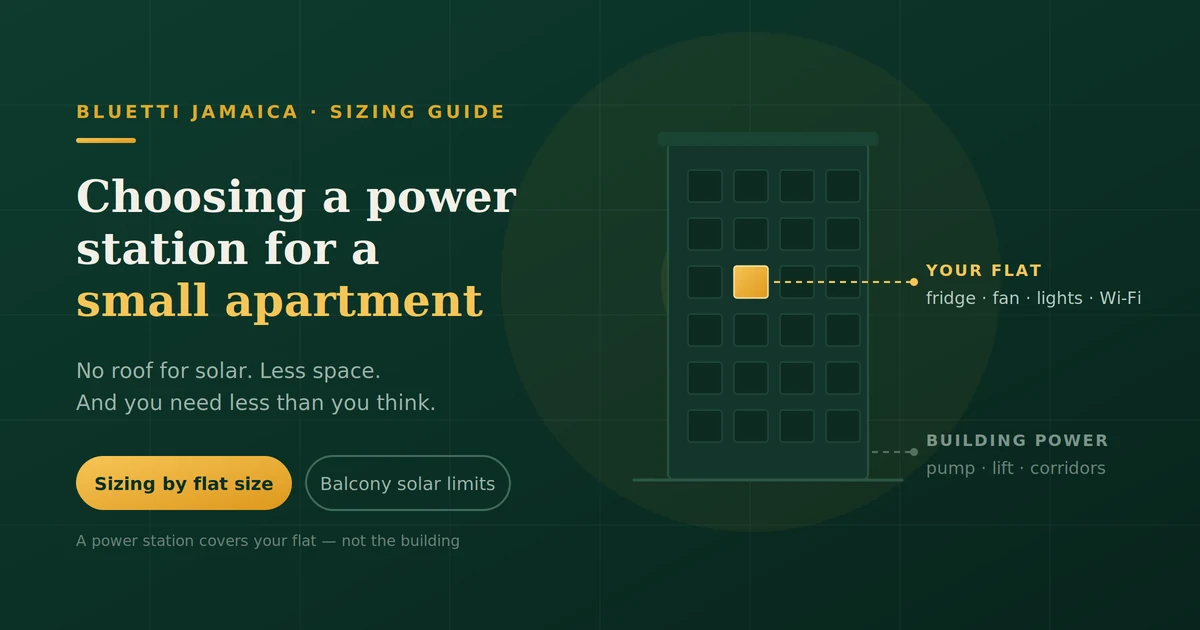
Your unit powers what’s inside your flat. It does nothing for anything on building power:
| On building power | What that means for you |
|---|---|
| Water pump | No water above ground level, regardless of your battery |
| Lift | Stairs, including carrying water up them |
| Corridor and stairwell lighting | Dark stairwells; keep a torch |
| Intercom and security gates | Manual entry, possible security implications |
| Shared laundry | Unavailable |
If you live above the second floor, the water is the real problem, not the power. A fully charged 2,000Wh unit and an empty tap is a worse outage than a modest unit and stored water.
Store water before hurricane season. It costs almost nothing and solves a problem no battery can.
Cooking, and why gas matters more in a flat
Heating elements are what break apartment-sized power stations. There’s no efficiency trick available a 1,500W kettle draws 1,500W for as long as it’s on.
| Appliance | Draw | What it costs a 1,000Wh unit |
|---|---|---|
| Electric kettle | 1,500W | ~34 min total; a boil cycle is a big chunk |
| Hot plate | 1,200W+ | Under an hour of cooking |
| Microwave | 1,000W | ~50 min cumulative |
| Rice cooker | 500W | ~1.7 hrs |
Compare that with a fridge at 48W average, which the same unit runs for roughly 17 hours.
A small gas burner does more for outage comfort than a bigger battery. It costs a fraction as much, cooks and boils without touching your capacity, and frees the whole battery for refrigeration, fans and light. If you take one thing from this article, take that.
If you are renting
Quick checklist before you buy:
- Nothing permanent. No hard-wiring, no drilling, no fixed mounting. Portable units are the right category by definition.
- Check balcony rules. Some buildings restrict what can be placed or hung on balconies, including panels.
- Ask about strata or landlord restrictions if you’re considering anything beyond a portable panel.
- Buy something you can move. You’ll change flats before this unit reaches end of life.
- Keep the box if storage allows it makes moving considerably easier.
FAQs
What size power station do I need for an apartment?
Most apartments are well served by 500–1,500Wh. Studios can manage at the lower end; a one or two-bedroom with a fridge and fans running overnight sits nearer the top.
Can I use solar panels on a balcony in Jamaica?
Yes, with a portable panel, but expect reduced output from fixed orientation and shading. Treat it as a top-up rather than your main recharge method.
Is it safe to use a power station indoors?
Yes. Unlike fuel generators, lithium power stations produce no exhaust fumes and are designed for indoor use. Never run a petrol or diesel generator indoors or on a balcony that’s a carbon monoxide risk, and it’s fatal.
Will it run my apartment building’s water pump?
No. Building pumps run on the building’s supply, not your flat’s circuit. Store water before an outage if you live above ground level.
How loud is a power station?
Near-silent on light loads. Cooling fans become audible under heavy draw or fast charging, which matters in a studio or against a shared bedroom wall.
Can I charge it while the power is on and use it later?
Yes, and you should. Keep it at full charge as a habit, and plug it in the moment grid power returns during a patchy outage.
Do I need a bigger unit if I work from home?
Usually yes. A monitor, longer laptop hours and a router push you toward 2,000Wh or an expandable system.
Size it for your flat, not for a house
Most apartment buyers over-buy. They read a guide written for a house with a well pump and a yard, and end up with a unit that’s heavier than they can carry and larger than their living room wants.