The storm is two days out. You go to the cupboard for the power station you bought after the last one, and it’s sitting at 31% with the solar cable missing and a fridge you’ve never actually tested it on.
Prepare Your Power Station for Hurricane Season
That’s how most people find out their preparation was a plan rather than a habit. Preparing a portable power station for hurricane season isn’t complicated but it’s a sequence, and the jobs that matter most are the ones nobody does until it’s too late to do them properly.
This is written as a timeline. Find where you are and start there.
The short answer
Three things matter more than everything else: the unit at full charge before the grid goes, appliances you’ve already tested so you know they’ll start, and panels stowed before the winds arrive.
Almost every power station failure during a storm is a preparation problem, not an equipment problem.
Start of season: the jobs you do once
Ideally in May, before the season opens on 1 June. If it’s already September, do them today.
Test it under real load
The single most skipped step, and the one most likely to cause a nasty surprise.
Plug in the things you actually intend to run the fridge, a fan, the router and confirm they start and run. Motors matter here: a fridge compressor draws several times its running wattage for a fraction of a second at start-up, and if that spike exceeds your unit’s surge rating, it simply won’t start.
You want to discover that in May with the lights on, not at 2am with the grid down.
Update the firmware
Do it while you have internet and grid power. Updates fix bugs and sometimes improve charging behaviour, and the middle of an outage is the worst possible moment to be downloading anything.
Build the kit and keep it together
One labelled bag, kept with the unit:
- AC charging cable
- Solar cable and any adapters (MC4 connectors, XT60, whatever your unit uses)
- A decent extension lead
- A torch that isn’t your phone
Losing the DC cable is a surprisingly common way to lose access to solar charging entirely. Keep it with the unit, not in a drawer somewhere.
Write down what runs what
A short list on paper, taped inside the cupboard door: which appliances you’ll power, roughly what each draws, and how long the unit holds out running them.
Paper, because the point is that nobody should be doing arithmetic by torchlight with a phone they’re trying to conserve.
Through the season: keeping it ready
This is where preparation quietly decays.
Charge level: the honest nuance
There’s a real tension here and most articles ignore it.
For long-term storage, lithium batteries generally prefer sitting at a partial charge rather than at 100%. That’s the standard advice for a unit you’re putting away for six months.
During an active hurricane season, readiness wins. A unit at 50% when a storm forms is a unit you’re scrambling to charge in the 48 hours before landfall, competing with everything else you need to do. Keep it high through the season, top it up regularly, and store it lower in the off-season if you like.
Top it up monthly
Batteries self-discharge slowly. A unit charged in June won’t be where you left it in September.
Put a monthly reminder in your phone. It takes a couple of hours and it’s the difference between starting an outage at 100% and starting at 70%.
Where to store it
- Off the floor. Flooding is a real risk in a serious storm, and a power station is not a swimming device.
- Out of direct heat. Not in a hot car, not in direct sun, not in a sealed metal shed.
- Somewhere you can reach in the dark, with the cable bag beside it.
Turn the inverter off when idle
A unit left with its AC output switched on draws power to keep the inverter alive, quietly flattening itself over weeks. Switch AC off between uses.
72 hours out: a named storm in the forecast
The countdown starts here.
- Charge to 100% from mains. While the grid is still up and steady. This is the step people delay and regret charging after a warning is issued means competing with everyone else’s demand and a network that may already be unstable.
- Charge every device and power bank in the house. Phones, laptops, tablets, torches, rechargeable fans.
- Fill the fridge and freezer. A full fridge holds cold far longer than an empty one, because the contents act as thermal mass. Bottles of water work if you’ve nothing else.
- Confirm your plug list. Which appliances, in what order, off which outlet.
24 hours out: final checks
Stow the solar panels
The most damaging mistake people make, and it’s entirely avoidable.
Portable panels are sails. In hurricane-force winds they become projectiles damaging themselves, your roof, and whatever else they hit. Fixed arrays need proper wind-rated mounting; portable folding panels need to come inside, before the winds start rather than during them.
Nothing about your solar setup is useful during the storm itself. It all matters afterwards, which is why keeping it intact is the priority.
Move the unit somewhere safe
Away from windows, above likely flood level, in an interior room if you have one. Cable bag next to it. Torch on top of it.
Pre-cool and pre-cook
Use grid power for the heavy work while you still have it. Drop the fridge and freezer a degree or two colder than usual, cook what you can, boil and store water.
That way the battery only has to hold the situation rather than create it.
During the outage: making it last
Rationing rather than heroics.
Priority order for what you power:
- Phones and communications. Keeping in contact matters more than comfort, and phones use almost nothing.
- The fridge, in blocks rather than continuously. Run it, let it cycle off, keep the door shut.
- Fans and lights. LED lights cost almost nothing; fans are worth the draw in Jamaican heat.
- Everything else, if the capacity allows.
Three habits that stretch the battery:
- Keep the fridge door shut. The most effective free thing you can do.
- Take loads off while solar charging. Running appliances while recharging means net input, not full input which is why people report the unit “barely moving” after a day in the sun.
- Use DC where possible. USB charging skips the inverter and its conversion losses entirely.
A safety point worth stating plainly
A power station produces no exhaust, so unlike a generator it can be used indoors safely.
That distinction matters. Carbon monoxide poisoning from generators run indoors, in garages or under closed verandas causes deaths across this region after major storms, every season. If you have both, the generator stays outside and well away from windows always, no exceptions, regardless of rain.
After the storm: recharging and restarting
Deploy panels once it’s safe
Not before. Wait until winds have genuinely dropped, then check your footing and watch for debris, downed lines and unstable structures before setting anything up.
Expect slower charging than the brochure
Post-storm conditions are often overcast for days. Panels still generate under cloud typically a fraction of rated output so charging stretches rather than stops.
Which is the argument for sizing your panels against a poor-weather day rather than a clear one. A setup that only works in bright sun isn’t a setup for the week you actually need it.
Be careful when the grid comes back
Restoration can be unstable voltage dips, surges, and supply that comes and goes for a while.
Let the supply steady before plugging expensive equipment back in, and consider keeping essentials on the power station for the first few hours after power returns rather than switching everything back at once.
The hurricane-season checklist
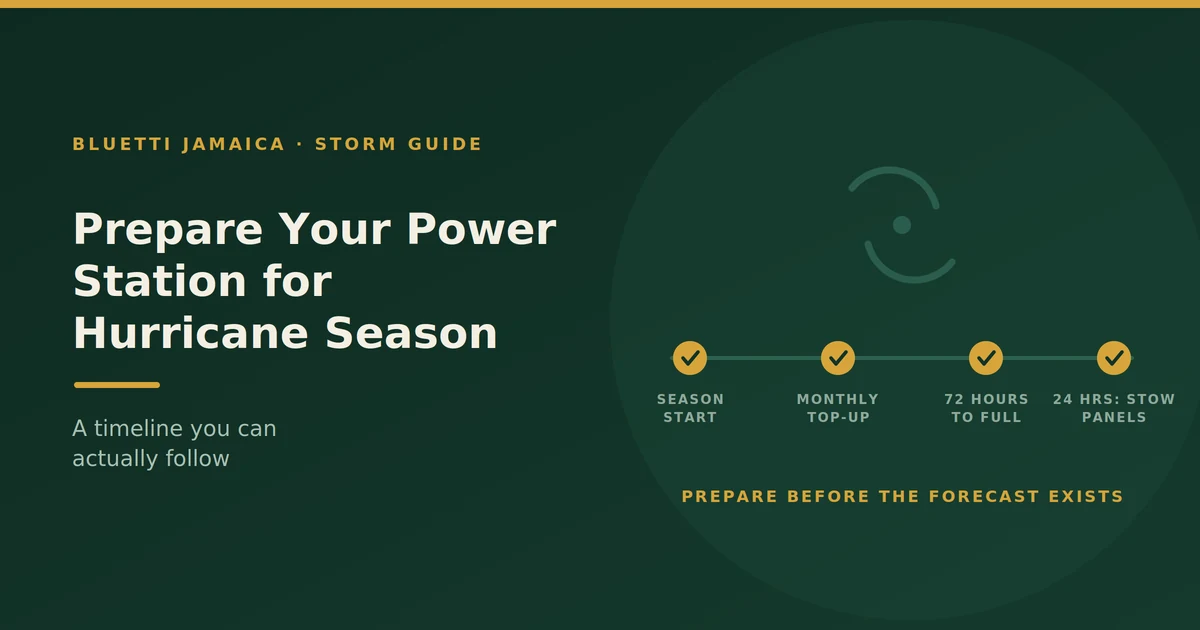
| When | What to do |
|---|---|
| Start of season | Test under real load · Update firmware · Assemble the cable kit · Write the appliance list on paper |
| Monthly | Top up to full · Check the cable bag is complete · Confirm storage spot is dry and off the floor · Inverter off when idle |
| 72 hours out | Charge to 100% from mains · Charge all devices and power banks · Fill fridge and freezer · Confirm plug list |
| 24 hours out | Stow portable panels indoors · Move unit somewhere dry, high and reachable · Pre-cool and pre-cook on grid power |
| During | Essentials only · Fridge in blocks, door shut · No loads while charging · DC where possible |
| After | Deploy panels when safe · Expect slow charging under cloud · Wait for stable supply before reconnecting |
Screenshot that, or print it and tape it inside the cupboard with the unit.
If you came up short this time
An honest forward-looking list, based on what people find out the hard way:
- More capacity, if you ran flat on night one. Either a larger unit or an expansion battery if your model supports one.
- Panels, if you had none. Without recharging, any power station is a one-night device.
- A second smaller unit for a bedroom or for someone elderly in the household, so one flat battery doesn’t take everything down.
- A longer extension lead, which sounds trivial until the only safe place for the unit is three rooms from the fridge.
Choosing panels that survive Jamaican conditions
Where the solar question genuinely matters here:
- Wind rating and mounting for fixed arrays hurricane-force loading is the real test, and mounting hardware fails before panels do
- Salt-air corrosion resistance if you’re near the coast, where frames and fixings degrade long before cells
- Monocrystalline or PERC cells, which handle the diffuse light of overcast post-storm days better
- Folding portable panels, which suit storm season specifically because they can be brought inside before a storm and redeployed the moment it’s safe
FAQs
Should I leave my power station fully charged all the time?
During hurricane season, keep it high and top it up monthly readiness matters more than the small longevity benefit of partial storage. Outside the season, a partial charge is kinder to the battery.
Can I use a power station indoors during a storm?
Yes. It produces no exhaust or fumes, which is the key difference from a generator. Generators must always be used outdoors and well away from windows and doors.
How do I protect solar panels in a hurricane?
Bring portable panels inside before the winds arrive. Fixed arrays need wind-rated mounting installed properly. Panels left out in hurricane-force winds can be destroyed and become dangerous.
How long will my power station last in an outage?
Depends on capacity and what you run. Essentials fridge, fans, lights, router, phones typically draw 2–3 kWh a day, so work out your capacity against that. Without solar, most units are a one-night proposition.
Can I charge it from a generator?
Generally yes, if the generator produces a clean enough output and the wattage is within the unit’s input limit. Check your manual, and test the combination before storm season rather than during it.
What should I do with it after the storm?
Recharge as soon as it’s safe from solar first, then mains once supply is stable. Then restock the cable bag and put it back in its spot ready for the next one.
Is it safe to charge when the power comes back?
Wait until the supply has steadied. Restoration can bring dips and surges, and it’s worth giving it an hour or two before reconnecting anything valuable.
The bottom line
The units that fail people during storms are almost never faulty. They’re flat, missing a cable, or trying to start an appliance nobody tested.
Do the May jobs once, top it up monthly, charge fully at 72 hours, and bring the panels in at 24. That’s the whole system and it’s why after Melissa, the households who got through comfortably weren’t the ones with the biggest units. They were the ones who’d prepared before the forecast existed.