The box says 1000Wh. What you want to know is whether that’s a night with the fridge still cold, or two hours and a flat battery.
Here’s the honest version and it’s less flattering than the runtime charts you’ll find on most comparison sites, because those divide the headline number by an appliance’s rated watts and stop there. Real units lose energy to the inverter, real fridges cycle on and off, and real Jamaican kitchens are hot. Once you account for all three, a 1000Wh power station runs a specific, useful set of things and a shorter list than the marketing suggests.
What Can a 1000Wh Power Station Run
The short answer: essentials overnight, not a household
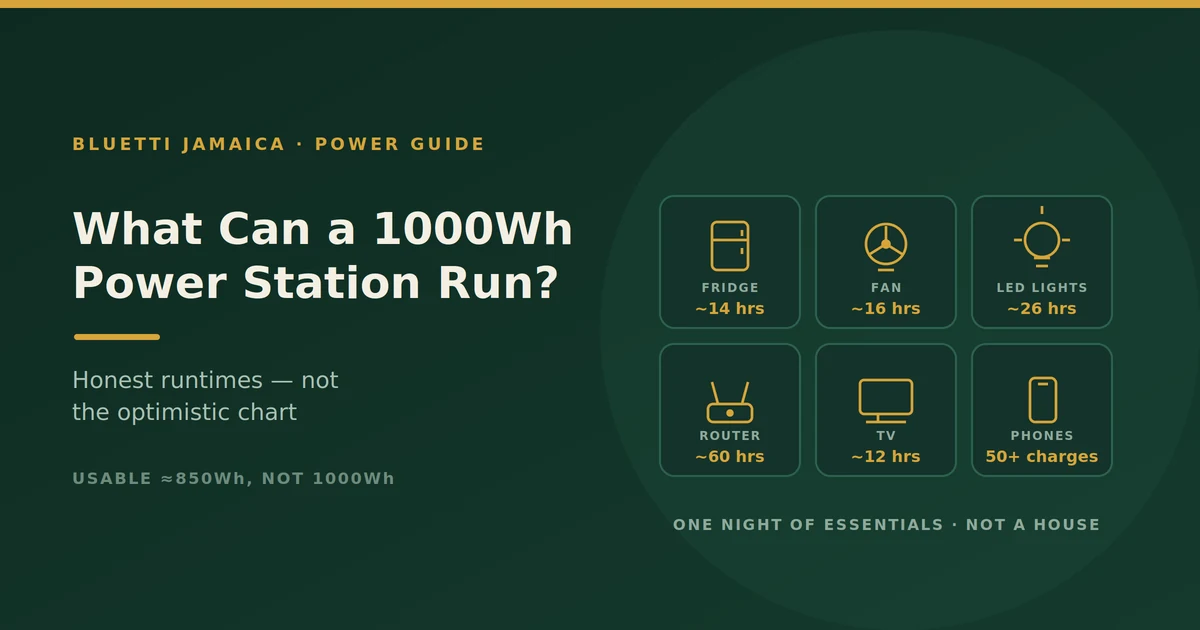
A 1000Wh power station covers a fridge, two fans, lights, a router and phone charging for roughly one night. Or a single larger appliance for a few hours. It will not run air conditioning, an electric water heater, or a house.
Think of it as one night of essentials. Anything more needs either solar recharging or more capacity.
The two numbers that decide everything
Learn these and you can size any unit, not just this one.
Watts: can it start the appliance?
Continuous output is what the unit can supply steadily. Surge rating is the brief peak it can handle.
Motors matter here. A fridge compressor, a water pump or a power tool draws several times its running wattage for a fraction of a second at start-up. If that spike exceeds the unit’s surge rating, the appliance simply won’t start and a full battery doesn’t change that.
So before asking how long something runs, check whether it runs at all. Most 1000Wh units offer somewhere around 1,000W continuous, which rules out kettles, heaters and most microwaves before capacity even enters the conversation.
Watt-hours: how long will it last?
The sum is capacity divided by the appliance’s draw. But two corrections almost nobody applies:
- Inverter losses. Converting DC battery power to AC costs roughly 10–15%.
- Usable capacity. Manufacturers reserve a portion of the battery to protect cell life, so nameplate isn’t what you get.
Together, a 1000Wh unit realistically delivers around 800–850Wh to your appliances. Every figure below uses that, not the headline number.
Realistic runtimes
| Appliance | Running watts | Realistic runtime | Notes |
|---|---|---|---|
| LED lights (3 bulbs) | ~30W | 25–28 hrs | Negligible draw |
| Wi-Fi router | 10–15W | 55–80 hrs | Cheapest thing to keep on |
| Phone charging | 10–15Wh per charge | 50–60 full charges | |
| Laptop | 45–65W | 13–18 hrs | Has its own battery too |
| Standing fan | 45–60W | 14–18 hrs | The comfort/runtime sweet spot |
| Ceiling fan | 70–80W | 10–12 hrs | |
| Medium fridge | 100–200W when cycling | 12–18 hrs | Cycles see below |
| Chest freezer | 100–200W when cycling | 10–16 hrs | Keep it shut |
| TV (32–43″ LED) | 50–90W | 9–16 hrs | |
| Rice cooker | 400–700W | 1–2 hrs | Fine for a meal |
| Microwave | 1,000–1,200W | 35–45 min total | May exceed continuous rating |
| Electric kettle | 1,500–2,000W | Usually won’t run | Exceeds most 1,000W units |
| Window AC | 500–1,500W | 35 min–1.5 hrs | Surge often too high |
| Electric water heater | 3,000W+ | No | Not close |
Two things the table can’t show.
These are single-appliance figures. Run a fridge, two fans and a router together and you’re drawing perhaps 200W, which is roughly four hours not the individual numbers added up.
The fridge line is where most articles go wrong. That deserves its own section.
The fridge question, answered properly
A fridge doesn’t draw power continuously. The compressor cycles on and off, running perhaps a third of the time in normal conditions.
So a fridge “drawing 150W” doesn’t consume 3.6kWh a day. It consumes somewhere around 1 to 1.5 kWh across 24 hours, because it’s only actually running for part of that time.
That’s the calculation that matters, and it cuts both ways:
- Better than the naive maths suggests the fridge isn’t eating 150W every minute.
- Worse than the optimistic charts claim 850Wh usable against 1–1.5kWh of daily fridge demand means most of a night, not a full day.
Why Jamaican heat changes the numbers
Every runtime figure you read from an overseas article assumes a temperate kitchen.
A fridge in a 32°C Jamaican kitchen works harder the compressor cycles more often and for longer to hold temperature. Expect noticeably shorter runtimes than a US or European article will tell you, particularly in the afternoon and particularly during an outage when the ceiling fans are off too.
Keep the door shut
The single most effective outage habit, and it costs nothing.
A full fridge holds cold far longer than an empty one the contents act as thermal mass. Open it as little as possible, decide what you need before you open it, and the compressor cycles less. That stretches your battery further than any setting on the power station.
What it won’t run
Be clear about these before you buy, not after.
- Air conditioning. Window units draw 500–1,500W continuously, and the compressor’s surge often exceeds a 1,000W unit’s limit. Even if it starts, you’re looking at under an hour.
- Electric water heaters. 3,000W and up. Not a capacity problem an output problem.
- Electric stoves and ovens. Same reason.
- Clothes dryers. Same again.
- Well pumps. High surge at start-up. Check the pump’s surge figure against the unit’s surge rating before assuming.
If you need any of these during an outage, you’re looking at a 2,000–3,000Wh unit with much higher continuous output, or a generator.
Three realistic scenarios
Overnight outage the common one. Fridge cycling (~500Wh over 12 hours), two fans on low (~100W combined for 6 hours = 600Wh), lights and router (~100Wh). That’s about 1,200Wh more than one 1000Wh unit holds. Drop one fan or accept the fridge going off for part of the night, and it fits. This is the calculation most buyers should do before ordering.
Working through a cut. Laptop (50W), router (15W), one fan (50W), a lamp (10W) = 125W. At 850Wh usable, that’s roughly six to seven hours of full working time. Comfortable, with margin.
A weekend away. Lights, phone and camera charging, a small speaker, a portable cooler running intermittently. Easily two days. This is where a 1000Wh unit is genuinely generous.
Making 1,000Wh go further
In order of impact:
- Cut the biggest load first. One fewer fan does more than any efficiency trick.
- Use the fridge’s thermal mass. Let it run in blocks rather than continuously, and keep the door shut.
- Run high-draw items one at a time. A rice cooker or a microwave, not both.
- Take loads off while recharging. Running appliances while solar charges means net input, which is why people report “it’s been in the sun all day and barely moved.”
- Use DC where you can. USB charging skips the inverter and its 10–15% loss entirely.
Recharging it: where solar comes in
A 1000Wh unit is a one-night device unless it refills. Solar is what turns it into multi-day power which, in hurricane season, is the whole point.
How much panel do you need?
Panels realistically deliver 70–80% of their rated output, so:
- 200W of panel → roughly 150W real output → about 6–7 hours to refill from empty
- 400W of panel → roughly 300W real → about 3 hours
Which means 200W refills the unit across a good day, and 400W does it in an afternoon with time to spare. On an overcast day, expect both figures to stretch considerably grey skies slow charging rather than stopping it.
Choosing panels for Jamaican conditions
The “best solar panels” question has a local answer, and it isn’t a brand ranking.
- Monocrystalline or PERC cells perform better in the diffuse light of an overcast wet-season day
- Wind rating and mounting matter if the panels are fixed hurricane-force loading is the real test
- Salt-air corrosion resistance near the coast, where frames and hardware fail long before cells do
- Portable folding panels can be repositioned through the day and brought inside before a storm, which is worth a lot here
Mains and car charging
Where mains is available, it’s far faster most units refill in a couple of hours or less. The sensible planning habit: fill it before the storm arrives, and use solar to extend it afterwards. Car charging is a slow middle option on a long drive.
Is 1,000Wh the right size for you?
A quick decision path:
- Under 1,000Wh camping, device charging, a fan. Not a fridge.
- 1,000Wh overnight essentials. Fridge, fans, lights, router, phones, for a night.
- 2,000Wh+ a fridge running across multiple days, or longer outages covered comfortably.
- Expansion batteries the middle path, if your unit supports them: start at 1,000Wh and add capacity later rather than replacing the whole thing.
For a Jamaican household buying primarily for outages, be honest about how long your outages actually last. If they’re hours, 1,000Wh plus panels is sensible. If your last one ran for days, size up.
FAQs
How long will a 1000Wh power station run a fridge?
Roughly 12–18 hours for a medium fridge, since the compressor cycles rather than running constantly. In a hot kitchen expect the lower end, because the fridge works harder to hold temperature.
Can a 1000Wh power station run an air conditioner?
Generally no. Window units draw 500–1,500W continuously and their start-up surge often exceeds what a 1,000W unit can supply. Even if it starts, you’d get well under an hour.
How many phone charges do you get?
Around 50–60 full charges, depending on the phone. Phone charging is one of the least demanding things you can do with a unit this size.
Can it run a TV?
Yes a 32 to 43-inch LED TV draws 50–90W, giving roughly 9–16 hours. Add a fan and a light and you still have most of an evening.
How long does it take to recharge from solar?
About 6–7 hours with 200W of panels, or around 3 hours with 400W, in good sun. Overcast conditions stretch both figures considerably.
Is 1000Wh enough for a power outage?
For an overnight outage with essentials only, usually yes. For multi-day outages, only if you’re recharging it with solar otherwise you’ll want 2,000Wh or more.
Can I run several appliances at once?
Yes, within the continuous output limit but runtime divides accordingly. A fridge, two fans and a router drawing 200W together gives you roughly four hours, not each item’s individual runtime.
The bottom line
A 1000Wh power station is a night of essentials: fridge, fans, lights, router, phones. It’s not a house, and it’s not air conditioning.
Two things decide whether it works for you. Check the surge rating against anything with a motor, because an appliance that won’t start is the most disappointing possible outcome. And size against your real outages if yours run for days rather than hours, either add panels or buy bigger, because a unit that runs flat on night one hasn’t solved your problem.