Two in the morning, the power’s been out for hours, and nothing in the room is moving. That’s the situation behind this question, and it isn’t really about fans.
The good news: how long a BLUETTI power station can run a fan is the easiest question in this whole category. A long time. Most fans draw 30–60W, so even a modest unit will carry one through the night, and a mid-size one through several.
How Long Can a BLUETTI Power Station Run a Fan?
What’s worth knowing is the choice that makes the difference between “all night” and “most of the week.”
The short answer
A typical AC pedestal fan draws around 40–60W, which means roughly:
- 500Wh unit 8 to 10 hours
- 1,000Wh unit 16 to 20 hours
- 2,000Wh unit 32 to 40 hours
A small DC fan running off the USB or 12V output can stretch those figures dramatically often three to four times longer. More on why below, because it’s the single most useful thing on this page.
The maths, briefly
Watt-hours ÷ watts = hours, minus 10–20% for conversion losses.
A 2,000Wh unit running a 50W fan: 2,000 ÷ 50 = 40 hours, so call it 32–35 in practice.
Our guide to running a TV during an outage covers the formula in more detail if you want to apply it to other appliances.
| Fan type | Typical draw | 500Wh | 1,000Wh | 2,000Wh | 2,764.8Wh |
|---|---|---|---|---|---|
| USB / DC desk fan | 5–15W | 40–80 hrs | 80–160 hrs | 160+ hrs | 200+ hrs |
| DC 12V fan | 15–25W | 20–28 hrs | 40–56 hrs | 80–110 hrs | 110–150 hrs |
| Small AC pedestal | 30–40W | 11–14 hrs | 22–28 hrs | 45–55 hrs | 60–75 hrs |
| Standard AC pedestal | 45–60W | 7–9 hrs | 15–18 hrs | 30–36 hrs | 40–50 hrs |
| AC tower fan | 50–70W | 6–8 hrs | 13–16 hrs | 26–32 hrs | 35–44 hrs |
Figures allow for conversion losses. Check your fan’s rating plate draw varies more between models than people expect.
The insight that changes everything: DC versus AC
This is why the post exists, and almost nobody mentions it.
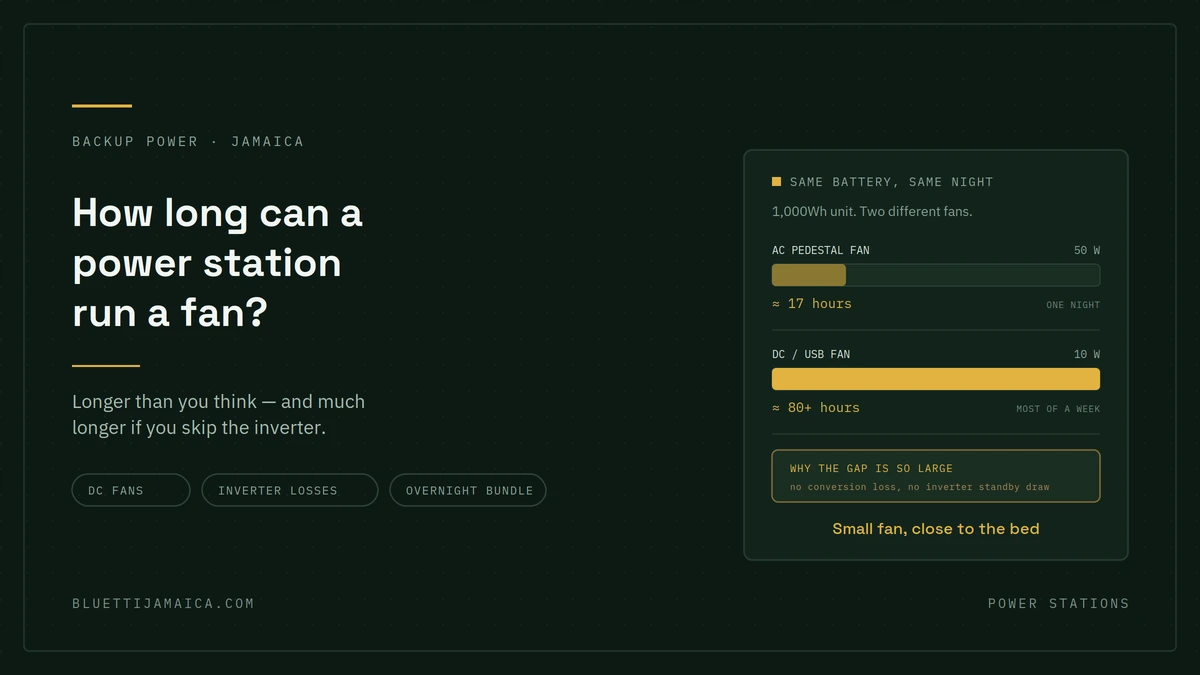
A DC fan running off the DC output uses a fraction of what an AC fan uses. Not a marginal improvement often three or four times the runtime from the same battery.
Why the inverter costs you
Your power station stores DC power. An AC appliance needs AC, so the inverter converts it and conversion isn’t free. There’s an efficiency loss, plus the inverter draws a standby amount simply by being switched on.
On a large load, that overhead is a small percentage of the total. On a 40W fan, it’s a significant share of what you’re using. You’re spending real capacity on the conversion rather than on moving air.
What a DC fan avoids
Plug a USB or 12V fan straight into the DC outputs and there’s no conversion at all. The power goes from the battery to the fan.
That’s why a 10W USB fan on a 1,000Wh unit runs for the better part of a week, while a 50W AC fan on the same unit runs for less than a day. Some of that gap is the wattage difference and a meaningful part is the inverter you’ve switched off entirely.
Practical version: if you’re running only a fan overnight, use a DC fan and turn the AC inverter off.
The honest trade-off
DC fans are smaller and move less air. A USB desk fan is not a pedestal fan.
But for sleeping, that matters less than you’d think a small fan aimed at the bed does more for comfort than a large fan aimed at a room. Which brings us to the section below.
Worth adding to your outage kit
A DC or USB fan costs very little and it’s one of the highest-value additions you can make to a power station setup. If you’re preparing for hurricane season, it belongs on the list next to the torch and the batteries.
Fan speed matters more than you’d expect
Fan consumption doesn’t scale evenly with speed. Dropping from high to low can cut draw substantially proportionally more than the reduction in air movement.
For sleeping, that’s a good trade. You want air moving across you, not a gale filling the room. A fan on low, positioned close, is quieter, uses much less, and often feels better.
Simple habit: set it to low and move it nearer the bed rather than running it high from across the room.
The real question: the overnight bundle
Nobody runs a fan alone. Here’s what an actual night looks like.
| Load | Draw |
|---|---|
| AC pedestal fan (low) | ~35W |
| Router + modem | ~20W |
| Phone charging × 2 | ~20W |
| One LED lamp | ~8W |
| Total | ~83W |
On a 1,000Wh unit that’s roughly 9–10 hours a full night with a little margin. On a 2,000Wh unit, closer to 20 hours.
Swap the AC fan for a DC one and drop the lamp, and the same 1,000Wh unit covers two nights comfortably.
Fan and fridge together
The most common real pairing, and the one that changes the sizing answer.
A fridge-freezer uses roughly 1kWh across 24 hours because the compressor cycles rather than running constantly. Add a fan and a few small loads and you’re looking at a mid-size unit for a full day. Our guide to running a refrigerator overnight has the full arithmetic.
If food is the priority, size for the fridge the fan comes almost free.
What to leave off
Anything that makes heat. A kettle, an iron, a hot plate, a hair dryer. Each of those uses more in ten minutes than your fan uses all night.
Air conditioning is the obvious one people ask about: a split unit will empty a mid-size station in a couple of hours, which is why a fan is the sensible overnight answer rather than AC.
Sleeping through a hot Jamaican night
The fan is only part of the answer. These cost nothing and reduce how much fan you need.
- Position the fan to exhaust, not to blow. Pointing a fan out of a window pulls cooler air in from the rest of the house. Counter-intuitive, and often more effective than aiming it at yourself.
- Set up cross-ventilation. One opening low on the cool side, one high on the warm side, fan assisting the flow.
- Close the room during the day. Curtains drawn, door shut. A room that never heated up doesn’t need cooling at night.
- A damp sheet works. Evaporative cooling, and the fan makes it far more effective.
- Small fan close beats big fan far. Uses less, feels better, and it’s the whole argument for a DC fan.
- Run it on low. Quieter, cheaper, and usually more comfortable to sleep with.
Multi-night outages
Here’s where a fan becomes genuinely trivial.
A fan uses so little that even a modest solar panel covers it several times over. Where a fridge needs real daily generation to stay stable, a fan needs almost nothing a small folding panel in a few hours of sun replaces an entire night’s fan use.
That means for a multi-day outage, a fan is essentially a solved problem as long as you have any solar input at all. Our guide to charging while using it covers the daily-balance framing.
Realistic note: rated panel wattage is a laboratory figure. Angle the panel toward the sun and plan on less than the sticker number but for a fan, you have enormous margin.
What size to buy if a fan is your main concern
Just a fan and phones overnight? An entry unit around 300–600Wh is plenty. With a DC fan, it’s more than plenty.
Fan, router, lights and phones for a night or two? Around 1,000Wh.
Fan plus a fridge? 2,000Wh or more but you’re sizing for the fridge at that point, not the fan.
Being straight about it: if a fan is genuinely all you need, buy small. We’d rather sell you a unit you’re happy with than a larger one bought on a misunderstanding. You can compare capacities at BLUETTI Jamaica, with island-wide delivery and warranty handled locally.
FAQs
How long will a power station run a fan?
A 1,000Wh unit runs a typical 50W AC fan for around 16–18 hours. A small DC fan on the same unit can run for several days. Divide capacity by wattage and subtract 10–20% for losses.
How many watts does a fan use?
Most AC pedestal and tower fans draw 30–70W. USB and 12V DC fans draw 5–25W. Check the rating plate, as draw varies considerably between models and with speed setting.
Is a DC fan better than an AC fan on a power station?
For runtime, substantially. A DC fan avoids the inverter entirely, which removes both the conversion loss and the inverter’s standby draw. Expect three to four times the runtime. The trade-off is that DC fans are smaller and move less air.
Can it run a fan and a fridge overnight?
Yes on a mid-size unit. The fridge dominates the calculation roughly 1kWh over 24 hours so size for that and the fan is almost free.
Does fan speed affect battery life?
Yes, and more than proportionally. Dropping from high to low cuts consumption substantially. For sleeping, low and close to the bed is usually both cheaper and more comfortable.
Can I run a ceiling fan?
Only if it’s on a plug rather than hard-wired to a wall switch. Most ceiling fans are hard-wired, which a portable unit can’t power without an electrician involved.
What size power station do I need just for a fan?
An entry-level unit around 300–600Wh covers a fan and phone charging overnight, particularly with a DC fan. Buying larger only makes sense if you’re adding a fridge or other loads.