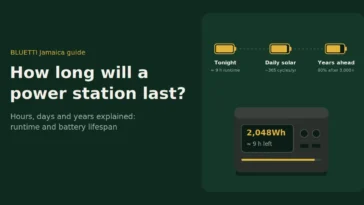

You set the panel out at 7am, came back at 6pm, and the power station is showing 40%. Eleven hours of daylight, and less than half a charge. So how much sun does a portable solar panel need to charge properly?
The honest answer: about four to six hours of strong sun, not eleven hours of daylight. Those are two completely different numbers, and the gap between them explains almost every disappointing charge you’ll ever have.
How Much Sun Does a Portable Solar Panel Need to Charge?
The short answer: peak sun hours, not daylight hours
A portable solar panel needs roughly 4–6 peak sun hours per day to deliver a useful charge in Jamaica. Daylight runs about 11–13 hours here, but only the middle portion of the day carries enough intensity to matter. Early morning and late afternoon light produces a trickle, not a charge.
That’s not a fault in your panel. It’s physics, and once you plan around it the numbers stop being frustrating.
What “peak sun hours” actually means
One peak sun hour equals one hour of sunlight at 1,000 watts per square metre roughly what you get on a clear day with the sun high overhead. It’s a way of converting a whole day’s uneven light into a single usable figure.
So a day in Kingston might give you 11 hours of daylight but only 5 peak sun hours. From about 6am to 9am the sun is low and the light is weak. From roughly 10am to 3pm you’re in the productive window. After 4pm output falls away fast.
When you read that a panel “needs 5 hours of sun,” that’s peak sun hours being quoted not hours of your day.
How to work out your own charging time
Multiply your panel’s rated wattage by your peak sun hours, then multiply by 0.75 to account for real-world losses. That gives you watt-hours harvested per day. Divide your power station’s capacity by that number and you have your charge time in days.
The formula:
Panel watts × peak sun hours × 0.75 = watt-hours per day
Worked through at 5 peak sun hours, which is a fair Jamaican average:
- 200W panel → 200 × 5 × 0.75 = 750Wh per day
- 350W panel → 350 × 5 × 0.75 = 1,310Wh per day
- 500W panel → 500 × 5 × 0.75 = 1,875Wh per day
Now put that against a battery. A 1,000Wh power station on a 200W panel takes about a day and a half of good sun to go from empty to full. On a 500W panel, comfortably within one day.
That surprises people. It shouldn’t it just means panel size and battery size need to be chosen together rather than separately.
Why you never get the wattage on the label
A 200W panel almost never produces 200W. That rating comes from lab conditions: 25°C cell temperature, perfect perpendicular light, no cable loss. Your yard is not a lab.
Real losses stack up like this:
- Heat panels lose output as cell temperature climbs, and 25°C is cool by Jamaican standards
- Angle anything off-perpendicular to the sun cuts the light striking the cells
- Cable and connector loss small, but real, and worse with long or thin cables
- Charge controller efficiency the conversion into the battery isn’t free
- Dust and salt film a hazy surface reduces transmission
Together that’s typically 20–30% off the label. Which is why 0.75 is the multiplier to plan with, not 1.0. Anyone quoting you the rated figure as a daily expectation is selling, not advising.
Jamaica’s sun: what you can actually count on
Jamaica gets strong, consistent sun by global standards generally in the range of 5–6 peak sun hours daily as an annual average, with less seasonal swing than temperate countries. The variation here comes from cloud and rain, not from short days.
That consistency is a genuine advantage. A panel in Jamaica outperforms the same panel in a country at higher latitude, and you don’t face the winter collapse in output that temperate users plan around.
Rainy season and hurricane season output
May–June and September–November bring the heavier cloud and rain. Expect fewer productive hours on wet days, and plan for consecutive poor days rather than one.
This matters most because storm season is exactly when outages happen. The worst-case scenario is a system sized for clear-sky charging, facing three overcast days and a grid that’s down. Size for the bad week, not the average one.
The heat penalty nobody mentions
Panels are rated at 25°C cell temperature. Sitting in direct Jamaican sun, a panel’s cells can reach well above ambient air temperature, and output falls as they heat up. Typical loss from heat alone lands in the region of 10–15% during the hottest part of the day.
The practical consequence is counterintuitive: a bright, breezy morning can out-produce a blazing, still afternoon. And there’s a free fix get air under the panel. Don’t lay it flat on hot concrete or a metal roof, where it bakes. Prop it so air moves across the back.
Panel size vs battery size: matching them properly
The right pairing gives you a full recharge in one good day of sun. Undersize the panel and you never catch up; oversize it beyond your power station’s PV input limit and you’re paying for wattage the unit can’t accept.
| Panel size | Realistic daily harvest (5 peak sun hours) | Suits battery capacity | Empty to full |
|---|---|---|---|
| 100W | ~375Wh | 250–500Wh | 1–1.5 days |
| 200W | ~750Wh | 500–1,000Wh | 1–1.5 days |
| 350W | ~1,300Wh | 1,000–1,500Wh | ~1 day |
| 500W | ~1,875Wh | 1,500–2,000Wh | ~1 day |
| 1,000W | ~3,750Wh | 3,000–4,000Wh | ~1 day |
Two things this table makes obvious. Small panels suit small batteries, not big ones. And there’s no benefit in connecting 1,000W of panels to a unit that accepts 500W maximum.
Positioning: the free 20–30% most people leave on the table
Tilt the panel toward the sun and face it south. In Jamaica, at roughly 18° north, a tilt angle near your latitude works well as a year-round compromise, though for a portable panel the more useful instruction is simpler: aim it at the sun, not at the sky.
A panel lying flat on the ground loses a meaningful share of what it could collect, especially outside the middle hours of the day. The kickstand exists for a reason.
Shade is worse than you think
Partial shade doesn’t reduce output proportionally it can reduce it far more than the shaded area suggests. Cells wired in series behave a bit like a hose with a kink in it, and bypass diodes limit the damage without eliminating it.
The real-world version: a single utility line, a roof edge, or one palm frond crossing the panel can cost you a large fraction of your output while looking harmless. Before you walk away, crouch to panel level and check for shadows falling anywhere on the surface.
Then check again two hours later, because shadows move.
How often to reposition a portable panel
Two or three repositions across the productive window captures noticeably more than setting it once and leaving it. Roughly: aim it east-ish mid-morning, square at midday, west-ish mid-afternoon.
If you’re out of the house all day, set it for the midday position and accept the loss. One good aim beats three bad ones.
What changes when the weather doesn’t cooperate
Panels keep working under cloud, just slowly. Light overcast might give you 50–70% of clear-sky output; heavy dark cloud or rain can drop you to 10–25%. You’ll still gain charge across a full day it just won’t be a full charge.
That’s worth knowing during an outage. A panel on a grey day isn’t useless, and people give up on it too early.
Planning for consecutive bad-weather days
Work out your daily consumption, then hold enough battery capacity to cover two or three days without meaningful solar input. If your essentials draw 400Wh a day, a 1,000Wh unit gets you through roughly two and a half days of nothing.
Storm season is when this gets tested, and it’s the reason battery capacity not panel wattage is usually the constraint worth spending on.
Pros and cons of charging by solar alone
In favour: no fuel, no running cost, silent, works during grid outages, no fumes so it’s safe near the house, and nothing to source when the fuel stations have queues.
Against: slow compared with AC charging, weather-dependent, needs open unshaded space, requires repositioning for best output, and panels take up room to store.
The sensible position is not choosing one. Charge from the grid when it’s up and cheap, keep solar as the method that still works when it isn’t. For most households the panel is insurance, not a primary supply.
Common mistakes that slow charging down
- Panel flat on the ground. Costs you output all day, every day.
- Ignoring partial shade. The single most underestimated loss.
- Panel resting on hot concrete or metal. Traps heat and cuts output; raise it for airflow.
- Long, thin extension cables. Voltage drop is real over distance use the shortest adequate run.
- Voltage or connector mismatch. Check your power station’s PV input range before buying panels; being within the wattage limit isn’t enough if the voltage is outside the window.
- Mixing mismatched panels in series. Different wattages or ages drag the whole string toward the weakest member.
- Dusty surface. A rinse takes two minutes and you’ll see the difference.
Choosing a panel size for your situation
Phones, lights and a fan through an outage. A 100–200W panel with a 500–1,000Wh power station. Enough to keep devices alive and a couple of lights running indefinitely if the sun cooperates.
Keeping a fridge going. Step up to 350–500W and 1,500Wh or more. Fridges draw modestly but constantly, and that constant draw is what outruns a small panel.
Work site or off-grid weekends. 500W and up, paired with capacity to match. Here you’re the only power source, so size for your heaviest realistic day plus margin.
FAQs
Will a portable solar panel charge in the shade?
Barely. You’ll see a trickle from ambient light, but not a useful charge. Even partial shade across one section cuts output disproportionately, so move the panel rather than accepting it.
Can I charge a panel through a window?
It works, poorly. Glass reflects and absorbs part of the light, and window glass often blocks a portion of the spectrum panels use. Expect a fraction of outdoor output. Fine for topping up a phone battery, not for charging a power station.
How long does a portable solar panel take to fully charge a power station?
Divide the battery’s watt-hours by your panel’s realistic daily harvest. A 1,000Wh unit on a 200W panel is about a day and a half of good sun; on a 500W panel, less than one.
Do solar panels work in the rain?
Yes, at much reduced output often 10–25% of clear-sky performance. Modern panels are built to handle rain safely, though you should still follow the manufacturer’s guidance on water resistance for your specific model and keep the connectors dry.
Can I leave my panel outside overnight?
Better not to, if you can avoid it. Overnight dew, sudden rain and theft are the practical concerns rather than damage from darkness. Bring it in or cover it.
Can I connect two panels together to charge faster?
Usually yes, if both stay within your power station’s maximum solar input wattage and voltage window. Use matched panels where possible, and check whether your unit expects series or parallel wiring before you buy a connector.
Does more expensive mean faster charging?
Not directly. Higher-quality panels tend to hold output better in heat and last longer, but a well-positioned cheaper panel will beat a badly positioned expensive one on any given day. Positioning is free; buy the size you need, then aim it properly.