It’s a cool night up in Mandeville and JPS power has gone again. Or it’s morning, the power’s out, and you’re facing a cold shower before work. Either way, you’ve got a power station in the corner and you’re wondering whether it can handle the heater.
So, can a power station run a heater? A large one can, but not for long. Heaters are among the most power-hungry appliances in your home, and they drain a battery far faster than a fridge, fan or TV.
Can a Power Station Run a Heater
This guide explains why, shows realistic runtimes, covers water heaters and instant shower heaters, and walks through better ways to stay warm and get hot water when JPS power is out.
The short answer
Yes, a large power station can run a heater, but only for a short time. Heaters draw 1,000–5,000 watts, so even a 2,000Wh battery lasts somewhere between minutes and a couple of hours. For warmth, an electric blanket is far more efficient. For hot water, a solar water heater is usually the better choice.
In practice, it comes down to two checks:
- Can the power station deliver enough watts? If its output rating is lower than the heater’s wattage, it won’t run it at all.
- Can it deliver them for long enough? Even if it can power the heater, the battery empties quickly.
Most small and mid-size power stations fail the first check. Large ones pass it but struggle with the second.
Why heaters drain batteries so fast
Electric heaters turn electricity directly into heat, and making heat takes a lot of power. A typical space heater uses as much power as 15 to 30 fans. Water heaters use even more. A battery that runs your fridge all night can be emptied by a heater in under an hour.
Here’s how common heating appliances compare:
| Appliance | Typical power draw | Notes |
|---|---|---|
| Heated pad | 20–60 W | Warms one person directly |
| Electric blanket | 50–100 W | Warms the bed, not the room |
| Small ceramic heater, low setting | 400–750 W | Takes the chill off a small space |
| Oil-filled radiator | 700–1,500 W | Slow to warm up, steady heat |
| Fan or space heater, high setting | 1,200–1,500 W | Common 110V household heater |
| Instant shower heater | 3,000–5,500 W | Often wired to 220V |
| Tank water heater | 3,000–4,500 W | Usually 220V, runs until the tank is hot |
These are typical ranges. Check the label on your own appliance for its exact wattage and voltage.
Voltage matters too
Many Jamaican homes have both 110V and 220V circuits. Many water heaters and instant shower heaters run on 220V, while most portable power stations sold in Jamaica provide 110–120V output. If your heater needs 220V and your power station doesn’t supply it, they can’t work together, however big the battery is.
How long will a power station run a heater?
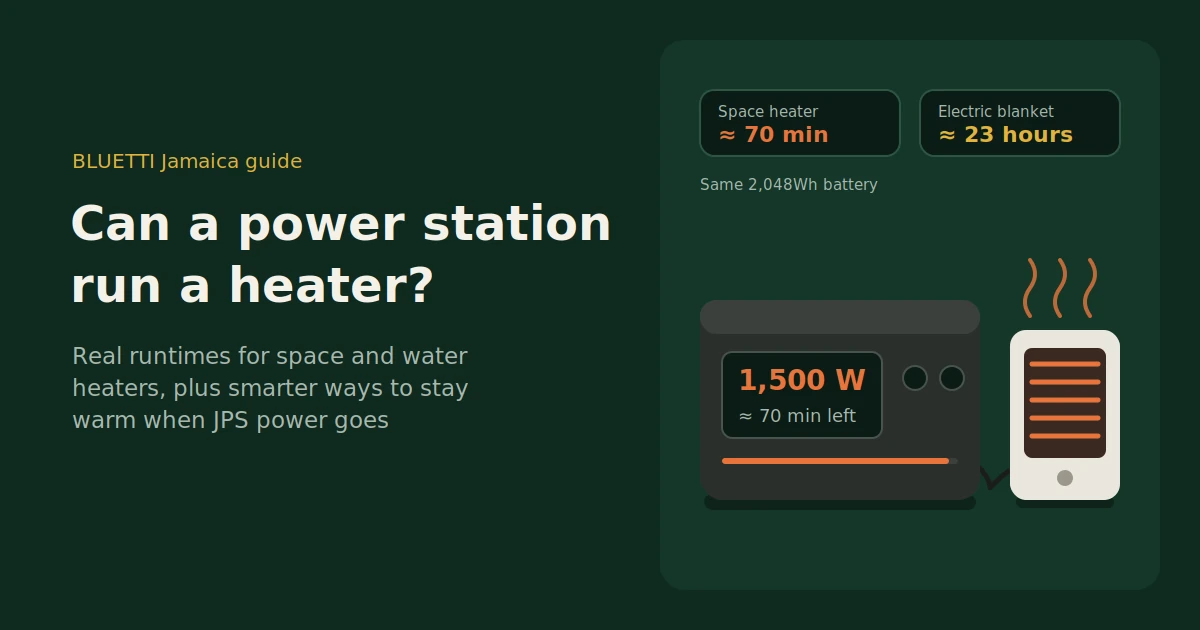
A large power station like the BLUETTI AC200L can run a 1,500W space heater for roughly an hour. The bigger Apex 300 manages about an hour and a half. Small units can’t run a space heater at all, but they can run an electric blanket for several hours.
To estimate runtime, use this formula:
Runtime (hours) = battery capacity (Wh) × 0.85 ÷ heater wattage (W)
The 0.85 allows for energy lost in conversion. The heater’s wattage must also be below the power station’s maximum output, or it won’t run at all.
| BLUETTI model | Capacity / max output | Electric blanket (75W) | Small heater (750W) | Space heater (1,500W) | Water or shower heater (3,500W, 240V) |
|---|---|---|---|---|---|
| Elite 30 V2 | 288Wh / 600W | About 3 hours | Can’t run it | Can’t run it | Can’t run it |
| AC50B | 448Wh / 700W | About 5 hours | Can’t run it | Can’t run it | Can’t run it |
| AC200L | 2,048Wh / 2,400W | About 23 hours | About 2 hours 20 min | About 70 min | Can’t run it (120V only) |
| Apex 300 | 2,764.8Wh / 3,840W | About 31 hours | About 3 hours | About 1 hour 30 min | About 40 min, in 240V mode |
These are estimates. Many heaters cycle on and off once the room warms up, which stretches runtime, while running a heater flat out shortens it. Check the live wattage on your power station’s display for the real figure.
The pattern is clear: even the largest unit gives you around 90 minutes of space heating, but more than a full day of electric blanket warmth.
Water heaters: the bigger question in Jamaica
Most power stations can’t run a water heater, because water heaters draw too much power and often need 220V. A large 240V-capable unit can manage a few short showers with an instant heater, but heating a full tank would drain it several times over. For hot water during outages, solar water heating is usually the better answer.
Instant shower heaters
Instant heaters only draw power while the water is flowing, which helps. A 10-minute shower with a 3,500W heater uses roughly 580Wh.
The catch is the wattage and voltage. Many instant shower heaters are rated above 3,500W and wired to 220V. Most power stations output only 110–120V and 2,400W or less, so they can’t run them at all. A unit like the BLUETTI Apex 300, which offers 240V output up to 3,840W, could handle a few short showers on a heater within that rating. Check your heater’s label before you try, and have a qualified electrician make any wiring changes.
Tank water heaters
Tank heaters are the hardest load of all. Heating a typical 150-litre (40-gallon) tank by 30°C takes over 5kWh of energy, nearly double the capacity of the Apex 300. A power station isn’t a practical way to run one.
The better option: solar water heating
Solar water heaters, already a familiar sight on Jamaican rooftops, heat water directly with the sun, with no battery involved. They keep working during JPS outages and cost nothing to run on sunny days.
| Option for hot water during outages | Works in an outage? | Ongoing cost | Best for |
|---|---|---|---|
| Solar water heater | Yes, on sunny days | Very low | Daily hot water, with or without JPS |
| Instant heater on a 240V power station | Yes, for a few short showers | Battery recharging | Occasional showers during short outages |
| Tank heater on a power station | Not practical | High | Not recommended |
| Gas water heater | Yes | Gas refills | Homes with gas supply and proper ventilation |
If hot water during outages matters to you, a solar water heater does that job better than any battery.
Better ways to stay warm during an outage
Heat yourself, not the room. An electric blanket or heated pad uses a fraction of a space heater’s power and can run all night on a mid-size power station. If you do use a heater, use it in short bursts to take the chill off one small room.
- Electric blanket. At 50–100W, it can warm your bed all night. Even a compact unit like the AC50B can run one for around five hours.
- Heated pad or throw. Ideal for sitting up in the evening, at 20–60W.
- Short heater bursts. Run a heater on low for 15–20 minutes to warm a small bedroom, then switch to a blanket.
- Heat one room only. Close the doors and gather everyone in one space.
- Keep the heat in. Close curtains at dusk and block draughts under doors with a rolled towel.
- Dress warm. Layers, socks and a hot drink from a gas stove go a long way on a cool hill-country night.
When a solar system makes sense for heating loads
If you need to run heavy loads like a heater or water heater regularly, a single power station won’t be enough. A home solar system with battery storage and enough panels can carry larger loads and recharge every day. Jamaica’s strong sun makes solar a practical option for many homes.
A few points to plan around:
- Heaters need big systems. Running a 1,500W heater for two hours uses 3kWh, which is more than the capacity of most portable units. Plan your battery and panels around that.
- Jamaica’s sun works in your favour. Strong, year-round sun means solar panels can produce well across most of the year, so recharging between outages is realistic.
- Panel quality matters. The best solar panels for home backup are efficient monocrystalline panels with solid warranties, sized to your power station or inverter’s solar input limit.
- Combine technologies. A solar water heater for hot water, plus a solar system with a battery for everything else, is often cheaper and more effective than trying to run everything electrically from one battery.
For most homes, the smart split is simple: solar thermal for hot water, battery and solar panels for lights, fans, fridge and devices, and electric blankets rather than heaters when it’s cool.
Safety: heaters, power stations and outages
Heaters are high-power, high-heat appliances, so treat them with care, especially on battery power. Stay within your power station’s output rating, plug heaters in directly rather than through cheap extension cords, and keep them well away from the power station, bedding and curtains.
- Stay within the rating. If a heater’s wattage is close to the power station’s limit, it may trip the overload protection. Use the low setting.
- Avoid thin extension cords. High-power heaters can overheat light-duty cords. Plug directly into the power station where you can.
- Give everything space. Keep heaters at least a metre from the power station, furniture, bedding and curtains.
- Never leave a heater running unattended or while you sleep.
- Never run a generator or gas heater indoors. Fumes contain carbon monoxide, which can kill without warning. Generators belong outside, well away from doors and windows.
- Leave wiring to electricians. Don’t try to connect a power station to a 220V water heater or your home’s wiring yourself.
FAQs
Can a power station run a space heater?
Yes, if its output rating is higher than the heater’s wattage. A 2,400W unit like the AC200L can run a 1,500W heater for about an hour. Smaller units under 1,000W output usually can’t run a space heater at all.
Can a power station run a water heater?
Usually not. Tank water heaters need more energy than any portable power station holds, and most run on 220V. A large 240V-capable unit like the Apex 300 can run some instant shower heaters for a few short showers.
Can I run my shower heater during a JPS outage?
Only with a power station that supplies 240V, if your heater needs it, and that’s rated above your heater’s wattage. Check the heater’s label, keep showers short, and have an electrician handle any wiring. A solar water heater is a simpler long-term fix.
How long will a 2,000Wh power station run a heater?
Roughly an hour for a 1,500W heater, about two hours on a 750W setting, or close to a full day for a 75W electric blanket. The exact time depends on your heater and how often it cycles on and off.
Is a solar water heater better than a power station for hot water?
Yes, for most homes. A solar water heater heats water directly from the sun and keeps working during outages, without draining a battery. Power stations are better saved for fridges, fans, lights and devices.
What size power station do I need for a heater?
For a 1,500W space heater, choose a unit with at least 2,000W of continuous output and 2,000Wh or more of capacity. For an electric blanket, almost any power station will do.
Plan your backup around the loads that matter
A power station can run a heater, but it’s rarely the best way to stay warm or get hot water when JPS power goes. Pair a power station with an electric blanket for warmth and a solar water heater for showers, and your battery goes much further.
Browse BLUETTI power stations and solar options at BLUETTI Jamaica, with local stock, island-wide delivery, and warranty and parts handled in Jamaica. Not sure what size you need? Tell our team what you want to run, and we’ll help you plan it.