It’s day two of an outage after a storm. JPS crews are working through the parish, your power station is down to 20%, and the sun has finally come out. You’ve got a solar panel. The question is simple: will the battery be full again by tonight?
How long it takes to charge a power station with solar depends on three things: how big the battery is, how much solar power your power station can accept, and how much strong sun you actually get. Get those right and solar in Jamaica can keep you powered through long outages.
This guide gives you a simple formula, real estimates for BLUETTI models, and the practical fixes that make charging faster.
The short answer
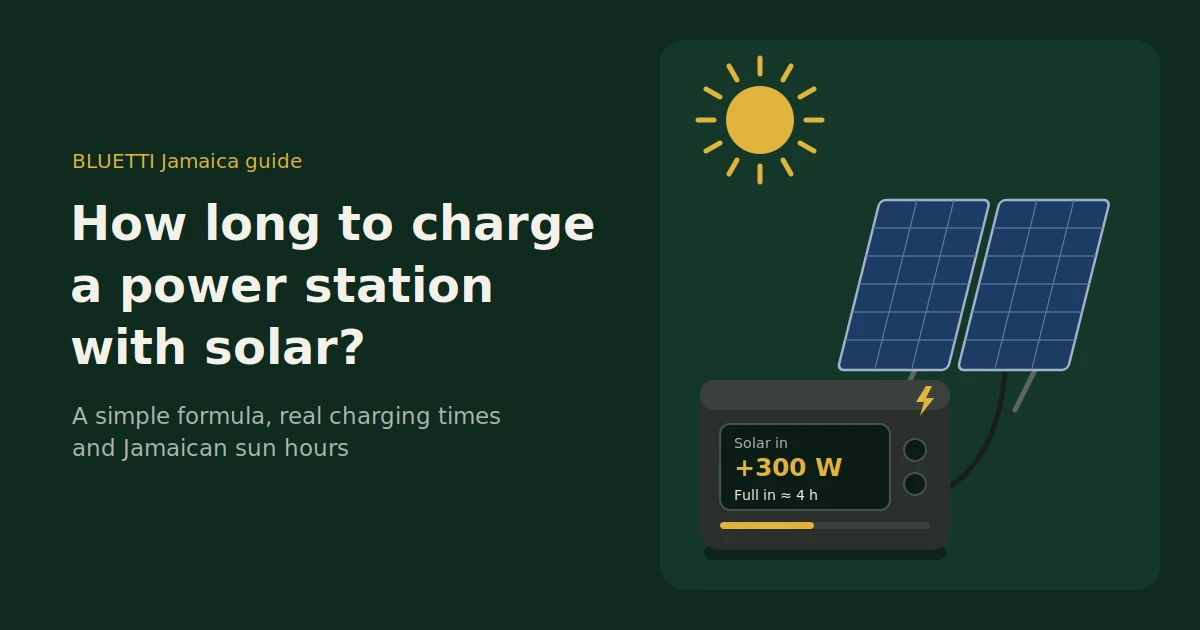
In good Jamaican sun, a small power station can charge from solar in about 2–4 hours of strong sun. A large home-backup unit can take a full day or more, depending on how many panels you use and how much solar input the power station accepts. Cloud, heat and shade can stretch that further.
As a rough guide:
- Small units (around 300–500Wh): often a few hours of strong sun with a 200W panel.
- Mid-size units (around 1,000Wh): most of a sunny day with 200–400W of panels.
- Large units (2,000Wh and up): a full sunny day or more, unless you add enough panels to reach the station’s maximum solar input.
The rest of this guide shows you how to work out your own charging time and how to shorten it.
The simple formula (and the limit most people miss)
To estimate charging time, divide the battery’s capacity by your panels’ real-world output, which is about 75% of their rated watts. Then check two limits: how many hours of strong sun you get in a day, and the maximum solar input your power station accepts. Extra panels beyond that limit won’t speed things up.
The formula
Hours of strong sun needed = battery capacity (Wh) ÷ (panel watts × 0.75)
The 0.75 allows for real-world losses from heat, panel angle, dust and charging conversion. For example, charging a 2,048Wh BLUETTI AC200L with 400W of panels:
- 400W × 0.75 = about 300W of real charging power
- 2,048 ÷ 300 = about 6.8 hours of strong sun
- That’s a bit more than one good sunny day
Peak sun hours: not the same as daylight
A sunny day in Jamaica might have 12 hours of daylight, but panels only produce close to full power when the sun is high. Solar planners call this “peak sun hours”.
Jamaica does well here. Solar modelling for locations across the island, including Kingston and Montego Bay, shows a fixed panel producing roughly 5.2–5.4kWh per kilowatt of panels a day in winter, rising to about 6.8–7kWh in spring. For portable panels laid out by hand, plan on around 5 strong sun hours on a clear day.
The solar input limit
Every power station has a maximum solar input. Once your panels reach that limit, adding more won’t charge any faster. The Elite 30 V2, for example, accepts up to 200W of solar, while the AC200L accepts up to 1,200W.
Panels must also fall within the power station’s input voltage range. Check both numbers on the spec sheet before you buy panels.
Charging time table for BLUETTI models
With 200W of panels, a compact BLUETTI like the Elite 30 V2 charges in about two hours of strong sun. A large unit like the AC200L needs around 800W or more of panels to fill up in a single sunny day. The table shows estimates for common setups.
Estimates use the formula above and assume about 5 strong sun hours on a clear Jamaican day.
| BLUETTI model | Capacity | Solar setup | Strong sun hours needed | Roughly |
|---|---|---|---|---|
| Elite 30 V2 | 288Wh | 100W panel | About 4 hours | Most of a sunny morning |
| Elite 30 V2 | 288Wh | 200W panel (its maximum) | About 2 hours | Well within one day |
| AC50B | 448Wh | 100W panel | About 6 hours | About one sunny day |
| AC50B | 448Wh | 200W panel | About 3 hours | Half a sunny day |
| AC200L | 2,048Wh | 200W panel | About 14 hours | About 2.5 sunny days |
| AC200L | 2,048Wh | 400W of panels | About 7 hours | A bit over one sunny day |
| AC200L | 2,048Wh | 800W of panels | About 3.5 hours | Half a sunny day |
| AC200L | 2,048Wh | 1,200W of panels (its maximum) | About 2.3 hours | A few hours around midday |
| Apex 300 | 2,764.8Wh | 400W of panels | About 9 hours | Nearly two sunny days |
| Apex 300 | 2,764.8Wh | 800W of panels | About 4.6 hours | Most of one sunny day |
| Apex 300 | 2,764.8Wh | 1,200W of panels | About 3 hours | Half a sunny day |
These are estimates for charging from empty to full with nothing else running. Real results vary with weather, heat, panel angle and what you’re powering at the same time. Check your power station’s solar input limit and voltage range before adding panels.
What slows solar charging in Jamaica
Heat, cloud, shade, dirt and running appliances while you charge are the main reasons real-world charging is slower than the box suggests. Jamaica’s strong sun helps, but its heat and rainy-season afternoons work against you. Knowing which one is affecting you makes it easier to fix.
- Heat. Solar panels produce less power as they get hotter, typically losing around 0.3–0.5% of output for every degree above 25°C. On a hot Jamaican rooftop or concrete driveway, panel surfaces can run well above air temperature, which can cut output noticeably.
- Rainy-season cloud. Afternoon showers are common through much of the rainy season. Even thin cloud reduces output, and heavy cloud can cut it dramatically.
- Shade. Shade from a tree, wall or roof edge over even part of a panel can reduce its output by far more than the shaded area suggests.
- Dust and salt spray. Near the coast, a film of salt and dust builds up quickly. Dirty panels produce less.
- Panel angle. Panels lying flat, or facing the wrong way, capture less sun than panels angled towards it.
- Running appliances while charging. If your fridge and fans are drawing 200W while the panels supply 300W, only about 100W is going into the battery.
- Slower charging near full. Most power stations slow down the charge rate as the battery approaches 100%, so the last 10–20% can take a little longer.
How to charge faster
The biggest gains come from matching your panels to your power station’s solar input limit, angling them towards the sun, and keeping them cool, clean and unshaded. Combining solar with AC or car charging also helps when you need a full battery quickly.
- Match your panels to the input limit. If your power station accepts 1,200W and you’re using 200W, more panels will make a big difference. If you’re already at the limit, they won’t.
- Check the voltage range. When wiring several panels together, series wiring raises voltage and parallel wiring raises current. Keep the total within the power station’s input voltage range.
- Face the panels south and tilt them. In Jamaica, the sun sits to the south through much of the year. For fixed panels, a tilt of around 16–17° suits most of the island. With portable panels, angle them towards the sun and adjust a couple of times a day.
- Keep panels cool. Prop panels up so air can flow underneath, rather than laying them flat on hot concrete or a roof.
- Clean them regularly. Wipe off dust and salt with water and a soft cloth, especially near the coast.
- Avoid shade. Set panels up away from trees, walls and roof edges, and watch for shadows moving across them during the day.
- Charge midday, run heavy loads later. Let the battery fill around midday, then use it for heavier appliances in the evening.
- Combine charging sources. Many BLUETTI units can charge from AC and solar at the same time. When JPS power returns, plug in to top up faster.
Choosing solar panels for your power station
The best solar panels for a power station aren’t simply the biggest or cheapest. They’re the ones that match your station’s input limit and voltage range, cope with heat and salt air, and suit how you’ll use them: folded away for emergencies or set up permanently.
| Portable folding panels | Rigid panels | |
|---|---|---|
| Typical use | Set up during outages, then pack away | Mounted on a roof, frame or carport |
| Setup | Unfold and connect in minutes | Needs mounting and cabling |
| Storage during hurricanes | Easy to bring inside | Need secure mounting |
| Cost per watt | Usually higher | Usually lower |
| Heat handling | Can run hot if laid flat; prop them up | Better airflow when mounted |
| Best for | Occasional outages, small to mid-size power stations | Frequent outages, larger power stations |
What to check before buying:
- Watts. Enough to fill your battery in a day, without going far past the power station’s input limit.
- Voltage. The panel’s open-circuit voltage, alone or wired together with others, must fall inside the power station’s solar input range.
- Connectors. Most BLUETTI power stations and panels use MC4 or a compatible solar connector. Check you have the right cable.
- Efficiency. Monocrystalline panels produce more power per square metre, which matters when space is limited.
- Build quality. Look for weather resistance and durable materials that suit Jamaica’s heat and coastal air.
When a full solar system makes more sense
If outages are frequent, or you want to run your whole home rather than a few essentials, a fixed solar system with battery storage is often the better long-term option. Portable panels are ideal for occasional backup. A larger system charges more every day and can also reduce your JPS bill.
Signs you’ve outgrown portable panels:
- You’re setting up panels most days, not just during outages
- Your power station regularly runs flat before the next sunny day
- You want to run a fridge, freezer, fans and lights together for days
- You’d like to cut your electricity bill, not just ride out outages
Many households start with a portable power station and panels, then expand into a larger system with more battery storage and roof-mounted panels as their needs grow.
FAQs
How long does it take to charge a power station with a 200W solar panel?
It depends on the battery size. A 200W panel produces roughly 150W in real conditions. That charges a 288Wh unit in about two hours of strong sun, a 448Wh unit in about three, and a 2,048Wh unit in around 14 hours, or two to three sunny days.
How many solar panels do I need to charge a 2,000Wh power station in a day?
With about 5 strong sun hours, you’d need around 550W or more of panels to fill a 2,000Wh battery from empty. In practice, 600–800W gives you a comfortable margin, as long as your power station’s solar input accepts that much.
Can I charge a power station with solar on a cloudy day?
Yes, but much more slowly. Thin cloud can reduce output noticeably, and heavy cloud or rain can cut it to a small fraction of normal. Plan on needing extra days during the rainy season.
Why is my power station charging slowly from solar?
Common causes are heat, partial shade, dirty panels, a poor panel angle, running appliances at the same time, or panels that exceed or fall short of the input limits. Check the live input watts on your power station’s display to see what you’re getting.
Can I use the power station while it’s charging from solar?
Yes, most BLUETTI power stations support pass-through charging. Whatever your appliances use comes out of the solar input first, so the battery charges more slowly.
Are portable or rooftop solar panels better for a power station?
Portable panels are better for occasional outages and are easy to store during storms. Rigid rooftop panels cost less per watt and suit frequent use or larger systems. Many people start with portable panels and add fixed panels later.
Turn sunshine into backup power
With the right panels, solar in Jamaica can keep a power station topped up through even long outages. Size your panels to your battery and your power station’s input limit, keep them angled, cool and clean, and you’ll get the most from every sunny hour.
Browse BLUETTI power stations and solar panels at BLUETTI Jamaica, with local stock, island-wide delivery, and warranty and parts handled in Jamaica. Not sure which panels suit your power station? Tell our team which model you have, and we’ll help you match the right setup.