
Pull out your last JPS bill and look at the rate per kilowatt-hour. Then look at how many hours of strong sun fall on your roof in an average Jamaican week. That gap expensive power, abundant sunlight is the entire reason solar panel installation services in Jamaica have gone from a niche purchase to a mainstream household decision.
Best Solar Panel Installation Services
The catch is that the quality of installers varies wildly. Some are licensed outfits with a decade of roofs behind them. Others are two guys with a ladder and a shipping-container full of unbranded panels. This guide is about telling them apart, understanding what a solar system will genuinely save you, and knowing what to do if a full rooftop install isn’t the right fit yet.
What solar actually costs and saves in Jamaica right now
A typical Jamaican household system sits somewhere between 3kW and 8kW, and installed pricing is usually quoted per watt rather than as a flat figure. Payback depends far more on how much electricity you currently use than on the size of your roof. High-consumption homes see the fastest return, because every unit of solar output displaces power you’d otherwise buy at full retail rate.
The reason the maths works so well here is simple. Jamaica imports most of its fuel for electricity generation, and that cost flows straight through to your bill. When your retail rate is high, every kilowatt-hour your roof produces is worth more than it would be to a homeowner in a cheap-power country. Solar in Jamaica isn’t a lifestyle statement. It’s arithmetic.
How JPS billing and net billing change the maths
Jamaica runs a net billing scheme, not net metering. The difference matters more than most sales conversations admit. Under net metering, exported power offsets imported power one-for-one. Under net billing, JPS credits your exports at a lower avoided-cost rate while you still buy back at full retail.
The practical consequence: self-consumption beats export. A system sized to cover what your household actually uses during daylight hours will outperform an oversized array that dumps surplus onto the grid for a modest credit. Ask any installer how they’ve sized your system against your daytime load profile. If they can’t answer that question, they’ve sized it against your roof area, which is not the same thing.
A worked example: a 5kW system on a Kingston roof
Numbers make this concrete. Take a household running two inverter air conditioners, a fridge, a washing machine and the usual electronics.
An original example like this is the single strongest thing you can put on a page like this. Generic payback ranges are everywhere online. A real Jamaican bill, before and after, is not.
What separates a good solar installer from a cheap one
Three things genuinely differ between installers: whether they’re properly licensed and handle the JPS paperwork, the tier of equipment they fit, and whether their warranty means anything. Almost everything else in a sales pitch is presentation. Price differences between quotes usually trace back to one of those three.
Licensing, JPS approval, and the paperwork that trips people up
A grid-connected system in Jamaica isn’t a private matter between you and your installer. The work needs to be carried out and certified by a licensed electrician, inspected under the Government Electrical Inspectorate process, and approved by JPS before it can be legally connected and metered.
Ask, in writing:
- Who is the licensed electrician of record on the job?
- Does the quote include the JPS interconnection application, or is that your problem?
- Who handles the inspection and the meter change, and how long does it usually take?
Installers who handle this routinely will answer in a sentence. Installers who go vague are telling you something.
Hurricane-rated mounting the detail most quotes skip
This is the Jamaica-specific one, and it’s where cheap quotes cut corners you can’t see from the ground. Panels are relatively cheap. Racking, rail spacing, fastener type, and how the mounts tie into your roof structure are what decide whether the array is still there after a serious storm.
Ask what wind loading the mounting system is rated for and how the roof penetrations are sealed. A good installer will have a specific answer. Also worth checking: whether your home insurer wants documentation of the install, and whether the array is covered under your existing policy or needs to be declared.
Warranty that survives the installer
There are two warranties in every solar quote, and buyers routinely confuse them.
- Manufacturer warranty covers the panels and inverter. Panels commonly carry long performance warranties; inverters are typically shorter. This warranty survives the installer going out of business, though you’ll need someone to make the claim.
- Workmanship warranty covers the installation itself leaks, loose mounting, wiring faults. This one is only as good as the company behind it.
A five-year workmanship warranty from an established installer is worth considerably more than a ten-year promise from a company that started trading last year.
How to compare quotes without getting lost in the specs
Three numbers make quotes genuinely comparable: cost per watt installed, the estimated annual kWh yield, and the warranty terms on both equipment and workmanship. Convert every quote to those three figures and the differences stop being about branding. Anything a quote won’t state in writing shouldn’t count in its favour.
| Grid-tied | Hybrid (solar + battery) | Off-grid | Portable / modular power | |
|---|---|---|---|---|
| Upfront cost | Lowest | Higher | Highest | Lowest entry point |
| Works during a blackout? | No | Yes, on backed-up circuits | Yes | Yes, for selected devices |
| JPS approval needed | Yes | Yes | Not for connection | No |
| Roof work required | Yes | Yes | Yes | No |
| Best suited to | Homeowners chasing fastest payback | Homeowners in outage-prone areas | Remote properties with no service | Renters, apartments, phased buyers, backup |
| Main drawback | Dead during outages | Battery adds cost and eventual replacement | Capital-heavy, needs generous sizing | Doesn’t cover whole-home loads |
Grid-tied, hybrid, or battery backup which suits a Jamaican home?
Grid-tied gives the fastest payback because you’re not paying for batteries. Hybrid costs more but keeps your fridge and fans alive when the grid drops. In much of Jamaica, outage frequency makes that trade-off a real decision rather than a theoretical one which is why the “cheapest payback” answer isn’t automatically the right answer.
Be honest with yourself about how much an outage actually costs you. If you work from home, run a small business off the property, or have medical equipment in the house, resilience has a value you can put a number on. If outages are rare where you live and mostly an inconvenience, grid-tied and a smaller backup unit may serve you better than paying for a large battery bank.
The blackout problem no grid-tied system solves
Here’s the thing most first-time buyers discover at the worst possible moment: a standard grid-tied system shuts down during a power cut. Even at midday. Even with full sun on the roof.
This isn’t a fault. It’s anti-islanding protection, and it’s mandatory the inverter disconnects so it can’t push power onto lines that utility crews may be working on. Without a battery and a transfer arrangement, your panels sit idle through every outage.
If nobody raised this with you during the sales conversation, treat it as a signal about how that installer handles the parts of the story that don’t help close the sale.
Where portable and modular power fits
Not every household needs a roof install to cut costs or stay powered through an outage. Renters can’t drill into someone else’s roof. Apartment dwellers often have no roof rights at all. And plenty of homeowners want to phase the spend rather than commit the full capital in one go. Portable power stations cover that middle ground honestly.
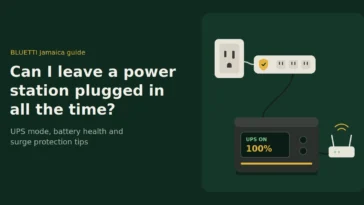
What they do well: keep essential circuits and devices running through an outage, charge from solar panels without any fixed installation, and move with you if you move. Paired with folding or portable panels, they’ll top themselves up during the day and carry your fridge, fans, router and lights through the evening.
What they don’t do: run a whole house, replace a properly sized rooftop array, or deliver the kind of bill reduction a permanent grid-tied system does. Anyone telling you otherwise is overselling.
If that middle path suits your situation, the range of portable power stations and solar generators available in Jamaica is a sensible place to work out what capacity your essential loads actually need.
Renters, apartments, and phased buyers
Three groups get the most out of this approach:
- Renters — no roof rights, no landlord negotiation, and the equipment leaves with you.
- Apartment residents — balcony or window solar plus a battery unit covers essentials without touching the building.
- Phased buyers — start with backup power now, add the rooftop array when the capital is there. Nothing you buy in stage one is wasted in stage two.
Red flags in a solar quote
Some warning signs are consistent enough to be worth memorising. If you see two or more of these, get another quote.
- No site visit. Nobody can size a system properly from a phone call and a photo.
- Vague equipment. “High-efficiency panels” is not a brand and not a model number. Ask for both.
- Full payment upfront. Staged payments tied to milestones are the norm for a reason.
- No written yield estimate. If they won’t put expected annual kWh production in writing, they don’t want to be held to it.
- No local references. Ask for two customers within 30 minutes’ drive whose systems have run through at least one wet season.
- Silence on JPS approval. If the interconnection process doesn’t come up, they either don’t do it or don’t do it well.
Your step-by-step path to a solar quote
- Gather 12 months of JPS bills. Seasonal variation matters don’t size off one high month.
- Work out your daytime load. Under net billing, power you use as you generate it is worth more than power you export.
- Shortlist three licensed installers. Confirm licensing and JPS experience before you invite anyone to quote.
- Insist on a site visit for each quote. Roof condition, orientation and shading all change the numbers.
- Convert every quote to cost per watt plus estimated annual kWh. Compare like with like.
- Check two references each, ideally systems more than a year old.
- Confirm who handles the paperwork GEI inspection and the JPS interconnection application.
- Install, inspect, connect. Keep every certificate; you’ll want them for insurance and resale.
Pros and cons of going solar in Jamaica
In favour:
- High retail electricity rates mean each self-consumed unit saves real money
- Strong, consistent year-round sun resource
- Protection against future rate increases and fuel-price swings
- Hybrid systems add genuine outage resilience
- Documented, well-installed systems can support property value
Against:
- Meaningful upfront capital, and financing costs eat into savings
- Your roof needs to be in good condition first retrofitting onto a roof due for replacement is a false economy
- Net billing pays less for exports than net metering would
- Batteries add cost now and replacement cost later
- Installer quality varies, and a bad install is expensive to unwind
FAQs
How much does a solar system cost in Jamaica?
Pricing is usually quoted per watt installed, so a larger system costs more in total but less per watt. Always compare quotes on cost per watt rather than headline price.
How long does it take to pay back a solar installation?
Payback is driven mainly by how much electricity you currently buy and how much of your solar output you consume directly. High-usage households recover their investment faster. Ask each installer to show their payback calculation and the assumptions behind it.
Will my solar panels work during a JPS outage?
Only if you have battery storage and the right inverter setup. Standard grid-tied systems shut down automatically during an outage as a safety requirement, regardless of how much sun is available.
Do I need JPS approval to install solar panels?
Yes, for any grid-connected system. The installation must be certified by a licensed electrician and inspected, and JPS must approve the interconnection before the system is legally connected and metered.
Is my roof suitable for solar panels?
It depends on structure, condition, orientation and shading. If your roof is within a few years of needing replacement, deal with the roof first removing and reinstalling an array later costs far more than the delay saves.
What happens to solar panels in a hurricane?
Correctly rated and properly fastened mounting systems are designed to withstand high winds, which is why racking specification deserves as much attention as panel choice. Confirm the wind rating in writing and check how your home insurance treats the installation.
Can I go solar if I rent my home?
Not with a rooftop install, but portable power stations paired with portable solar panels give renters backup power and some bill relief without touching the building and the equipment moves with you.