
Third outage this month. Fridge full of food you paid good money for. You’ve asked two salespeople how long a power station would keep it running and both said “it depends on your usage.”
That’s not an answer. So here are actual numbers the runtime you can expect for a fridge, a fan, a light, and yes, an air conditioner plus the one calculation that lets you work it out for any appliance in your house. Including the part most sellers skip: what a BLUETTI won’t do.
How Long Will a BLUETTI Run My Fridge Fan & AC?
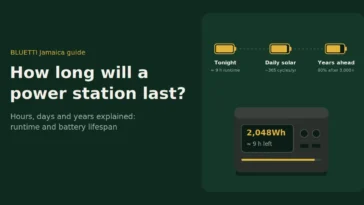
Runtime equals usable watt-hours divided by the appliance’s real average draw. Take the power station’s capacity, multiply by roughly 0.85 to allow for inverter losses, then divide by the watts your appliance actually pulls on average.
Runtime (hours) = (Capacity in Wh × 0.85) ÷ Average watts
So a 2,048Wh unit running a 50W load gives you about 34 hours. That’s it. Every number in this article comes from that one line, and you can apply it to anything you own.
The tricky part isn’t the maths. It’s knowing what number to use for “average watts” because for a fridge, it isn’t the number on the label.
Why your fridge’s label lies to you (in a good way)
The wattage on your fridge’s sticker is what the compressor draws while it’s running. But a fridge’s compressor doesn’t run continuously it cycles on and off. Over a full day it might run a third of the time, so a fridge labelled 150W often averages 40 to 60W.
That’s good news. It means real runtime is much better than the label suggests, and it’s why “capacity divided by nameplate watts” produces figures that scare people off unnecessarily.
Duty cycle explained without the jargon
Your fridge cools down, the compressor stops, the temperature slowly rises, the compressor kicks back on. That on-off pattern is the duty cycle.
If the compressor pulls 150W but only runs 20 minutes in every hour, your average is 50W. The power station sees the average across the whole outage, not the peak.
How to measure your own fridge in 24 hours
This is the single most useful thing in this article. Buy a plug-in energy meter, put it between your fridge and the wall, and leave it for 24 hours. It will tell you exactly how many kilowatt-hours your fridge uses in a day.
Divide that by 24 and you have your real average watts. No guessing, no manufacturer optimism your fridge, in your kitchen, in Jamaican heat.
Jamaican heat makes this worse
Ambient temperature drives duty cycle. A fridge in a 32°C kitchen fights a much bigger temperature difference than the same fridge in a 20°C test lab, so the compressor runs longer and more often.
Rated figures from overseas assume cooler conditions. Whatever number you land on, build in margin and if you measure during a hot week, you’ve measured the case that matters.
Real runtime numbers by appliance
Below are indicative runtimes across four units in the range, using realistic average draws rather than nameplate figures. Your appliances will differ, which is why the measuring step matters.
| Appliance (average draw) | Elite 30 V2 (288Wh) | AC50B (448Wh) | AC200L (2,048Wh) | Apex 300 (2,764Wh) |
|---|---|---|---|---|
| Fridge (~50W avg) | ~5 hrs | ~7.5 hrs | ~34 hrs | ~47 hrs |
| Chest freezer (~70W avg) | ~3.5 hrs | ~5.5 hrs | ~25 hrs | ~33 hrs |
| Ceiling fan (~70W) | ~3.5 hrs | ~5.5 hrs | ~25 hrs | ~33 hrs |
| Pedestal fan (~50W) | ~5 hrs | ~7.5 hrs | ~34 hrs | ~47 hrs |
| 5 LED bulbs (~45W) | ~5.5 hrs | ~8.5 hrs | ~38 hrs | ~52 hrs |
| WiFi router (~12W) | ~20 hrs | ~32 hrs | ~145 hrs | ~195 hrs |
| 32″ LED TV (~60W) | ~4 hrs | ~6.5 hrs | ~29 hrs | ~39 hrs |
| CPAP, no humidifier (~40W) | ~6 hrs | ~9.5 hrs | ~43 hrs | ~58 hrs |
| Phone charges (~15Wh each) | ~16 | ~25 | ~115 | ~155 |
| 12,000 BTU inverter AC (~1,000W) | Won’t run | Won’t run | ~1.7 hrs | ~2.3 hrs |
Assumptions: 85% inverter efficiency, average draws rather than peak, and one appliance at a time. Real figures vary with your specific appliance, its age, and how hot your house is.
The combination that actually matters
Nobody runs one thing. Here’s a realistic Jamaican outage night fridge, two fans, five lights and the router:
50W + 100W + 45W + 12W = 207W
- AC200L: about 8.5 hours. A full night.
- Apex 300: about 11 hours. A night with margin.
- AC50B: under 2 hours. Enough to ride out a short cut, not a night.
- Elite 30 V2: about 1 hour. This is a device-charging unit, not a household one.
That single line is the honest sizing answer for most homes.
The air conditioning answer nobody wants to give you
A 12,000 BTU inverter split draws roughly 900 to 1,200W and runs more or less continuously. Even on a 2,048Wh unit that’s under two hours. Air conditioning doesn’t fit into a small power station it changes which system you need entirely.
Better to know that now than after delivery.
Startup surge and why some ACs won’t run at all
Running watts aren’t the whole test. A non-inverter compressor demands several times its running current for the first moment of startup, and if the unit can’t supply that surge, the AC simply won’t start even when the running figure looks comfortable.
Inverter-type ACs ramp up gently and are far more cooperative. If you’re serious about backing up cooling, an inverter split is part of the answer.
What it actually takes to run AC through an outage
Realistically, a stackable system. The Apex 300 accepts expansion batteries and scales well beyond its base capacity, which is the route to hours rather than minutes of cooling or a whole-home system like the EP900 if you’re backing up a house rather than a room.
The honest framing: AC backup is a capacity problem, and capacity costs money. Anyone selling you AC backup on a $400 unit is not being straight with you.
The cheaper answer: fans
A ceiling fan at 70W runs for around 25 hours on an AC200L. Moving air makes a Jamaican night genuinely tolerable at a fraction of the energy cost of cooling it.
For most households the sensible combination is fridge plus fans plus lights comfortable, affordable, and achievable on a single unit.
What “run my whole house” actually means
Most Jamaican homes don’t need whole-house backup. They need the fridge cold, some fans turning, a few lights on, the router up and phones charged. That’s a load of roughly 200 to 250W a very different purchase from backing up air conditioning and a water heater.
Separate the essentials from the nice-to-haves and the decision gets much cheaper.
Building your own load list
- List what must stay on. Be strict. Fridge, fans, lights, router, phones.
- Find each appliance’s average draw. Measure the fridge; nameplate is fine for fans, lights and routers since they run steadily.
- Add them up for your total watts.
- Multiply by the hours you need to get the watt-hours required.
- Add 20% for heat, inefficiency and the thing you forgot.
A 207W load for 10 hours is 2,070Wh, plus 20% is roughly 2,500Wh. That points you at the Apex 300 tier rather than the AC200L which is exactly the kind of clarity a load list gives you.
Stretching runtime: the levers that actually work
Small changes buy real hours. The biggest wins are keeping the fridge closed, running fans instead of cooling, and switching off outputs you aren’t using.
- Keep the fridge shut. Every opening dumps cold air and forces a long compressor cycle.
- Turn off unused outputs. AC inverters draw idle power even with nothing plugged in. If you’re only charging phones, use the USB ports and leave AC off.
- Use DC where you can. Charging directly from USB avoids the inverter losses entirely.
- Eco mode. Reduces standby drain on units that offer it.
- One heavy appliance at a time. Runtime is shared, not parallel.
Pre-cool before the storm
Hurricane season makes this worth planning. When you know weather is coming:
- Turn the fridge and freezer down a setting or two the day before
- Freeze bottles or containers of water and pack them into both
- Charge every unit and every device to full
A cold, full freezer holds temperature far longer than an empty one, so the compressor cycles less once you’re on battery. It’s free runtime.
Recharging between outages
For a short cut, runtime is what matters. For an outage running into days the JPS reality after a serious storm recharge rate matters more. Mains charging is fastest when power returns; solar is what keeps you going when it doesn’t.
What solar realistically adds per day in Jamaica
Jamaica gets strong, consistent sun, which makes solar in Jamaica genuinely practical rather than aspirational. As a planning figure, a 200W panel in good conditions might deliver somewhere around 700 to 800Wh across a day once you allow for angle, cloud and heat.
Two panels of that size can broadly cover a typical fridge’s daily consumption. That’s the threshold worth understanding: enough solar panels and your fridge stops being on a countdown and starts running indefinitely.
A dedicated fridge UPS as the other approach
If the fridge is the whole reason you’re shopping, there’s a narrower answer than a general-purpose power station. FridgePower is a slim UPS built specifically for refrigeration, switching to battery within about 10ms so the compressor never stalls.
Matching a model to your outage
| Your situation | Realistic target | Where to look |
|---|---|---|
| A few hours, phones and a fan | 300–500Wh | Elite 30 V2, AC50B |
| Fridge through a half-day cut | 1,000–2,000Wh | Premium 100 V2, AC200L |
| A full night of essentials | 2,000–3,000Wh | AC200L, Apex 300 |
| Two days, or some cooling | 3,000Wh+ with expansion | Apex 300 + B300K, Elite 400 |
| Hurricane-week resilience | Whole-home system | EP900 + B500 |
You can see current pricing and what’s held locally at BLUETTI Jamaica.
FAQs
How long will a BLUETTI run a fridge during a JPS outage?
Roughly 5 hours on a 288Wh unit, 34 hours on a 2,048Wh unit, and around 47 hours on a 2,764Wh unit assuming a typical fridge averaging about 50W. Measure your own fridge for a day to get an accurate figure.
Can a BLUETTI run an air conditioner in Jamaica?
A 12,000 BTU inverter split needs roughly 1,000W continuously, so a 2,048Wh unit gives under two hours. Meaningful AC backup needs a stackable or whole-home system, not a portable unit.
Why does my fridge use less power than the label says?
Because the label shows the compressor’s draw while running, and the compressor cycles on and off. Over a full day the average is often a third of the nameplate figure.
How many fans and lights can I run overnight?
Two fans and five LED bulbs is about 145W. On a 2,048Wh unit that’s roughly 12 hours a full night before you add the fridge.
Does hot weather reduce runtime?
Indirectly, yes. Heat makes your fridge’s compressor run more often, which raises its average draw and shortens runtime. Plan with a margin rather than with lab figures.
Do I need an inverter AC to run cooling from a power station?
It helps considerably. Non-inverter compressors demand a large surge at startup that many units can’t supply, so the AC may not start at all even when the running wattage looks fine.
What size do I need to get through a hurricane outage?
Depends on how long you expect to be out and whether you can recharge. For multi-day resilience, plan on 3,000Wh or more with expansion capacity, plus solar panels so you’re generating rather than just draining.