Your neighbour just installed solar without paperwork you saw. Your installer’s talking about JPS interconnection forms. Someone on Facebook said you need OUR approval too. Google gives you contradictory answers depending on which article you read.
Solar Panels in Jamaica
So: do I need permission for solar panels in Jamaica, and if so, from whom? This guide gives the straight answer, separated by system type because “permission required” depends entirely on whether you’re installing a plug-in portable BLUETTI or a rooftop grid-tied array. Four different approvals could apply. Knowing which ones apply to your specific setup matters more than most buyers realise.
Note: reflects Jamaican solar permit and approval processes as of early 2026. Verify specific requirements with your parish council and JPS before signing installer contracts.
The 30-second answer depends on what you’re installing
Permission requirements in Jamaica break down clearly by system type:
- Portable BLUETTI (plug-and-play) → no permits required
- Portable BLUETTI + portable solar panels → no permits required
- Grid-tied rooftop solar → JPS interconnection + electrician + possibly building permit
- Hybrid solar + battery + grid → JPS interconnection + electrician + possibly building permit
- Off-grid solar (no JPS connection) → electrician + possibly building permit (JPS approval skipped)
- Commercial solar (>10 kW) → all of the above + OUR licensing
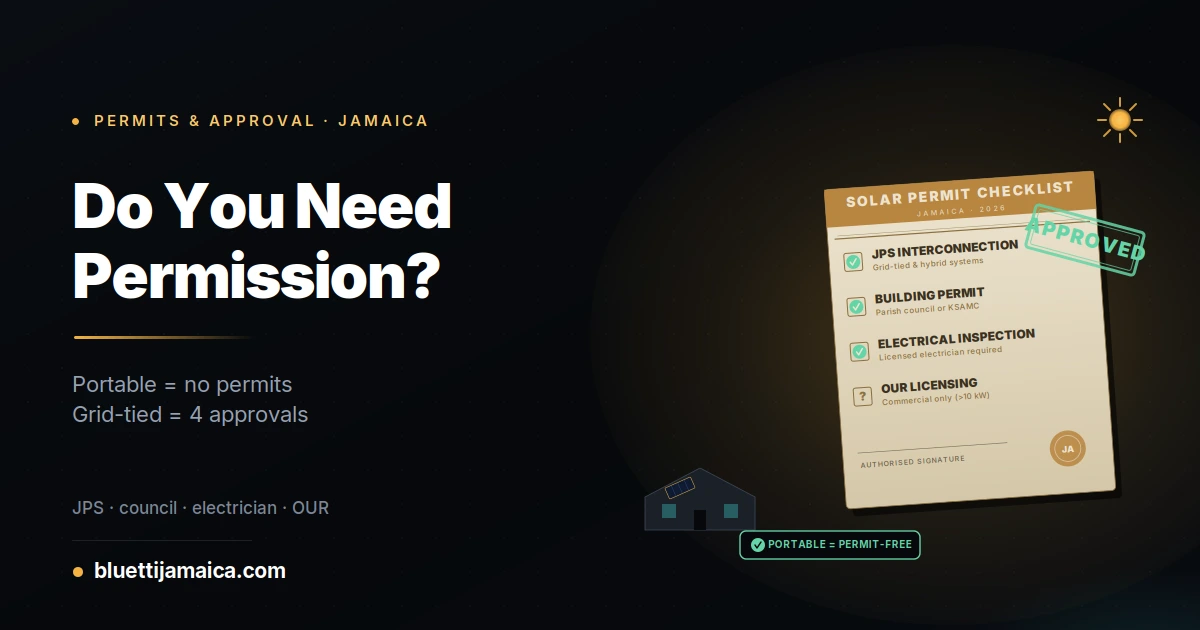
Four distinct approvals could apply to different installation types. Match your planned system to the correct approvals list you can’t skip a required one and expect it to work out.
The four types of approval that could apply to your installation
Not all four apply to every installation. Here’s what each covers, who grants it, and how long it typically takes:
| Approval Type | When Required | Who Grants It | Typical Timeline |
|---|---|---|---|
| JPS Interconnection | Grid-tied or hybrid systems | Jamaica Public Service Company | 4-8 weeks |
| Building Permit | Structural work, ground arrays | Parish Council or KSAMC | 2-6 weeks |
| Electrical Inspection | Any permanent electrical work | Licensed electrician + inspector | Included with installation |
| OUR Licensing | Commercial energy generation | Office of Utilities Regulation | Business-only, weeks to months |
For a typical residential rooftop hybrid installation, expect the first three. For portable and off-grid setups, fewer approvals apply. For commercial installations, all four often apply plus additional business licensing.
Portable BLUETTI systems no permission required
Portable power stations (BLUETTI AC200MAX, AC300, EB series, and comparable units) that plug into standard household outlets or connect directly to portable solar panels require zero permits or approvals in Jamaica. They’re consumer electronics, legally classified the same as buying a laptop or a portable generator. You buy one, plug it in, use it.
Why portable systems bypass the permit process
Portable BLUETTI units don’t connect to JPS infrastructure, don’t modify your building structure, and don’t require licensed electrical work. The system charges from your standard household outlet (which is already permitted infrastructure) and outputs power to devices you plug directly into it. Nothing in this process triggers any Jamaican permitting requirement.
Portable solar panels connected directly to a BLUETTI unit (not to your household electrical system) work under the same principle you’re using consumer solar equipment for personal off-grid use, not modifying licensed infrastructure.
The one exception permanent wiring modifications
If you take a portable BLUETTI system and hard-wire it into your household electrical panel (creating a “transfer switch” setup where the BLUETTI can power household circuits during outages), you’ve moved into permanent electrical installation territory. That requires a licensed electrician and inspection. The BLUETTI itself doesn’t need permits, but the wiring modification does.
Grid-tied solar JPS interconnection is mandatory
Any solar system that feeds power back to the JPS grid including standard rooftop grid-tied installations and hybrid solar-plus-battery systems staying connected to the grid requires formal JPS interconnection approval before activation. This is legally required, not optional. Activating a grid-tied system without JPS approval carries fines, forced disconnection, and possible legal action against you.
What JPS interconnection actually approves
- Your system meets JPS’s safety and technical standards
- Your inverter has automatic disconnect capability (prevents back-feeding during outages)
- Your electrical work meets Jamaican electrical code
- Your metering setup is compatible with net-metering (if applicable)
- Your installer is properly qualified to interconnect with JPS infrastructure
The bi-directional meter requirement
JPS installs a bi-directional meter that measures both your grid consumption AND your solar export. This meter installation typically happens near the end of the JPS approval timeline. Old-style meters that only measure consumption cannot accommodate net-metering.
Realistic timeline 4-8 weeks typical
The JPS interconnection process involves engineering review, site inspection, meter replacement, and paperwork processing across multiple JPS departments. Typical timeline: 4-8 weeks. During busy periods (post-hurricane rebuild seasons, government incentive announcements), timelines extend to 10-12 weeks. Any installer promising 2-week interconnection is either lying or hasn’t dealt with JPS recently.
What happens if you skip JPS approval
Real consequences, not theoretical. Activating grid-tied solar without JPS approval:
- Fines: enforcement action from JPS with monetary penalties
- Forced disconnection: JPS can and does disconnect unauthorised systems
- Legal action: for repeat offences or commercial installations
- Insurance void: home insurance typically excludes coverage for unauthorised electrical work
- Utility injury liability: if line workers are injured during outages because your system back-fed power
For a complete walkthrough of the full 6-stage installation process including JPS approval details, see our companion Solar Panel Installation in Jamaica guide.
Building permits depends on structural work
If your installation involves structural roof modifications, ground-mounted arrays with foundation work, or major electrical panel changes, you likely need a building permit from your parish council or KSAMC. Roof-mounted arrays on existing roofs without structural change often qualify as minor works verify with your specific parish council before assuming.
When roof-mounted solar requires a building permit
Standard rack-mounted solar panels on an existing residential roof typically don’t require a building permit in most Jamaican parishes if:
- No structural roof modification
- No addition of significant weight beyond what the roof was designed for
- Standard rack-mount hardware (not custom structural work)
Building permits are typically required when:
- Reinforcing the roof structure to accept panels
- Ground-mounted arrays with concrete foundations
- Major electrical panel upgrades
- Any structure exceeding certain height or footprint thresholds
How to check your specific parish requirements
Requirements vary by parish. KSAMC (Kingston and St. Andrew) has its own building department process; other parishes work through their respective parish councils. Rules can differ. Your installer should know the current requirements for your specific parish if they don’t, that’s a warning sign about their local experience.
Electrical inspection always required for permanent work
Any permanent solar installation touching your home’s electrical system requires work by a licensed electrician and inspection to verify compliance with Jamaican Electricity Standards. This applies to all grid-tied, hybrid, and permanent off-grid installations anything that isn’t purely portable.
DIY permanent solar installations are illegal in Jamaica, void home insurance coverage, and cannot receive JPS interconnection approval. Even for off-grid systems that don’t need JPS approval, licensed electrical work remains mandatory for indoor wiring, battery bank installation, and inverter integration.
What licensed electrical work covers
- Wiring from solar panels through inverter to household panel
- Installation of solar-specific breakers and disconnects
- Grounding and lightning protection systems
- Battery bank wiring (for hybrid or off-grid systems)
- Any modification to your existing electrical panel
Your installer’s team should include or contract with licensed Jamaican electricians. Verify certifications before signing installation contracts.
Off-grid solar different rules apply
Truly off-grid systems (no JPS connection at all) skip the JPS interconnection process entirely. But they still need licensed electrical work for any indoor wiring, building permits for structural mounting, and compliance with electrical standards.
Off-grid isn’t permit-free it just skips one of the four permit categories.
The permits off-grid still requires
- Licensed electrical work for indoor wiring and battery integration
- Building permits for ground-mount installations or structural modifications
- Electrical inspection for permanent installations
The only permit off-grid systems genuinely skip is JPS interconnection. Everything else still applies. Don’t assume “off-grid” means “unregulated” that’s a common misconception that leads to insurance and legal complications.
Commercial installations OUR licensing enters the picture
For commercial solar generation (business installations exceeding certain capacity thresholds, or installations intended for wholesale energy trading), the Office of Utilities Regulation (OUR) requires additional licensing beyond standard residential requirements.
Typical residential installations (under 10 kW) don’t hit OUR licensing thresholds. Small businesses installing larger systems should verify current thresholds before proceeding the licensing process adds weeks to project timelines and involves additional fees and reporting requirements.
Residential vs commercial threshold
The line between residential and commercial is generally around 10 kW system capacity, but the specific threshold shifts periodically as OUR updates regulations. Confirm the current threshold with a Jamaican electrical consultant or the OUR directly if your planned installation is close to the boundary.
The complete permit checklist by system type
Match your planned installation to the correct permit list:
| System Type | JPS Approval | Building Permit | Licensed Electrician | OUR License |
|---|---|---|---|---|
| Portable BLUETTI (plug-in) | No | No | No | No |
| Portable + portable solar panels | No | No | No | No |
| Grid-tied rooftop (5-10 kW) | Yes | Maybe | Yes | No |
| Hybrid solar + battery + grid | Yes | Maybe | Yes | No |
| Off-grid residential | No | Maybe | Yes | No |
| Commercial (>10 kW) | Yes | Yes | Yes | Yes |
This is the single most important table in this article. Print it, save it, reference it before making any solar purchase decision.
FAQs
Do I need permission for a BLUETTI portable power station in Jamaica?
No. Portable BLUETTI units and comparable portable power stations are consumer electronics no permits, licenses, or approvals required. You can buy one at retail and use it immediately, including with portable solar panels for genuine off-grid capability. This is one of the biggest practical advantages of portable systems for Jamaican buyers who want to avoid regulatory paperwork.
Can I install rooftop solar without telling JPS?
Not legally. Any solar system connected to JPS infrastructure (grid-tied or hybrid) requires formal JPS interconnection approval before activation. Skipping this step carries fines, forced disconnection, and possible legal action. The approval process takes 4-8 weeks plan for it rather than trying to bypass it.
How long does JPS interconnection approval actually take in 2026?
Typically 4-8 weeks from submission to approval and meter installation. During busy periods (post-hurricane rebuild seasons, incentive-scheme launches), timelines extend to 10-12 weeks. Any installer promising 2-week interconnection either doesn’t understand the current process or is misleading you.
Do I need a building permit for solar panels on my roof in Jamaica?
Depends on your parish and the installation specifics. Standard rack-mounted panels on existing residential roofs often qualify as minor works (no permit required). Structural modifications, ground-mount installations, or major electrical panel changes typically require permits from your parish council or KSAMC. Verify with your specific council before assuming either way.
What happens if I install solar and don’t get any permits?
Real consequences vary by permit skipped. JPS interconnection skipped: fines, forced disconnection, possible legal action. Building permit skipped: council-ordered removal, insurance voided, complications during property sales. Electrical inspection skipped: insurance void, safety liability, fire liability if damage results. None of these are theoretical enforcement happens, especially after storm damage insurance claims or property inspections trigger scrutiny.
Is DIY solar installation legal in Jamaica?
Only for portable systems. Portable BLUETTI units and portable solar panels are legal to purchase and use DIY no licensed electrician required. Permanent installations (anything touching your household electrical panel or requiring roof mounting) legally require a licensed Jamaican electrician. DIY permanent installations are illegal, void insurance, and cannot receive JPS approval.
Does my insurance cover unpermitted solar installations?
Generally no. Most Jamaican home insurance policies exclude coverage for damage caused by or to unpermitted electrical work. If your unpermitted solar installation causes a fire, storm damage claim, or property damage, expect your insurer to deny the claim. This is often the most expensive consequence of skipping permits losing insurance coverage on the entire property, not just the solar system.