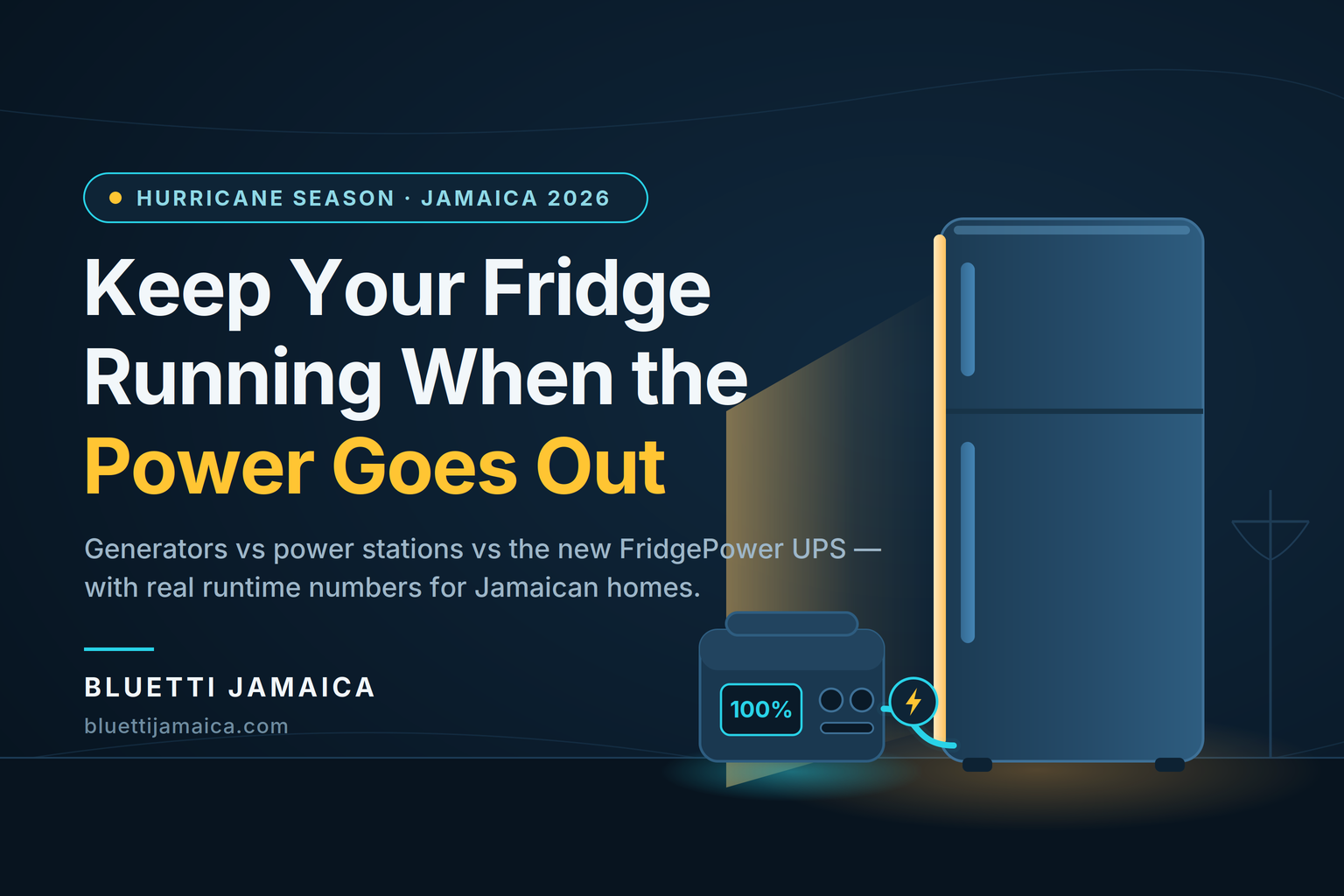
You have about four hours. That’s how long a closed refrigerator keeps food at a safe temperature once the power cuts out. After that, milk, chicken, leftovers, and anything else perishable starts moving into the danger zone — and a full fridge of spoiled food can easily cost J$15,000–30,000 to replace. Investing in reliable fridge backup power for a power outage in Jamaica is one of the most practical preparedness moves you can make, especially now that hurricane season is underway and JPS outages remain a routine part of island life.
This guide covers how long your food actually lasts, how much power your fridge really draws, and the four realistic backup options — from gas generators to a dedicated fridge UPS — with honest runtime numbers so you can size things correctly the first time.
How Long Does Food Last in a Fridge Without Power?
An unopened refrigerator keeps food safe for roughly 4 hours after an outage begins. A full freezer holds a safe temperature for about 48 hours, and a half-full freezer for about 24 hours — but only if you keep the doors closed.CDC emergency food safety guidelines
That 4-hour window is fine for a short JPS switching outage. It’s nowhere near enough for the outages that matter most in Jamaica:
- Storm and hurricane blackouts routinely run 12 hours to several days, particularly in rural parishes where restoration takes longest.
- Load management and grid maintenance outages often land in the 2–6 hour range — right at the edge of the safety window, and longer if you’ve been opening the door.
- Repeated short outages are their own problem: each restart hits your compressor with a surge, and food temperature climbs a little more each time.
The takeaway: if an outage stretches past half a day, the fridge is usually the first appliance you genuinely regret not backing up. Phones can charge in the car. Food can’t be un-spoiled.
How Many Watts Does a Fridge Actually Use?
A typical household fridge in Jamaica runs on 100–250 watts while the compressor is on, but needs a surge of roughly 3–6 times that — often 800–1,500 watts — for a second or two at compressor start-up. Over a full day, most fridges consume between 1 and 2 kWh.
That surge figure is the number that catches people out. Plenty of Jamaicans have bought a small inverter or power bank rated “300W,” plugged in the fridge, and watched it shut down instantly. The unit wasn’t broken — it just couldn’t handle the compressor’s start-up spike.
Before choosing your fridge backup power setup, you need to understand your specific appliance’s electricity demands.
Quick reference: fridge power draw
| Fridge type | Running watts | Start-up surge | Daily energy use |
|---|---|---|---|
| Mini fridge / bar fridge | 50–100W | 300–600W | 0.5–1 kWh |
| Standard single-door (10–14 cu ft) | 100–180W | 800–1,200W | 1–1.5 kWh |
| Large double-door / French door | 150–250W | 1,000–1,500W | 1.5–2.5 kWh |
| Chest freezer | 80–150W | 500–1,000W | 1–1.5 kWh |
Your fridge’s actual numbers are on the rating plate inside the door or on the back panel. In hot Jamaican kitchens, expect real-world consumption toward the higher end of these ranges — the compressor works harder when the ambient temperature is 30°C+.
Two rules when sizing any backup:
- Your backup’s continuous output must exceed the fridge’s running watts (easy — almost anything qualifies).
- Its surge/peak output must exceed the compressor’s start-up spike (this is where cheap solutions fail).
Sizing Your Fridge Backup Power: The 4 Best Options
There are four realistic ways to keep a fridge alive through an outage in Jamaica: a gas generator, an inverter generator, a portable power station, or a dedicated fridge UPS. Generators win on raw runtime per dollar; battery options win on safety, silence, and the ability to run indoors — which matters when it’s raining sideways during a storm.
| Gas generator | Inverter generator | Portable power station | Dedicated fridge UPS | |
|---|---|---|---|---|
| Indoor use | Never — CO risk | Never — CO risk | Yes | Yes |
| Noise | Loud (65–75dB) | Moderate (50–60dB) | Silent | Silent |
| Fuel/running cost | Petrol, ongoing | Petrol, ongoing | Free after purchase (solar) | Negligible |
| Runs in a hurricane | Risky — must sit outside | Risky — must sit outside | Yes, indoors | Yes, indoors |
| Switchover | Manual, minutes | Manual, minutes | Manual or UPS mode | Automatic, ~10ms |
| Power quality | Rough — hard on electronics | Clean sine wave | Pure sine wave | Pure sine wave |
| Maintenance | Oil, spark plugs, stale fuel | Same | None | None |
| Also powers other loads | Yes | Yes | Yes | No — fridge only |
A few points worth expanding:
- Carbon monoxide is the deal-breaker for generators during storms. They must run outside, away from windows — which is exactly where you can’t put them when a hurricane is passing. Every hurricane season brings CO poisoning cases from generators run in kitchens and carports.
- Fuel logistics fail when you need them most. After a major storm, petrol stations may be closed, out of stock, or unreachable. A battery charged before the storm doesn’t care.
- Power stations are the flexible middle ground. One unit runs the fridge today, the fan and router tonight, and charges from solar panels tomorrow morning.
- A fridge UPS is the specialist. It does exactly one job — keeping the fridge on — and does it automatically, with no one home required.
The Dedicated Fridge UPS Option: BLUETTI FridgePower
The BLUETTI FridgePower is a slim UPS built specifically for refrigerators. It sits between the wall socket and your fridge, and when the grid drops, it switches to battery in about 10 milliseconds — fast enough that the compressor never stalls or restarts.
That 10ms figure matters more than it sounds. A fridge compressor that loses power mid-cycle can’t restart immediately; the refrigerant pressure needs minutes to equalise, and repeated hard stops shorten compressor life. A near-instant switchover means the compressor simply keeps running as if nothing happened — no stall, no restart surge, no wear.
Who it suits:
- Households that mainly worry about food spoilage, not whole-home backup
- Anyone who’s away at work when daytime outages hit — the switchover is automatic
- Small shops and offices with a stocked fridge or display cooler
- People who want a set-and-forget solution with no cables to run when the lights go out
FridgePower is currently available for pre-order through BLUETTI Jamaica, with units shipping in July.You can reserve one through BLUETTI Jamaica.
Power Stations That Run a Fridge for 12–48+ Hours
For outages measured in days rather than hours — the hurricane scenario — a portable power station with real capacity is the better tool. As a rule of thumb, every 1,000Wh of battery runs a standard fridge for roughly 12–16 hours in real conditions, once you account for inverter losses and Jamaica’s heat.
Here’s how that maths plays out on two popular units:
- BLUETTI AC200L (2,048Wh, 2,400W output).Around 1,700Wh usable after inverter losses. For a standard fridge using ~1.5kWh/day, expect roughly 24–28 hours of continuous fridge backup power to comfortably get you through a JPS outage.
- BLUETTI Apex 300 (2,764.8Wh, 3,840W output). Roughly 36–44 hours on the fridge alone. The bigger story is expansion: each B300K battery bolts on another 2,764.8Wh with one cable, and the system stacks toward 30kWh. Two B300Ks take you past four days of fridge runtime — genuine multi-day hurricane territory.
The 3,840W output on the Apex 300 also means compressor surges are a non-issue, and you can run the fridge alongside a freezer, fans, and lights without thinking about it.
Running Your Fridge Backup Power on Solar During Blackouts
Jamaica averages 5+ peak sun hours daily, which changes the runtime equation entirely. A 350W solar panel in good sun puts back roughly 1.4–1.7kWh per day — close to what a standard fridge consumes. Pair a power station with even one decent panel and your fridge backup stops being a countdown timer and becomes a loop: run the fridge overnight, recharge through the day, repeat until the grid returns. During extended post-hurricane restoration periods, that loop is the difference between two days of backup and two weeks.
How to Set Up Your Fridge Backup Power
Don’t wait for the storm warning. Get this done on a normal weekend:
- Check your fridge’s rating plate. Note the rated watts (or amps × 110V) so you know your running and likely surge numbers.
- .Choose your ideal fridge backup power system based on your specific JPS outage pattern. Short frequent outages → FridgePower-style UPS. Multi-day storm risk → power station, ideally expandable.
- Position the backup near the fridge with a proper heavy-gauge extension cord if needed — long thin cords cause voltage drop that stresses the compressor.
- Do a live test. Kill the breaker or unplug from the wall and confirm the fridge keeps running. Better to find a problem now than at 9pm in a blackout.
- Keep batteries topped up during hurricane season. LiFePO₄ units hold charge well; a quick monthly top-up keeps them ready.
- Prep the fridge itself before a storm. Turn it to its coldest setting, freeze bottles of water to add thermal mass, and group items together.
Common Mistakes That Kill Your Fridge Backup
- Sizing your fridge backup power system for running watts and ignoring surge. This is the most common failure. A “500W” inverter cannot start a fridge with a 1,200W compressor spike.
- Running everything off one small unit. The fridge, plus the TV, plus the microwave — capacity vanishes in hours. During a long outage, ration the battery for the fridge first.
- Storing batteries flat. A power station left at 0% for months degrades and won’t be ready. Store at 50–80% and top up monthly.
- Using modified sine wave inverters. Compressor motors run hotter and less efficiently on rough power. Pure sine wave output — standard on BLUETTI units — is worth insisting on.
- Opening the fridge constantly during the outage. Every door opening costs cold air and forces the compressor to work, burning battery. Decide what you need, open once, close quickly.
Frequently Asked Questions
Can a portable power station provide enough fridge backup power overnight? Yes. Any unit with 1,000Wh or more of capacity and a surge rating above ~1,500W will handle your fridge backup power duties easily through the night.
What size battery do I need to run a refrigerator in Jamaica? Plan on 1,000–1,500Wh per day of fridge runtime for a standard model, and a surge rating of at least 1,500W. For hurricane-length outages, 2,500Wh+ or an expandable system is the safer choice.
How long will the BLUETTI Apex 300 run a fridge? Roughly 36–44 hours for a standard fridge in real-world conditions. Each B300K expansion battery adds around another day and a half of runtime.
Is it safe to run a fridge on a UPS? Yes, provided the UPS is designed for motor loads with pure sine wave output and adequate surge capacity — which is exactly what a fridge-specific unit like the FridgePower is built for. Small computer UPS units are generally not suitable.
Do I need pure sine wave power for a refrigerator? Strongly recommended. Compressor motors run hotter, noisier, and less efficiently on modified sine wave power, and long-term use can shorten compressor life.
Can I charge a power station with solar panels during a blackout? Yes — that’s one of their biggest advantages in Jamaica. A 350W panel in good sun can replace most of a fridge’s daily consumption, effectively extending your backup indefinitely.
Is a gas generator cheaper than a power station for fridge backup? Upfront, often yes. But factor in fuel (which may be unavailable after a storm), oil changes, and the fact that it can’t run indoors during a hurricane, and the battery option usually wins for fridge backup specifically.
Ready before the next outage? Browse power stations and expansion batteries in local stock, or pre-order the FridgePower ahead of its July arrival, at BLUETTI Jamaica — island-wide delivery, with warranty and support handled locally.