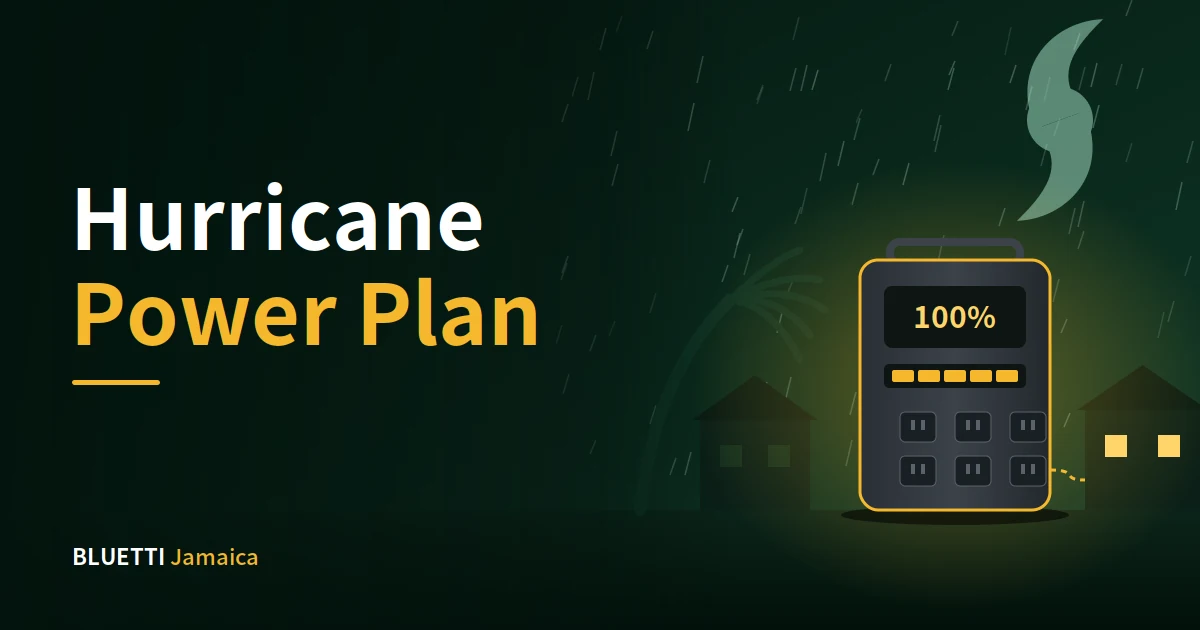
Quick answer: For hurricane backup power in Jamaica, most homes need 2 to 4kWh of battery to keep a fridge, fans, lights and Wi-Fi running through the first day without JPS power. For outages lasting several days or weeks, battery size matters less than solar charging: pair a 2 to 4kWh BLUETTI with about 1kW of solar panels so it refills every day.
Key takeaways
- Size your BLUETTI by how much energy your essentials use per day, not by the length of the outage.
- A 2,048Wh to 3,840Wh power station covers about one day of essentials. Longer outages need solar recharging or expansion batteries.
- After Hurricane Melissa, JPS took around four months to restore power to almost all customers, so plan for weeks, not hours.
- Charge to 100% as soon as a storm watch is issued, and keep solar panels indoors until the storm has passed.
Who this guide is for: Jamaican households preparing backup power before or during hurricane season. Who it is not for: homes planning a permanent rooftop solar installation, which needs JPS interconnection and a licensed installer.
Why does hurricane backup power matter in Jamaica?
Hurricane backup power matters in Jamaica because major storms can cut JPS supply for weeks. When Category 5 Hurricane Melissa struck on 28 October 2025, the Jamaica Information Service reported that about 240,000 JPS customers, 35% of the total, had already lost electricity, with St. Elizabeth, Manchester, Hanover and St. James worst affected.
Restoration took months, not days. JPS restored power to 98% of customers within 120 days of the storm, according to an industry account of its recovery. Outages also happen outside hurricane season: in June 2026, an islandwide outage left most JPS customers without power overnight. A backup plan protects your food, communication and comfort whenever the grid goes down.
How much backup power does a Jamaican home need per day?
Most Jamaican homes need between 1.5kWh and 5kWh per day to run essentials during an outage. The table below groups common appliances into three levels so you can find your daily energy use.
| Backup level | What it runs | Daily energy (approx.) |
|---|---|---|
| Level 1: Stay connected | Wi-Fi router (24 hrs), phone and laptop charging, 6 LED lights (5 hrs), 1 fan (10 hrs) | About 1.4kWh |
| Level 2: Essentials | Level 1 + refrigerator, a second fan, TV (3 hrs) | About 3.4kWh |
| Level 3: Comfort | Level 2 + chest freezer and short water pump runs | About 5kWh |
These figures use typical appliance wattages: a modern refrigerator uses roughly 1 to 1.5kWh per day, a fan 40 to 75W, an LED bulb about 9W and a router about 15W. Check the labels on your own appliances for a closer estimate. For appliance-by-appliance runtimes, see our guide on how long a BLUETTI will run your fridge, fan and AC.
How many days will each BLUETTI last without recharging?
To estimate backup days, multiply your power station’s capacity by 0.85 to allow for inverter losses, then divide by your daily energy use.
Backup days = capacity (kWh) × 0.85 ÷ daily energy (kWh)
Example: a 2,764Wh BLUETTI Apex 300 at Level 2 gives 2.764 × 0.85 ÷ 3.4 = about 0.7 days, or roughly 17 hours.
| BLUETTI setup | Capacity | Level 1 (1.4kWh/day) | Level 2 (3.4kWh/day) | Level 3 (5kWh/day) |
|---|---|---|---|---|
| AC50B | 448Wh | About 6 hours | Phones, router and lights only | Not suitable |
| Pioneer Na | 900Wh | About 13 hours | About 5 hours | Not suitable |
| AC200L | 2,048Wh | About 1.2 days | About 12 hours | About 8 hours |
| Apex 300 | 2,764Wh | About 1.7 days | About 17 hours | About 11 hours |
| Elite 400 | 3,840Wh | About 2.3 days | About 1 day | About 16 hours |
| Apex 300 + 1 B300K | 5,529Wh | About 3.4 days | About 1.4 days | About 1 day |
| Apex 300 + 2 B300K | 8,294Wh | About 5 days | About 2 days | About 1.4 days |
These are estimates. Refrigerators and freezers cycle on and off, and opening the door often or keeping the unit in a hot room increases energy use.
What if the outage lasts longer than your battery?
If the outage lasts longer than your battery, you need a way to recharge it without JPS. Solar panels are the only practical option that is silent, fuel-free and safe to use near the home. With solar, a BLUETTI can run essentials indefinitely, refilling each day and powering your home each night.
To refill your battery in one day, match your solar panel capacity to your daily energy use:
Solar panels needed (kW) = daily energy (kWh) ÷ 0.85 ÷ 4
This guide assumes 1kW of panels produces about 4kWh on an average Jamaican day. Cloudy days after a storm produce less, so add a margin if you can. For Level 2 essentials, that is 3.4 ÷ 0.85 ÷ 4 = about 1kW of panels.
Check your power station’s solar input limit before buying panels. The Elite 400, for example, accepts up to 1,000W of solar input, which suits Level 2 backup. Browse BLUETTI solar panels to match your unit.
Which BLUETTI should you choose for hurricane season?
Choose your BLUETTI by your backup level and how long outages usually last where you live.
| Your situation | Best fit | Why |
|---|---|---|
| Stay connected only, short outages | AC50B or Pioneer Na | Keeps phones, router, lights and a fan going for an evening |
| Essentials through a one-day outage | AC200L or Apex 300 | Runs a fridge, fans, lights and Wi-Fi for most of a day |
| Essentials for a full day, no expansion needed | Elite 400 | 3,840Wh in a single rolling unit with 2,600W output |
| Multi-day outages, room to grow | Apex 300 with B300K expansion batteries | Starts at 2,764Wh and adds capacity one battery at a time |
| Weeks without JPS | Any 2kWh+ unit with about 1kW of solar panels | Solar refills the battery daily, so backup does not run out |
| Whole-home backup | EP900 + B500 home battery system | Built for larger homes and businesses; contact us for sizing |
The Elite 400 has a fixed capacity and cannot take expansion batteries, while the Apex 300 is designed to grow with B300K expansion batteries of 2,764.8Wh each. If you expect to add capacity later, the Apex 300 is the more flexible starting point.
Hurricane season power checklist for Jamaican homes
Use this checklist to make sure your backup power is ready when a storm approaches.
Before hurricane season (by 1 June)
- List the appliances you need during an outage and work out your daily energy use.
- Test your BLUETTI with those appliances for a few hours to confirm it runs them all.
- Update the BLUETTI app and firmware while you still have internet.
- Check that your solar panels, cables and connectors are complete and undamaged.
When a hurricane watch is issued
- Charge your power station to 100% from the wall while JPS power is still on.
- Turn your refrigerator and freezer to their coldest settings so they hold cold longer.
- Charge phones, power banks and laptops separately to save your BLUETTI for larger loads.
- Bring solar panels indoors and store them flat in a dry, secure place.
During the storm
- Keep the power station indoors, dry and away from windows.
- Run only what you need: lights, router, fans and the fridge in cycles.
- Keep fridge and freezer doors closed as much as possible.
After the storm passes
- Set solar panels out in full sun, away from fallen lines and flooded areas.
- Recharge during the day and run essentials in the evening and overnight.
- Follow official updates from the Office of Disaster Preparedness and Emergency Management (ODPEM) and JPS before reconnecting anything to the grid.
- Check official JPS channels for restoration news. JPS has warned customers about fake outage notices circulating on social media.
Is a BLUETTI better than a gas generator for hurricanes?
For most homes, a BLUETTI is the safer hurricane backup. A portable power station runs silently, produces no exhaust and can be used indoors, while a gas generator must always run outdoors because of carbon monoxide risk. Fuel can also be scarce and expensive after a major storm.
A generator can run high loads for as long as fuel lasts, so some households keep one for heavy appliances. If you use a generator, never run it indoors, in a garage or near open windows.
Do you need permission to use a BLUETTI in Jamaica?
No. Portable BLUETTI power stations plug into standard outlets or connect directly to portable solar panels, so they need no permits or JPS approval. Permanent rooftop systems connected to your home’s wiring are different and must be installed by a licensed electrician. Never connect a power station into your home’s wiring yourself, since back-feeding the grid can injure JPS line workers.
Where to buy hurricane backup power in Jamaica
BLUETTI Jamaica keeps local stock available for pickup, delivers island-wide, and handles parts and warranty in Jamaica. Buying before hurricane season avoids the rush and shortages that follow a storm warning.
Frequently asked questions
How much backup power do I need for a hurricane in Jamaica?
Most Jamaican homes need 2 to 4kWh of battery to run a fridge, fans, lights and Wi-Fi for about a day. For longer outages, add around 1kW of solar panels so the battery recharges daily.
How long will a BLUETTI run my fridge during a power outage?
A refrigerator typically uses about 1 to 1.5kWh per day. A 2,764Wh BLUETTI Apex 300 can run a fridge alone for well over a day, or a fridge with fans, lights and Wi-Fi for roughly 17 hours.
Can I charge a BLUETTI with solar after a hurricane?
Yes. BLUETTI power stations charge from compatible solar panels, so you can recharge every day while JPS power is out. Store the panels indoors during the storm and set them out once it has passed.
Should I charge my power station before a hurricane?
Yes. Charge your power station to 100% from the wall as soon as a hurricane watch is issued, while JPS power is still on. This gives you full capacity before any outage starts.
Is a portable power station safe to use indoors during a hurricane?
Yes. A BLUETTI portable power station produces no exhaust and can be used indoors. Keep it dry, away from windows and on a stable surface. Gas generators must always run outdoors.
Which BLUETTI is best for long outages in Jamaica?
For long outages, choose an Apex 300 with B300K expansion batteries or any 2kWh+ BLUETTI paired with about 1kW of solar panels. Solar charging matters more than battery size when outages last weeks.
Do I need a permit for a BLUETTI power station in Jamaica?
No. Portable BLUETTI power stations are consumer electronics and need no permits or JPS approval. Permanent solar systems wired into your home need a licensed installer and JPS interconnection approval.
Get your hurricane power plan
Tell us which appliances you need to keep running and how long outages usually last in your parish, through our Contact Us page. Our team will recommend the right BLUETTI and solar setup before the next storm.