Ask a BLUETTI owner in Jamaica what they want to know, and you’ll usually hear one of two questions. During an outage it’s “Will this last until JPS comes back?” Before buying, it’s “Will this still be working in ten years?”
So, how long will a power station last? The honest answer is that it depends on which kind of “last” you mean. On a single charge, it’s measured in hours or days. Over its lifetime, it’s measured in charge cycles, and for a modern LiFePO4 battery, those can add up to well over a decade.
How long will a power station last
This guide answers both, in plain language, with real numbers for Jamaican homes.
The quick answer
A power station lasts anywhere from a few hours to several days on one charge, depending on its capacity and what you plug in. Over its lifetime, a LiFePO4 power station is typically rated for 3,000 or more full charge cycles before its capacity drops to 80%. For most households, that means many years of use.
| Question | Short answer |
|---|---|
| How long on one charge? | Hours to days, depending on battery size and load |
| How many charge cycles? | Typically 3,000+ to 80% capacity for LiFePO4 models |
| How many years? | Often 10+ years with occasional use; around 8 years if cycled daily |
| What shortens it most? | Heat, deep discharges, storing at empty or full, overloads |
Part 1: How long it lasts tonight
Runtime on one charge comes down to two numbers: how much energy the battery stores, measured in watt-hours (Wh), and how much power your appliances draw, measured in watts (W). The bigger the battery and the smaller the load, the longer it lasts.
Use this simple calculation:
Runtime in hours ≈ battery capacity (Wh) × 0.85 ÷ appliance draw (W)
The 0.85 accounts for the energy lost when the battery’s power is converted to the AC power your appliances use.
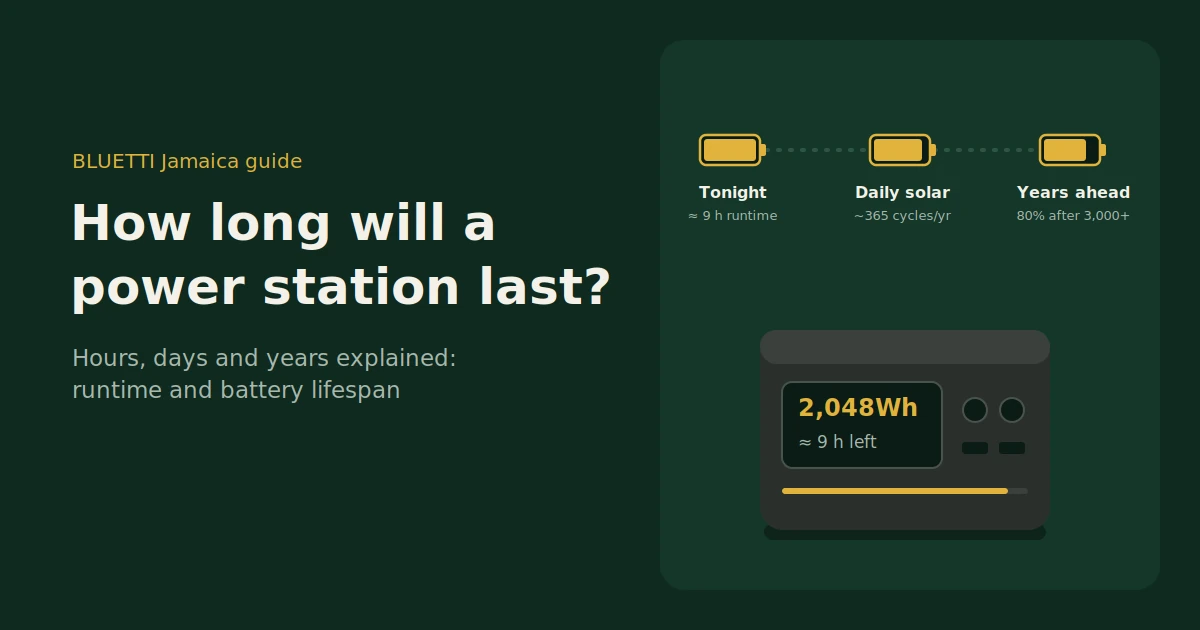
Example: a BLUETTI AC200L stores 2,048Wh. Running a 50W standing fan:
- 2,048 × 0.85 = about 1,740Wh of usable energy
- 1,740 ÷ 50 = about 35 hours
Add a TV and some lights, and the total load rises to around 200W. Now the same battery lasts about 8–9 hours. That’s why the appliances you choose during an outage matter as much as the battery size.
Runtime examples for Jamaican homes
A compact power station keeps a Wi-Fi router going through a typical outage. A mid-size unit covers a night of essentials. A large home-backup unit can run a fridge for more than a day. The table shows estimated runtimes for common outage setups.
| What you’re running | Typical draw | Elite 30 V2 (288Wh) | AC50B (448Wh) | AC200L (2,048Wh) | Apex 300 (2,764.8Wh) |
|---|---|---|---|---|---|
| Wi-Fi router and modem | 20 W | About 12 hours | About 19 hours | About 3.5 days | About 5 days |
| Fan, LED lights and phone charging | 80 W | About 3 hours | About 5 hours | About 22 hours | About 29 hours |
| Fridge (average over a day) | 60 W | About 4 hours | About 6 hours | About 29 hours | About 39 hours |
| Fan, TV and lights together | 200 W | About 1 hour | About 2 hours | About 9 hours | About 12 hours |
These are estimates. Real runtime varies with your appliances, the temperature and how much the fridge door is opened. Check the live wattage on your power station’s display to see exactly what your setup draws.
What drains a battery fastest: air conditioners, kettles, irons, microwaves and electric water heaters. Each draws 1,000W or more, so even a large power station runs them for only a short time.
Part 2: How long it lasts over the years
A power station’s lifespan is measured in charge cycles, not years. One cycle is using the equivalent of a full battery. The BLUETTI AC200L, for example, is rated for 3,000+ cycles before its capacity drops to 80% of the original, and some newer BLUETTI models are rated for 6,000+ cycles.
What “3,000 cycles to 80%” really means
It doesn’t mean the battery stops working after 3,000 cycles. It means that after around 3,000 full cycles, it should still hold about 80% of its original capacity. A 2,048Wh battery at 80% stores roughly 1,640Wh. You’d get a little less runtime, but it would still be very useful.
Partial use adds up gradually. Using 30% one night and 70% the next counts as one cycle in total.
What that means in years
How quickly you use up those cycles depends entirely on how you use the power station:
| Your usage | Roughly how many cycles a year | What it means for a 3,000-cycle battery |
|---|---|---|
| Backup for occasional JPS outages | 20–50 | Cycles are unlikely to be the limit for many years |
| Regular weekend or frequent outage use | 50–100 | Many years before cycles become a factor |
| Charged from solar and used every day | About 365 | Around 8 years before reaching 80% capacity |
For most backup users, cycles won’t be what retires the power station. Over a long enough time, ageing electronics and normal wear matter more. That’s why caring for it properly, covered next, makes such a difference.
Why LiFePO4 matters
Current BLUETTI power stations use LiFePO4 (lithium iron phosphate) batteries. This chemistry handles far more charge cycles than the lithium-ion batteries found in many older or budget power stations, and it’s more thermally stable. When comparing models, check the cycle rating on the spec sheet.
Jamaica’s climate and your battery
Heat is the main thing that shortens battery life, and Jamaican homes, cars and garages can get hot. BLUETTI rates the AC200L for charging between 0°C and 40°C and for operation up to 40°C. Keeping your power station inside that range is the single best thing you can do for it.
Where heat builds up:
- Parked cars. The inside of a car in the sun can get far hotter than the air outside. Never store a power station there.
- Rooms under zinc roofs. Upper rooms and outbuildings can trap heat through the afternoon.
- Direct sunlight. A unit sitting in a sunny window or on a veranda can heat up quickly, even on a mild day.
- Blocked vents. A power station pushed against a wall or covered with cloth can’t cool itself while charging.
Humidity and salt air near the coast are worth thinking about too. Keep your power station dry, off the floor if your area floods, and away from spray.
Care habits that add years
A few simple habits make the biggest difference: keep it cool and ventilated, store it at a moderate charge when you won’t need it for months, use it now and then, and avoid pushing it to its limits. None of them take more than a minute.
- Keep it cool. Use and store it indoors, in a shaded, ventilated room.
- Leave room around the vents. Give the fans space to move air, especially when charging.
- Store it at a moderate charge. For long-term storage, BLUETTI recommends keeping the battery around 40–60% and topping it up every 3–6 months.
- Keep it ready in hurricane season. From June to November, keep it charged so it’s ready for outages, then go back to moderate-charge storage if you won’t use it in the off-season.
- Use it occasionally. A regular charge and discharge helps you notice any problems early.
- Stay within the ratings. Avoid running appliances that push the power station to its maximum output for long periods.
- Charge from solar within its limits. Match your solar panels to the power station’s input range.
- Keep the firmware updated through the BLUETTI app.
Using solar every day: wear vs savings
Charging from solar panels every day and running your home from the battery each evening uses cycles faster. But every cycle is electricity you don’t buy from JPS, and a LiFePO4 battery is designed for exactly this. For many households, the savings outweigh the wear.
Think of it this way. Over its rated life, a 2,048Wh battery rated for 3,000 cycles can deliver several thousand kilowatt-hours of electricity. With solar in Jamaica, much of that comes from free sunshine. Compare it against your JPS tariff to see what it could save your household.
To get the best of both:
- Use partial cycles. You don’t need to drain the battery to empty every night. Shallower daily use is gentler and adds up more slowly.
- Size your solar system to match. Enough panels to refill the battery on a normal day keeps it from sitting empty.
- Choose quality panels. The best solar panels for daily use are efficient, durable in heat and salt air, and matched to your power station’s input range.
- Scale up if you need to. If you want to run more of your home every day, a larger battery spreads the cycling across more capacity, so each cell works less hard.
When it’s time for a new one
Most power stations don’t fail suddenly. They gradually hold less charge. If your runtime no longer covers what you need, or the unit shows physical damage, swelling or unusual heat, it’s time to look at a replacement. A battery at 70–80% capacity is often still useful as a secondary unit.
Signs your power station is ageing:
- The same appliances run for noticeably less time than they used to
- The battery percentage drops faster, especially near the end
- The unit gets warmer than usual during normal use
Stop using it and contact your seller if you see swelling, damage, smoke or a burning smell.
Also check your warranty. BLUETTI offers a 5-year warranty on models like the AC200L, so if a problem appears within that period, contact your seller with your proof of purchase.
FAQs
How long does a power station last on a full charge?
It depends on its capacity and what you run. Multiply the capacity in watt-hours by 0.85, then divide by your appliances’ total watts. A 2,048Wh unit runs a 50W fan for about 35 hours, or a fan, TV and lights together for about 8–9 hours.
How many years will a BLUETTI power station last?
BLUETTI’s LiFePO4 power stations are rated for thousands of charge cycles. The AC200L, for example, is rated for 3,000+ cycles to 80% capacity. With occasional use that’s many years; cycled daily, it’s around eight years before reaching 80% capacity.
Does a power station lose charge when it’s not being used?
Yes, slowly. That’s why BLUETTI recommends topping up a stored power station every 3–6 months, and keeping it charged and ready during hurricane season.
Is it bad to use my power station every day?
No. LiFePO4 batteries are designed for frequent cycling. Daily use wears the battery faster than occasional use, but it can still last many years, and daily solar charging can cut your JPS bill.
Can heat damage my power station?
Yes. High temperatures can shorten battery life and trigger the unit’s protection systems. Keep it in a cool, shaded, ventilated place, and never leave it in a parked car.
What warranty comes with a BLUETTI power station?
Many current BLUETTI power stations, including the AC200L, come with a 5-year warranty. Check the warranty for your specific model, and keep your proof of purchase.
Get a power station that goes the distance
The best power station is one that gets you through tonight’s outage and keeps doing it for years. Choose a LiFePO4 model sized for your home, keep it cool and charged sensibly, and add solar panels if you want it to earn its keep every day.
Browse BLUETTI power stations and solar panels at BLUETTI Jamaica, with local stock, island-wide delivery, and warranty and parts handled in Jamaica. Not sure which size is right for you? Tell our team what you need to power, and we’ll help you choose.