The power goes at 7pm. Your fridge is full and the freezer has a month’s worth of meat in it. Somewhere around hour four, this stops being an inconvenience and starts being money.
Choosing the best backup power for a refrigerator in Jamaica means picking between four genuinely different options a lithium power station, a petrol generator, an inverter and battery bank, or simply ice and discipline. They cost different amounts, last different lengths of time, and one of them kills about a hundred people a year in the US alone.
Here’s the honest comparison.
What’s the best backup power for a refrigerator in Jamaica?
For most households, a lithium power station in the 1,000–2,000Wh range. A fridge draws far less than people expect once you account for the compressor cycling, so that capacity covers an overnight outage comfortably and often a full day.
A generator wins on cost per hour and runs indefinitely with fuel. It also produces carbon monoxide, which is the reason this article spends a section on safety rather than treating the two as equivalent.
First, how much power does a fridge actually need?
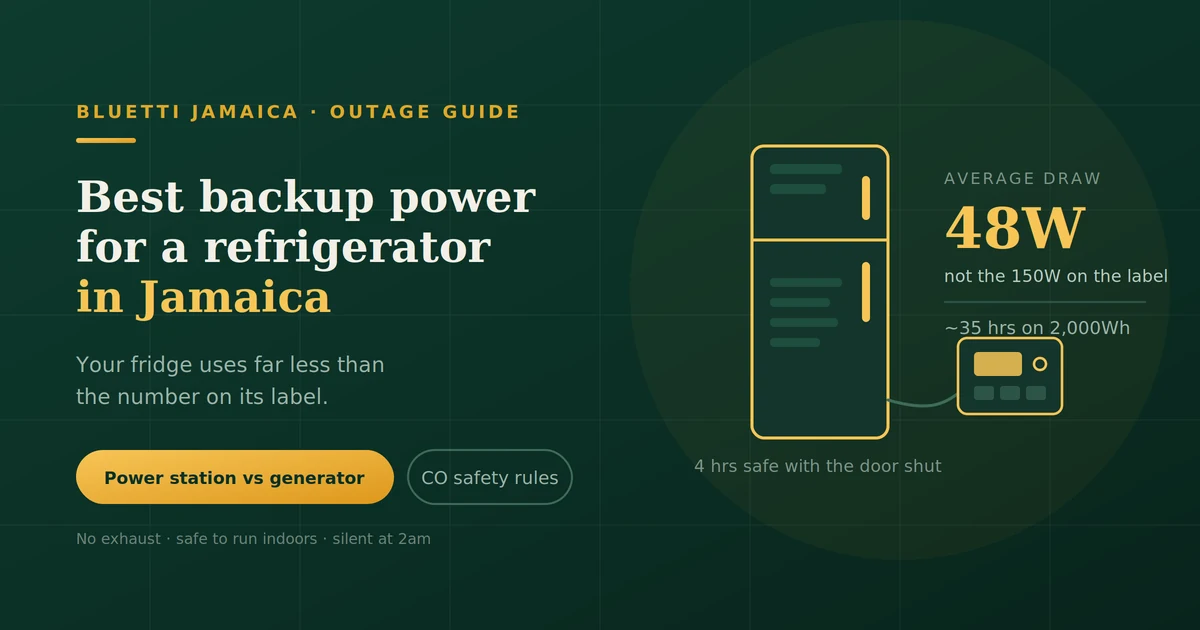
Less than the label suggests. A typical household fridge averages 40–65W over a day, even though the nameplate says 120–150W, because the compressor runs in cycles rather than continuously.
Why the nameplate misleads
Your fridge doesn’t run flat out. It cools to temperature, shuts off, and restarts when it drifts warm typically running 30–45% of the time, more in Jamaican heat and more if the door gets opened a lot.
So a 120W fridge at 40% duty averages 48W. Over 24 hours that’s roughly 1,150Wh, not the 2,880Wh the naive calculation gives. The method behind that is in our guide to calculating runtime properly if you want to work through your own numbers.
Surge the number that decides whether it starts
Separate check, and it stops everything if you get it wrong. A fridge compressor spikes on startup, often 3–5× its running draw. A 120W fridge can pull 600W for a second or two.
If that spike exceeds your backup’s surge rating, the fridge won’t start regardless of how much capacity sits behind it. Check this before anything else.
The four options compared
| Lithium power station | Petrol generator | Inverter + battery bank | Ice & discipline | |
|---|---|---|---|---|
| Upfront cost | Mid to high | Low to mid | High | Very low |
| Running cost | Electricity or solar | Ongoing fuel | Electricity or solar | Ice |
| Fridge runtime | 20–40 hrs per charge | Indefinite with fuel | Days, depending on bank | 4 hrs fridge / 48 hrs full freezer |
| Noise | Near-silent | Loud | Near-silent | Silent |
| Safe indoors | Yes | No, never | Yes (batteries need ventilation) | Yes |
| Refuelling during a storm | Not needed | Required, often when stations are down | Not needed | Ice may be unavailable |
| Maintenance | Minimal | Oil, filters, fuel stabiliser | Periodic | None |
| Install | Plug and play | Plug and play | Electrician required | None |
Be honest about the generator: per hour of fridge runtime, it’s the cheapest option, and it doesn’t stop when a battery empties. That’s a real advantage during a multi-day outage. The trade-offs are noise, fuel logistics, theft risk, and the safety issue below.
Carbon monoxide the part that matters most
Generator exhaust contains carbon monoxide: odourless, colourless, and capable of killing without warning. The CPSC estimates that around 100 people die each year in the US from CO poisoning associated with portable generators, and outages after hurricanes are exactly when it happens.
The dangerous misconception is that “outdoors enough” is enough. It isn’t.
CDC guidance: never run a generator inside a home or garage, even with doors and windows open. Use it outside, at least 20 feet from the house, with the exhaust directed away from doors, windows and vents.
Two findings worth knowing. A garage with the door open is still unsafe CO enters the attached house through gaps, vents and shared walls. And CDC testing found that nearly half of non-fatal CO poisonings during hurricanes involved generators used within about seven feet of a home.
If you do run a generator, do this:
- Site it 20 feet from the building, exhaust pointed away from every opening
- Never on a verandah, in a carport, or under the house
- Install battery-operated CO alarms outside sleeping areas they’re the only way to detect it
- Know the symptoms: headache, dizziness, weakness, nausea, sleepiness, confusion
- If anyone feels unwell, get outside first and seek medical help don’t investigate
A lithium power station produces no exhaust at all. It can sit in the kitchen beside the fridge. That isn’t a marketing line; it’s the single biggest practical difference between the two options, and it’s why battery backup suits households where siting a generator properly isn’t realistic.
Why battery backup suits Jamaican outages
Beyond the safety point, four practical advantages:
- No fuel queue. When JPS is down, stations often are too. A charged battery needs nothing.
- Silent at 2am. Generators are loud, and so is your neighbour’s.
- Nothing to steal. A generator running on the verandah overnight is visible and portable.
- No unattended combustion. You can sleep with it running.
The honest limits: capacity runs out, and refilling it depends on grid power returning or enough sun. A generator with fuel doesn’t have that problem. That’s the actual trade.
Sizing it for your fridge
Using 48W average adjust for your own fridge:
| Capacity | Fridge only | Fridge + lights, fans, Wi-Fi |
|---|---|---|
| 500Wh | ~9 hrs | ~4 hrs |
| 1,000Wh | ~18 hrs | ~9 hrs |
| 2,000Wh | ~35 hrs | ~18 hrs |
| 3,000Wh | ~53 hrs | ~27 hrs |
Planning estimates using roughly 85% usable capacity.
Fridge only, or fridge plus essentials?
Nobody runs only the fridge. In practice you’ll want lights, fans and Wi-Fi too, which roughly halves your runtime the right-hand column is the realistic one.
For an overnight outage, 1,000Wh covers essentials. For a full day, 2,000Wh. For a multi-day storm, you need solar or a generator, because no battery at a sensible price runs a fridge for a week.
Keeping the cold in the free half of the answer
This section costs you nothing and reduces how much backup you need to buy.
CDC figures: a refrigerator keeps food safe for up to 4 hours if you don’t open the door. A full freezer holds 48 hours; half-full, 24.
So a short outage needs no backup at all. What it needs is discipline.
Before hurricane season:
- Freeze water bottles and fill empty freezer space a full freezer holds cold far longer
- Keep a fridge thermometer inside, so you’re reading a number rather than guessing
- Turn both down to their coldest setting when a storm is forecast
During an outage:
- Keep the door shut. Decide what you need, then open once.
- Move fridge items into the freezer if you have space
- Block ice in the fridge extends it considerably
Do this and a 1,000Wh unit that looked marginal becomes comfortable.
Solar what it does and doesn’t solve
Jamaica gets roughly 5 peak sun hours, and panels realistically deliver 70–80% of their rating after heat, angle and cable losses.
- 400W array × 5 hrs × 0.75 = 1,500Wh per day
- 600W array × 5 hrs × 0.75 = 2,250Wh per day
A fridge needs around 1,150Wh a day. So 400W of panel keeps a fridge running indefinitely in good weather, with a little spare.
The catch is weather. Storm outages come with overcast days. If you’re harvesting 40% of normal for three days running, a 400W array falls behind. Size for the bad stretch, not the average one, and a small folding panel should be treated as a top-up rather than a recharge plan.
Food safety: when to throw it out
Worth knowing precisely, because guessing here makes people sick.
- Perishables meat, poultry, fish, eggs, leftovers should be discarded once the fridge has been above safe temperature for 4 hours or more
- Frozen food can be safely refrozen or cooked if it still contains ice crystals or is still cold to refrigerator temperature
- Thawed perishables in the freezer should be discarded
- When in doubt, throw it out
A cheap fridge thermometer removes the guesswork entirely and is the best few dollars you’ll spend on outage prep.
Which option suits which household
Lithium power station apartments, anywhere you can’t site a generator 20 feet away, households that lose power for hours rather than days, and anyone who’d rather not manage fuel. Plug and play.
Generator houses with a yard and a safe siting spot, frequent multi-day outages, and buyers prioritising running cost over convenience. Requires CO alarms and discipline.
Inverter and battery bank households wanting whole-house backup and willing to pay for installation. Best long-term answer, highest cost, needs an electrician.
Ice and discipline short outages, tight budgets, and as a supplement to everything above. Always worth doing.
FAQs
How long will a power station run a fridge?
Roughly 18 hours on 1,000Wh and 35 hours on 2,000Wh, based on a fridge averaging about 48W. Running lights and fans alongside it roughly halves that.
Can I run a fridge on a generator safely?
Yes, if the generator is outdoors at least 20 feet from the house with exhaust directed away from doors, windows and vents, and you have battery-operated CO alarms inside. Never in a garage, carport or verandah.
How much does it cost to back up a fridge?
It depends on the option. A generator is cheapest upfront with ongoing fuel costs; a power station costs more initially with no running cost; an inverter and battery bank is the most expensive and the most capable.
Will a solar panel keep my fridge running?
Around 400W of panel can keep pace with a typical fridge in good Jamaican sun. Consecutive overcast days during a storm are where it falls behind.
How long does food last without power?
A closed fridge keeps food safe for up to 4 hours. A full freezer holds 48 hours, half-full 24. Keep the doors shut.
Do I need an electrician?
Not for a portable power station you plug the fridge straight into it. An inverter and battery bank installation does require one.
Will my fridge start on a small unit?
Only if the surge rating covers the compressor’s startup spike, which can be 3–5× the running draw. Check surge separately from capacity.
Get your own fridge sized properly
Take the nameplate figure off the back of your fridge, decide how long you need to stay running, and the answer usually turns out to be less capacity than people expect.
Send us those details and we’ll size it honestly including telling you when a generator suits your situation better, or when ice and a closed door would get you through. The range is at BLUETTI Jamaica.