On the night of 5 June 2026, the whole island went dark at once. Most people had power back within hours. Eight months earlier, after Melissa, plenty of households waited weeks. Those two events are the reason you’re comparing a portable power station vs inverter for home backup and they point to different answers, because a few hours and a few weeks are not the same problem.
Power Station vs Inverter for Home Backup in Jamaica
Get that distinction right and the choice becomes straightforward. Get it wrong and you either overspend on a system you rarely need, or discover during the next storm that your backup ran flat on night two.
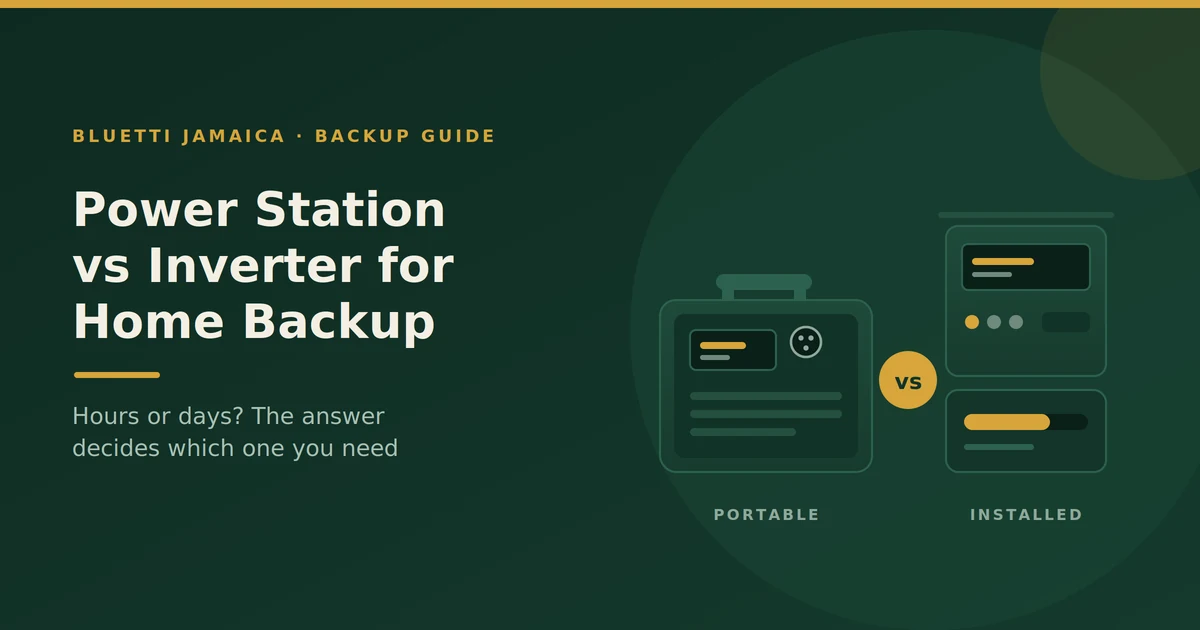
The short answer: it depends on how long you need to last
A portable power station suits short outages and a handful of essential appliances fridge, fans, lights, phones, router with no installation required. An installed inverter and battery system suits whole-home backup and long outages, switches over automatically, and can be recharged by solar. Duration is the deciding factor, not price.
First, what people actually mean by “inverter” in Jamaica
Before comparing anything, it’s worth separating three products that all get called “an inverter” in conversation. They’re not the same thing, and mixing them up is how people end up with the wrong equipment.
An inverter and battery system
Batteries plus an inverter, wired into your house by an electrician, usually powering selected circuits rather than everything. When JPS drops, it takes over often fast enough that you barely notice. Recharges from the grid when power returns.
A hybrid solar inverter
The same idea, built to accept solar panels as well as grid power. It can charge the batteries from the sun, which is what matters when the grid is down for days rather than hours. If you’re planning a solar system in Jamaica for both bill reduction and backup, this is the category you’re in.
An inverter generator
A fuel generator with electronics that produce cleaner power than an old-style unit. Despite the shared word, it’s a different category entirely it makes power by burning petrol, not by storing it.
When the rest of this article says “inverter system,” it means the first two.
What a portable power station actually is
A portable power station is a battery, an inverter and a charger in a single box with sockets on the front. No installation, no electrician, no wiring you plug it in, charge it, and plug appliances into it during an outage. Think of it as a very large, very quiet rechargeable battery for your house.
The appeal in Jamaica is obvious: it works the day it arrives, it makes no noise, produces no fumes, and if you move house it comes with you.
The two numbers that matter
Buyers get this wrong constantly, so it’s worth being precise.
- Watts (W) tells you what you can run at once. A 1,000W unit can’t start a 1,500W appliance, no matter how big its battery.
- Watt-hours (Wh) tells you how long you can run it. A 2,000Wh battery running 200W of load lasts roughly ten hours, minus conversion losses.
A worked example for a typical Jamaican household. A modern fridge doesn’t draw power continuously it cycles and typically uses somewhere around 1 to 1.5 kWh across a day. Two fans overnight at 50W each for ten hours is another 1 kWh. LED lights, a router and phone charging might add 0.5 kWh. That’s roughly 2.5 to 3 kWh, or 2,500–3,000Wh, to get a household through a night comfortably.
Note what isn’t on that list: air conditioning and electric water heating. Both are large loads that will empty most portable units quickly.
Portable power station vs inverter system vs generator
The generator belongs in this comparison because it’s what most Jamaican households already own or have considered. Ignoring it would be dishonest.
| Portable power station | Installed inverter + battery | Petrol generator | |
|---|---|---|---|
| Installation | None — use it immediately | Electrician required | None, but needs safe siting |
| Switchover | Manual — you plug things in | Automatic, near-instant | Manual start |
| Typical backup | Hours to a night | A day or more, sized to suit | As long as fuel lasts |
| What it runs | Selected appliances you plug in | Selected house circuits | Whatever it’s sized for |
| Recharging in a long outage | Solar panels | Solar panels | Fuel if you can buy it |
| Noise | Silent | Silent | Loud |
| Fumes and safety | None | None | Carbon monoxide risk outdoor use only |
| Portability | Carry it anywhere | Fixed | Heavy but movable |
| Running cost | Negligible | Negligible | Ongoing fuel and servicing |
| Upfront cost | Lowest of the three for real capacity | Highest | Low |
Where the generator still wins: raw output for the money, and the ability to run heavy loads like air conditioning. If you need to power a whole house including AC through a long outage and you can reliably get fuel, a generator does that for less upfront than an equivalent battery system.
Why households are still moving away from it: fuel is the weak link. Precisely when you need a generator most after a major storm is when stations are closed, queues are long, and supply is uncertain. Add the noise, the servicing, the fumes and the carbon monoxide risk, and the calculation looks different than it does on a showroom floor. Never run a generator indoors, in a garage, or under a closed veranda.
Which one fits your outage?
This is the section that should decide your purchase.
A few hours the ordinary JPS outage. A portable power station covers this comfortably. Fridge stays cold, fans run, phones charge, the router keeps the household online. Nothing gets installed, nothing gets started. The June 2026 island-wide blackout was this kind of event for most people: power was out overnight and back for the large majority of customers within hours.
A day or two a storm passes, localised damage. You now need recharging, because the grid isn’t coming back on your schedule. A power station paired with solar panels handles this well: run at night, recharge by day. A modest inverter system does the same job with more capacity and automatic switchover.
A week or more a Melissa-scale event. Be realistic here. Hurricane Melissa struck as a Category 5 in late October 2025, caused damage in the billions, and the restoration effort ran for months with international assistance. In that situation nothing recharges from the grid, and fuel supply is unreliable. Only a properly sized inverter system with solar recharging keeps a household running through it and even then, you’re running essentials, not living normally.
Most Jamaican households are honestly buying for the first two scenarios and hoping they’re covered for the third. Naming which one you’re buying for prevents disappointment.
Running costs and the maths people skip
Upfront price is the wrong comparison. A generator is cheapest to buy and most expensive to keep; a battery system is the reverse.
Over a five-year horizon, factor in:
- Fuel, at crisis prices, during exactly the weeks you’re using it most
- Servicing oil, filters, plugs, and the cost of a unit that’s been sitting unused for eight months refusing to start
- Replacement generators wear; batteries degrade. Both have a lifespan, but a LiFePO4 battery’s is typically measured in thousands of cycles
- The things that don’t show on an invoice noise at 2am, fumes near an open window, and the safety risk of a machine that has to sit outdoors in the rain
Adding solar to either option
Solar is what converts backup into something sustainable, and it works with both options. This is where the solar panels question actually belongs in a backup conversation.
How many panels do you need?
Match panel wattage to what you’re trying to replace each day. If your household uses about 3 kWh overnight, you need panels capable of putting roughly that back during daylight allowing for cloud, angle, and the fact that no panel produces its rated output all day. In practice that means several hundred watts of panels for a power station, and considerably more for a whole-home inverter system.
Jamaica’s sun makes this more workable than in most markets. Long daylight hours and high irradiance mean panels here recover a useful amount even on a mixed day.
Choosing panels: what matters more than the brand
The “best solar panels” question usually gets answered with a brand league table. On a Jamaican roof, three things matter more:
- Wind rating and mounting. Hurricane-force wind loading is the real test, and mounting quality matters as much as the panel itself.
- Salt-air corrosion resistance, if you’re anywhere near the coast frame and mounting hardware fail before cells do.
- Warranty and who honours it locally. A 25-year warranty is worth what the local support behind it is worth.
Net billing and JPS: backup is not the same as grid-tied solar
Worth being clear about, because people conflate the two. A backup system stores power for your own use. Grid-tied solar under Jamaica’s net billing arrangement exports surplus to JPS and earns credits, which requires a licence and an approved installation. A portable power station charged from panels does not automatically make you a net billing participant.
Sizing it for a Jamaican home
Start with a list of what genuinely has to keep running, not what you’d like to keep running.
Essentials for most households:
- Fridge or freezer roughly 1–1.5 kWh per day
- Two or three fans around 50W each while running
- LED lighting small, but constant
- Router and phone charging minimal, and the first thing people miss
That’s the 2.5–3 kWh a day figure from earlier, which points toward a power station in the 2,000–3,000Wh range for overnight coverage, or more if you want two nights without sun.
What surprises people:
- Air conditioning. A window unit is a large continuous load. Running one overnight requires substantially more capacity than most portable units hold.
- Electric water heating. A heavy load that will empty a battery fast. Most households simply do without during an outage.
- Well pumps. High starting surge check the surge rating, not just the continuous output.
Buying and installing in Jamaica
A few local realities.
What needs an electrician. A portable power station doesn’t you plug into it directly. An inverter system wired into your house panel does, and it should be done by a licensed electrician who understands transfer switching. Backfeeding the grid during an outage is dangerous to line workers and is not a corner to cut.
Duties, GCT and landed cost. An imported unit’s advertised price is not its landed price. Buying locally means the duty and GCT are already handled and you know what you’re paying.
Warranty support matters more here. A battery unit is a serviceable product. If the nearest support is overseas, a fault means shipping a heavy item off the island at your own cost. Ask who handles warranty claims before you buy, not after.
Timing. Availability and pricing tighten as soon as a storm is named. The cheapest time to buy backup power is a quiet week in March, not the day a system enters the Caribbean.
You can see the current range at BLUETTI Jamaica.
FAQs
Can a portable power station run a refrigerator?
Yes. Most fridges draw a manageable running wattage and cycle on and off, using roughly 1–1.5 kWh a day. Check the unit’s surge rating too, since a compressor draws extra power at start-up.
How long will a power station last during a blackout?
Divide its watt-hours by your load in watts, then allow for conversion losses. A 2,000Wh unit running about 200W of essentials lasts roughly eight to ten hours a night, not a week, unless you recharge it with solar.
Do I need an electrician to install an inverter system?
Yes. An inverter and battery system wired into your house panel needs a licensed electrician, including proper transfer switching so power can’t feed back to the grid during an outage. A portable power station needs no installation at all.
Is a power station better than a generator in Jamaica?
For short outages, usually it’s silent, fume-free, needs no fuel and starts instantly. For long outages with heavy loads like AC, a generator delivers more output, provided you can get fuel when it matters.
Is a power station better than a generator in Jamaica?
For short outages, usually it’s silent, fume-free, needs no fuel and starts instantly. For long outages with heavy loads like AC, a generator delivers more output, provided you can get fuel when it matters.
Can I charge a power station with solar panels?
Yes, most support solar input directly. This is what extends it from one night to indefinite use, and it’s the single most valuable addition for hurricane season.
What size inverter do I need for a 3-bedroom house?
It depends on which circuits you’re backing up, not the number of bedrooms. Essentials only might need a few kilowatts of inverter output and several kWh of battery; including air conditioning changes the answer substantially.
Will a backup system lower my JPS bill?
Only if it’s solar-charged and you’re using that power instead of grid power. A battery charged from the grid shifts when you use power, it doesn’t reduce how much you buy.
The bottom line
Decide how long you need to last, then buy for that.
For the ordinary outage and the occasional island-wide event, a portable power station does the job with no installation, no noise and no fuel and pairing it with panels turns one night of backup into as many as you need. For whole-home coverage, automatic switchover and genuine multi-day resilience, an inverter system with solar is the serious answer, and it costs accordingly.
The wrong choice is buying a small unit while quietly expecting Melissa-level performance from it.