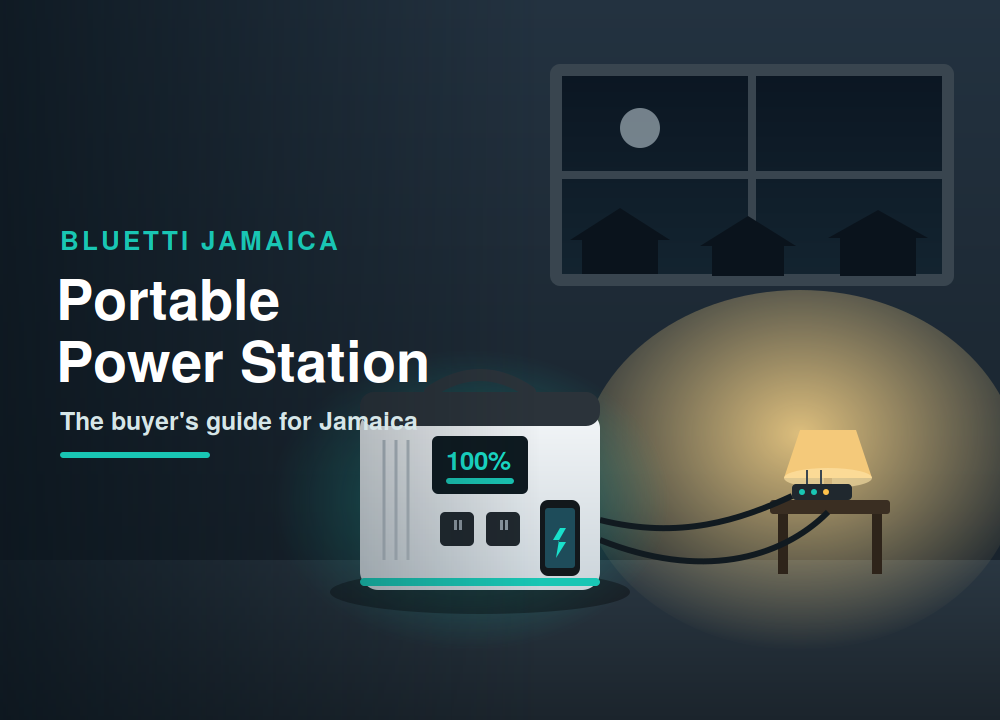
The light cuts out. Within an hour the fridge is warming, the router’s dead, phones are dropping to red, and the fan’s stopped in the heat. If that’s a familiar routine, a portable power station is the fix a quiet, fume-free battery that keeps your essentials running when JPS can’t. No fuel runs, no engine noise, no waiting.
This guide covers everything you need to choose the right one: what a portable power station actually does, what it can run and for how long, what size you need, whether solar is worth it here, what to spend, and how it stacks up against a generator. Straight answers, built for Jamaican conditions.
What is a portable power station and do you need one?
A portable power station is a large rechargeable battery with built-in outlets AC sockets, USB ports, and DC outputs that stores electricity and delivers it on demand, silently and without fumes. You need one if you face regular outages, want backup for essential devices, or need power away from the grid. If you only ever lose power for minutes at a time, you may not.
It earns its place in clear situations:
- Outage-prone homes — keep the fridge, fan, lights, router, and phones going through a cut
- Campers and outdoor users — power for trips, the beach, or the yard
- Remote and mobile workers — run a laptop and Wi-Fi anywhere
- Small businesses — keep a till, router, or key equipment alive during downtime
- Medical needs — reliable backup for devices like a CPAP machine
If your power is rock-solid and you never venture off-grid, the value is lower. For most Jamaican households, though, the question isn’t if the power will cut it’s when.
How does a portable power station work?
Inside is a rechargeable battery, an inverter that converts the stored DC power into the AC electricity your appliances use, and a set of output ports. You charge it from a wall socket, solar panels, or your car, then plug your devices straight in. That’s the whole operation no wiring, no installation, no fuel.
When fully charged, it sits quietly until you need it. Plug in a device and it draws power instantly; many models also act as a backup that switches on automatically the moment the grid drops.
What can you run on a portable power station?
That depends on the unit’s capacity (watt-hours) and output (watts), but a mid-sized station will comfortably run everyday essentials phones, laptops, a router, lights, a fan, a TV, and even a fridge for a stretch. Bigger units run more, for longer. Here’s a rough guide.
| Device | Typical power draw | Approx. runtime on a 1,000Wh station |
|---|---|---|
| Smartphone charge | ~10–20W | 40+ full charges |
| Wi-Fi router | ~10W | 3–4 days |
| Laptop | ~50W | 15+ hours |
| LED lights / fan | ~20–60W | 15–40 hours |
| TV | ~100W | 8–9 hours |
| Refrigerator | ~150W (cycles on/off) | Roughly a day (varies) |
Two things affect real runtime: how many devices you run at once, and whether the unit can supply enough output (watts) for their combined draw.
What size portable power station do you need?
Size by two numbers: capacity in watt-hours (how much energy it stores) and output in watts (how much it can deliver at once). Match capacity to how long you need power, and output to the biggest thing you’ll run. Most homes wanting essential-device backup land in the 500–2,000Wh range.
Understanding watts (W) vs watt-hours (Wh)
- Watts (W) = how much power a device pulls, and the maximum a station can deliver at any moment. If your devices together draw more watts than the unit’s output rating, it can’t run them no matter how big the battery.
- Watt-hours (Wh) = how much energy is stored, which sets runtime. A 1,000Wh station running a 100W TV lasts roughly 10 hours (minus some efficiency loss).
Get both right: enough watts to power the device, enough watt-hours to run it as long as you need.
Matching size to your needs
- Small (under ~500Wh): phones, laptops, lights, router — day trips and light backup
- Medium (~500–1,500Wh): the above plus a fan, TV, and a fridge for a while — solid home outage backup
- Large (~2,000Wh+, often expandable): whole-room or multi-appliance backup, longer outages, off-grid living
Solar portable power stations worth it in Jamaica?
For Jamaica, yes a solar-capable portable power station makes strong sense. With abundant sunshine most of the year, pairing a power station with solar panels lets you recharge for free, extend backup indefinitely during long outages, and cut reliance on both JPS and fuel. It turns a battery that eventually runs flat into a system that keeps topping itself up.
The appeal is simple: during a multi-day outage, a wall-charged station eventually empties, but a solar-charged one refills every sunny day. Look for a unit that accepts a good solar input and pair it with panels sized to your needs. It’s the closest thing to energy independence without a full rooftop installation and a natural fit for a sun-rich island.
What to look for when buying
Prioritise battery type, output and surge rating, recharge options, and warranty. A LiFePO₄ battery, enough output for your appliances, fast and flexible charging, and a solid warranty separate a unit you’ll rely on for years from one that disappoints.
Key things to check:
- LiFePO₄ (LFP) battery — the safest, longest-lasting chemistry, often rated for thousands of cycles
- Continuous output and surge — enough watts for your devices, with surge headroom for appliances that spike on start-up
- Ports — the right mix of AC outlets, USB-C/USB-A, and DC for your gear
- Recharge speed and options — AC, solar, and car charging; fast AC charging is a real convenience
- UPS / fast switchover — for sensitive gear like a router or CPAP, so it keeps running the instant the grid drops
- App control and warranty — remote monitoring and a multi-year warranty for peace of mind
For a range built around exactly these features, browse the portable power stations at Bluetti Jamaica or ask the team what suits your home.
How much does a portable power station cost in Jamaica?
Prices scale with capacity and features, from smaller units for device charging up to large expandable systems for whole-home backup. The right spend depends on what you need to run and for how long. Below is a general guide to the tiers.
| Tier | Capacity | Typical uses | Best for |
|---|---|---|---|
| Small | Under ~500Wh | Phones, laptops, lights, router | Day trips, light backup |
| Mid-range | ~500–1,500Wh | Fridge (a while), fan, TV, essentials | Everyday home outage backup |
| Large | ~2,000Wh+ | Multiple appliances, longer outages | Serious backup, off-grid |
| With solar | Any + panels | Recharge for free, extended outages | Sun-powered independence |
A quick note on “cheap”: the lowest-priced units often skip LiFePO₄ or cut output and warranty. Since a power station is something you’ll lean on during an emergency, reliability matters more than saving a little upfront.
Portable power station vs generator
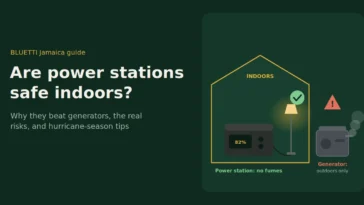
A portable power station is quiet, fume-free, safe indoors, and maintenance-free; a generator delivers more sustained high power and refuels instantly but is noisy, needs fuel and upkeep, and can’t run indoors. For most home backup in Jamaica, a power station (ideally with solar) is the more practical, liveable choice.
| Factor | Portable power station | Generator |
|---|---|---|
| Noise | Silent | Loud |
| Fumes / indoor use | Clean, safe indoors | Fumes, outdoor only |
| Fuel | None (electric/solar) | Petrol/diesel required |
| Maintenance | Minimal | Regular servicing |
| Running cost | Very low (free with solar) | Ongoing fuel cost |
| Sustained heavy load | Limited by capacity | Strong, as long as fuel lasts |
Generators still win for running heavy loads for many hours straight. But for keeping a household’s essentials alive quietly through an outage especially overnight or indoors a power station is hard to beat.
Common mistakes to avoid
A few missteps trip people up:
- Undersizing capacity: buying too small and running flat mid-outage
- Ignoring output (watts): a big battery still can’t run an appliance that exceeds its output rating
- Choosing non-LiFePO₄ units: shorter lifespan and lower safety to save a little money
- Overlooking solar: missing the free-recharge advantage that makes so much sense here
- No UPS for sensitive gear: a router or medical device that blinks off when the grid drops needs fast switchover
FAQs
What size power station do I need to run a fridge?
A mid-sized unit of around 1,000–1,500Wh with enough output (a fridge can surge on start-up) will typically run a household fridge for roughly a day, since it cycles on and off rather than drawing constantly. Check both the running and surge wattage of your fridge.
Can a portable power station power a whole house?
A large, expandable system can back up much of a home’s essential load, but running an entire house including heavy appliances for long periods usually needs a bigger home battery system. For most people, a power station covers the essentials that matter most during an outage.
How long do portable power stations last?
Units with LiFePO₄ batteries are commonly rated for thousands of charge cycles often enough for 10 years or more of regular use. Cheaper chemistries wear out faster, which is why battery type matters.
Can I charge a portable power station with solar?
Yes most quality units accept solar input, and in sunny Jamaica that lets you recharge for free and keep power going through extended outages. You’ll need compatible solar panels sized to the unit.
Portable power station vs generator which is better?
For quiet, clean, indoor-safe backup of your essentials, a power station wins. For running heavy loads continuously for many hours, a generator still has the edge. Many people find a solar-capable power station covers their real needs without the noise and fuel.
Are portable power stations safe to use indoors?
Yes. Unlike fuel generators, they produce no fumes and run silently, so they’re safe to use inside the home a major advantage during overnight outages.
What’s the difference between watts and watt-hours?
Watts measure how much power a device needs and how much the station can supply at once; watt-hours measure how much energy is stored, which sets how long it runs. You need enough of both.
Ready to keep the power on?
The next outage is coming the only question is whether you’ll be ready for it. A portable power station gives you quiet, reliable backup for your essentials, and with solar, near-endless runtime under the Jamaican sun. Browse the range of portable power stations at Bluetti Jamaica, or get in touch and we’ll help you match the right size and setup to your home.