Three days after the storm. The grid is still down, your power station is at 30%, and the sky has been the colour of concrete since Tuesday. That’s the moment people find out whether solar panels can charge a power station on a cloudy day and the honest answer is yes, considerably slower, and with one technical catch that makes some setups stop charging entirely when they don’t have to.
Can Solar Panels Charge a Power Station on Cloudy Days?
That catch is the useful part of this article. Most people can improve their bad-weather charging substantially without buying anything.
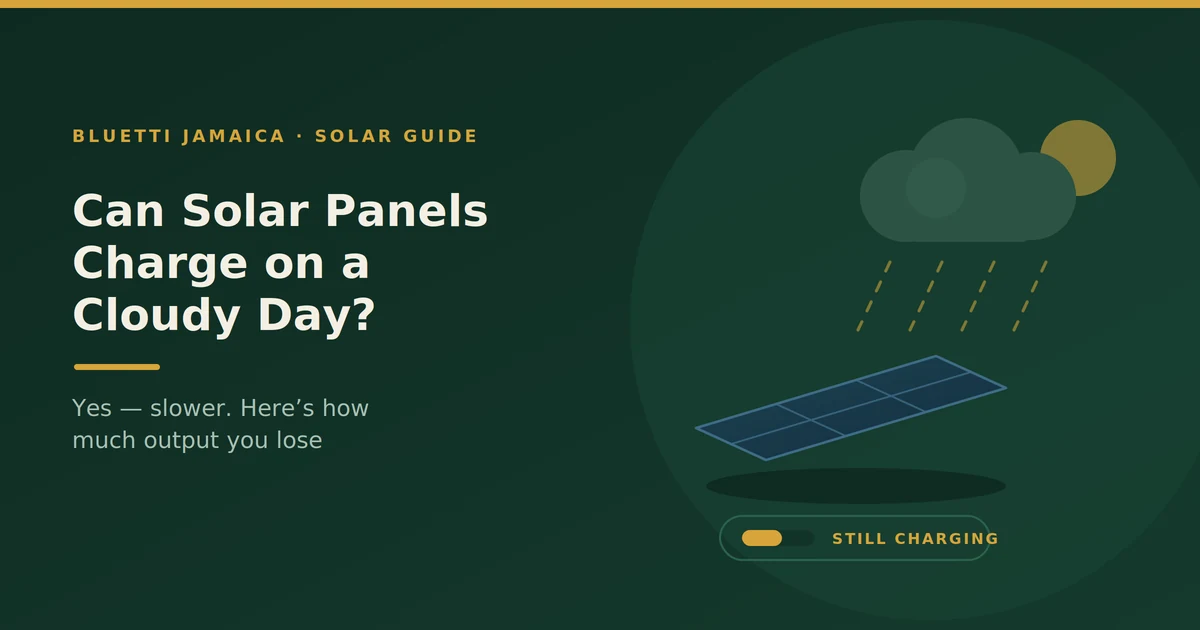
The short answer: yes, at a fraction of rated output
Solar panels generate from diffuse light, so they keep producing when the sun is hidden. On a partly cloudy day expect roughly 50–80% of rated output. Under heavy overcast, closer to 10–25%. In rain, around 10–20%. Slower, but spread across six or seven daylight hours it still adds up to real charge.
The mistake is treating a grey day as zero. It isn’t zero it’s a slower tap.
Why panels still work without direct sun
Sunlight reaches you two ways. Direct radiation travels straight from the sun and casts sharp shadows. Diffuse radiation is light scattered by clouds, water vapour and dust, arriving from across the whole sky.
Panels convert both. A photon is a photon whether it came straight from the sun or bounced off a cloud first the cell responds to how many photons land on it, not which direction they came from. On a clear day roughly 70–80% of the energy arrives as direct light. On an overcast day it’s all diffuse, and there’s simply less of it.
To put a number on “less”: a bright overcast sky, the kind where you can’t see the sun but the whole sky glows, still delivers somewhere around 300–500 W/m². That’s enough for a 410W panel to produce roughly 125–205W. Not a rounding error that’s real charge going into your unit.
The number on the box is a laboratory figure
Worth knowing before you judge cloudy-day performance. A panel’s rating is measured under standard test conditions a specific irradiance and cell temperature that rarely occur in the real world.
In Jamaica, one factor works against you even on a perfect day: heat. Panel output falls as cell temperature rises, and a black panel in full Caribbean sun runs far hotter than the lab standard. So a 200W panel producing 160W at midday in clear conditions isn’t faulty. It’s normal.
The edge-of-cloud effect
Here’s the counterintuitive one. On a partly cloudy day, when the sun breaks out from behind a cloud edge, reflected light off the cloud adds to the direct beam and irradiance can briefly exceed clear-sky levels.
That’s why broken cloud performs better than people expect, and why a day of sun-and-shower patterns is a genuinely good charging day in Jamaica. Don’t write off a showery day.
How much output do you actually lose?
| Sky condition | Share of rated output | A 200W panel delivers | Hours to add 1kWh | Verdict |
|---|---|---|---|---|
| Clear sky | 75–90% (heat losses) | 150–180W | ~6 hours | Full charging day |
| Light haze / bright overcast | 50–70% | 100–140W | 7–10 hours | Still a good day |
| Partly cloudy, broken sun | 50–80%, with spikes | 100–160W | 6–10 hours | Better than it looks |
| Heavy overcast | 10–25% | 20–50W | Not achievable in one day | Trickle only |
| Storm cloud | 18–60% of clear-sky | Highly variable | Variable | Take what you get |
| Rain | 10–20% | 20–40W | Not achievable in one day | Minimal, but not nil |
Two things the table can’t show you.
Judge by watt-hours, not watts. The number that matters is what accumulated across the whole day, not what the display showed at noon. A steady 60W for seven hours is 420Wh enough to run a fridge for a good part of a day.
Jamaica’s baseline is high. These percentages are of your clear-sky maximum, and a Caribbean clear-sky maximum is well above what a temperate country gets. An overcast day here often out-produces a bright day in a northern winter. Germany runs one of the world’s largest solar fleets on far less light than you have on a bad day.
The thing that actually stops charging: start-up voltage
This is the section nobody writes, and it’s the reason people conclude their panels have failed.
Your power station charges through an MPPT controller, and that controller needs a minimum input voltage before it will begin charging at all. Below that threshold it doesn’t trickle it simply doesn’t start. So in dim conditions you can have panels producing genuine power and a display showing zero watts coming in.
The panel isn’t broken. The controller hasn’t woken up.
Series vs parallel wiring in low light
This is the single most actionable thing in this article.
- Panels in series add their voltages together while current stays the same. Two 18V panels wired in series give roughly 36V.
- Panels in parallel add their currents while voltage stays the same. Two 18V panels in parallel still give roughly 18V.
In low light, voltage sags. A parallel setup that comfortably clears the threshold on a sunny day can drop below it under heavy cloud and stop charging entirely. A series setup starts from a higher voltage, so it stays above the threshold in conditions where parallel gives up.
If bad-weather charging is why you bought panels and in Jamaica it is series wiring is usually the better choice.
One important caveat: every power station has a maximum input voltage as well as a minimum. Exceeding it can damage the unit. Check your model’s open-circuit voltage limit before wiring panels in series, and account for the fact that voltage rises in cold conditions.
When it’s charging nothing at all
Work through this list before assuming a fault:
- Shading. Even a small shadow across one panel can collapse output disproportionately. Check for a pole, a cable, a leaf, a roof edge.
- Below start-up voltage. Covered above most common in heavy overcast with parallel wiring.
- Cable length and gauge. Long, thin cables cost you voltage before it reaches the unit.
- Connector mismatch. MC4 connectors and adapters need to match your input port properly.
- Dirty panels. Saharan dust events and salt film both reduce output more than people expect.
- Input limits. Some units cap solar input below what your array can deliver.
Getting more out of grey days
In order of how much difference it makes.
1. Oversize the array. The honest recommendation. If you need 400W of input on a bad day, fit enough panels to produce that at 20% of rated which means considerably more panel than the sunny-day maths suggests. Panels are the cheapest component in a solar backup setup, and the one that costs least to add.
2. Eliminate shading first. Partial shade costs you more than cloud does. Before buying another panel, move the one you have.
3. Rethink the angle. Under heavy overcast, light arrives from the entire sky rather than from the sun’s position. Measurements in overcast conditions have found horizontal orientation producing significantly more than pointing panels directly at where the sun should be. On a grey day, an unobstructed view of the whole sky beats a clever angle.
4. Keep them clean. Dust, salt film and bird mess all cut output. One bonus: rain does a reasonable job of washing panels, so a shower often leaves you better off than before it.
5. Harvest the bright gaps. Wet-season weather in Jamaica is rarely uniformly grey all day. Those bright spells between showers are worth far more than their duration suggests have panels deployed and connected so you catch them.
What this means in wet season and after a storm
Two Jamaican realities to plan around.
Wet season isn’t a wall of grey. It’s typically bright mornings, heavy afternoon showers, and clearing evenings. That pattern charges better than a solid overcast day, provided you’re set up to take advantage of it rather than packing panels away between showers.
After a hurricane, the sun is what you still have. The grid is what’s gone, sometimes for weeks. Research tracking PV during a hurricane found heavy cloud reduced output to roughly 18–60% of clear-sky levels reduced, not eliminated. Meanwhile, fuel supply for a generator is the thing that becomes unreliable.
That’s the real argument for panels: they’re the only recharging method that doesn’t depend on a supply chain working.
Size for the worst week, not the best day
The planning principle that prevents disappointment:
- Work out your essential daily load fridge, fans, lights, router, phone charging usually lands around 2–3 kWh.
- Decide how many consecutive bad-weather days you need to survive.
- Size the array against a poor-weather day, not a clear one.
If you size for a sunny day, your system works beautifully right up until the week you actually need it.
Choosing panels that perform in low light
This is where the “best solar panels” question genuinely matters, and the answer isn’t a brand ranking.
Panel type. Monocrystalline is more efficient than polycrystalline, and PERC cells also perform well in low-light conditions. For a setup that has to earn its keep on grey days, that difference is worth paying for.
Jamaican-specific factors that matter more than a spec sheet:
- Wind rating and mounting for hurricane-force conditions, if the panels are fixed
- Salt-air corrosion resistance near the coast frames and hardware fail long before cells do
- Heat tolerance, since output drops as panels get hotter and they get very hot here
Portable folding panels or fixed panels?
For power station owners specifically:
Folding portable panels can be repositioned through the day, brought inside before a storm, taken with you, and angled by hand. That flexibility is worth a lot in variable weather.
Fixed panels produce more consistently, need no daily handling, and suit a permanent installation but they stay out in the weather, which in hurricane season is a real consideration.
Plenty of households sensibly run both: a fixed array for daily charging and a folding panel that comes out when they need to chase light.
FAQs
Do solar panels work on cloudy days?
Yes. They generate from diffuse light, producing roughly 50–80% of rated output under partly cloudy skies and about 10–25% under heavy overcast. Less than full sun, but far from nothing.
How long does it take to charge a power station in cloudy weather?
Roughly three to five times longer than in clear conditions. A 200W panel that adds 1kWh in about six sunny hours may take most of a day, or more, under thick cloud.
Will solar panels charge in the rain?
A little usually 10–20% of rated output. Rain also washes dust and salt off the panels, so output often improves once it clears.
Do I need more panels for Jamaica’s wet season?
If you rely on solar to recharge during outages, yes. Sizing against a poor-weather day rather than a clear one is what keeps the system useful when you actually need it.
Why is my power station showing no solar input at all?
Most often shading, or input voltage below the controller’s start-up threshold. Check for shadows first, then consider wiring panels in series to raise voltage staying within your unit’s maximum input limit.
Are portable solar panels worth it for hurricane season?
Yes, particularly because they can be brought inside before a storm and redeployed immediately afterwards, when the grid is down and fuel is hard to get.
Does panel type matter for cloudy performance?
Somewhat. Monocrystalline and PERC cells handle low light better than older polycrystalline panels, which matters if bad-weather charging is the reason you’re buying.
The bottom line
Cloudy days don’t stop solar charging they slow it, and the slowdown is measurable rather than mysterious. Expect half to three-quarters of rated output under broken cloud, a fifth or less under heavy overcast, and plan your panel capacity around the bad days rather than the good ones.
If your system stops charging entirely when the sky darkens, that’s usually a wiring or shading problem, not a weather problem. Series wiring and a clear view of the sky solve more grey-day complaints than extra panels do.