
The power goes out ten minutes into the match. Or halfway through the evening news, or in the middle of the film the kids have been waiting for all week.
Can a Portable Power Station Run a TV in an Outage?
Yes, comfortably a modern TV is one of the easier things to run. The more useful question, and the one this article actually answers, is what else you can keep running at the same time.
The short answer
Yes. A modern LED TV draws roughly 60 to 150 watts depending on size, so most portable power stations will run one for several hours, and a larger unit for well over a day.
The TV is rarely the constraint. What you plug in alongside it usually is.
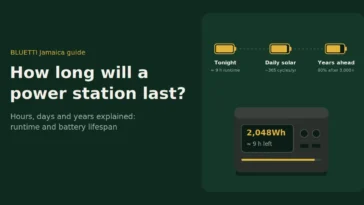
Watt-hours ÷ watts = hours. That’s it. Every question on this page comes back to that one line.
Your power station’s capacity is measured in watt-hours (Wh). Your appliance’s draw is measured in watts (W). Divide the first by the second and you get roughly how many hours it runs.
A worked example
A 2,000Wh power station running a 100W TV:
2,000 ÷ 100 = 20 hours
Then subtract a bit for conversion losses, and you’re looking at somewhere around 16 to 18 hours in practice. Still an entire evening several times over.
Why you won’t get the full number
Converting stored DC power to the 110V AC your TV needs costs energy, and you don’t want to run a battery to absolute zero. Between inverter efficiency and usable depth of discharge, plan on roughly 80 to 90% of the nameplate figure reaching your appliances.
That isn’t a defect or a brand issue it applies to every power station on the market. Anyone quoting runtimes without accounting for it is being optimistic.
How much power does a TV actually use?
Draw depends on screen size, panel type and how bright you run it. Here’s the rough picture, and what it means for runtime.
| TV | Typical draw | 500Wh unit | 1,000Wh unit | 2,000Wh unit | 3,000Wh unit |
|---|---|---|---|---|---|
| 32″ LED | 30–50W | ~10 hrs | ~20 hrs | ~40 hrs | ~60 hrs |
| 43″ LED | 50–80W | ~7 hrs | ~14 hrs | ~28 hrs | ~42 hrs |
| 55″ LED | 80–120W | ~4.5 hrs | ~9 hrs | ~18 hrs | ~27 hrs |
| 55″ OLED | 100–150W | ~3.5 hrs | ~7 hrs | ~14 hrs | ~21 hrs |
| 65″ LED | 100–160W | ~3.5 hrs | ~7 hrs | ~14 hrs | ~21 hrs |
Figures allow for conversion losses and assume the TV alone. Your own set may differ check the label.
Where to find your own figure
- The label on the back of the TV — look for a wattage or amperage rating
- The manual, usually in the specifications section
- A plug-in power meter, if you want the real number rather than the maximum rating
Worth doing. The rating plate shows maximum draw, and normal viewing is often well below it.
The add-ons people forget
A TV is almost never alone:
- Set-top box or decoder — 10 to 30W
- Streaming stick — 5 to 10W
- Soundbar — 20 to 50W
- Games console — 60 to 200W, considerably more than the TV in some cases
- Router and modem — 15 to 25W, and you’ll want these anyway
Add a decoder and a soundbar to a 55-inch TV and you’re at 150 to 200W rather than 100W. Runtime drops accordingly.
The real question: what else can run at the same time?
Nobody wants a TV alone during an outage. They want the TV, the Wi-Fi, their phones charging, a fan going, and a couple of lights on and that whole bundle is still comfortably within a mid-size unit.
Total draw is what matters. Add up everything you want running, then divide.
A realistic outage bundle
| Load | Draw |
|---|---|
| 55″ TV | ~100W |
| Decoder | ~20W |
| Router + modem | ~20W |
| Standing fan | ~50W |
| 3 LED lights | ~25W |
| Phone charging | ~20W |
| Total | ~235W |
On a 2,000Wh unit, allowing for losses: roughly 7 to 8 hours. An entire evening with the fan running, and enough left to get through breakfast.
That’s the setup most households actually want, and it’s well within reach.
Adding the fridge changes everything
Refrigeration is the load that should decide your purchase not the TV.
A fridge-freezer draws around 100 to 200W while the compressor runs, but it cycles rather than running constantly, so it uses roughly 1kWh over a full day. It also has a startup surge, briefly pulling 600 to 1,200W when the compressor kicks in.
Add a fridge to the bundle above and your 2,000Wh unit is covering both for around 6 to 7 hours, or the fridge alone for the better part of two days.
If your real concern is keeping food from spoiling, size for the fridge and the TV comes free.
Pure sine wave: the spec that matters for a TV
TVs contain sensitive electronics, and the shape of the AC power they receive matters more than it does for a lamp or a fan.
Pure sine wave output matches what comes out of a wall socket. Modified sine wave is a cheaper approximation, and with sensitive electronics it can cause audible buzzing, picture interference, or additional stress on the power supply over time.
Quality power stations output pure sine wave. It’s worth confirming on the spec sheet before buying particularly with unbranded units, where it’s the corner most often cut.
Surge: the other number to check
A TV draws a brief spike when it switches on, but it’s small and well within any unit that can run it steadily.
Surge only becomes the deciding number when something with a motor joins the party. A fridge compressor briefly pulling 600 to 1,200W, or a water pump pulling considerably more, is what sets your minimum not the television.
If a pump is on your list, that changes the sizing question substantially, and our guide to choosing a hybrid solar system covers how surge ratings work in more detail.
What size should you actually buy?
Match it to the bundle you want running, not to the TV.
Entry: around 300–600Wh
Phones, router, a few lights, and a smaller TV for a few hours. Good for short cuts and as a first unit. Won’t carry a fridge.
Mid: around 1,000–2,500Wh
The sweet spot for most households. TV, decoder, router, fan, lights and phones through a full evening or a fridge for most of a day. If you’re buying one unit for general outage cover, this is the range.
Large: 2,500Wh and up, expandable
Fridge plus entertainment across a multi-day outage. Worth it if outages in your area regularly run past a day, or if you’re protecting a freezer full of food.
You can compare capacities and output ratings across the range at BLUETTI Jamaica, with island-wide delivery and warranty handled locally.
Making it last longer
Small changes, real difference:
- Turn the TV backlight down. Often the single biggest saving on a modern set 20 to 30% is achievable without the picture suffering noticeably.
- Use a smaller TV if you have one. A 32-inch uses a fraction of a 65-inch.
- Skip the soundbar. TV speakers are adequate for the news.
- Unplug standby loads you’re not using consoles, second decoders, chargers with nothing attached.
- Prioritise. Fridge first, then internet, then entertainment.
- Recharge during the day if you have panels.
Recharging during a long outage
This is where solar genuinely changes the maths. A power station paired with panels stops being a countdown and becomes something that refills each day which for a multi-day outage after a storm is the difference between rationing and carrying on.
Be realistic about output. A panel’s rated wattage is a laboratory figure, and real output depends on panel size, angle, cloud cover and time of day. Plan on less than the sticker number, and angle the panel toward the sun rather than leaving it flat.
What a power station won’t do
Being straight about the limits:
- It’s not a whole-home solution. It powers what you plug into it, not your house.
- Air conditioning drains it fast. A split unit may start on a larger station, but it’ll empty it in a couple of hours.
- It can’t power hard-wired items — no ceiling fans on a wall switch, no hard-wired lighting, no water pump without an outlet.
- Anything that makes heat — kettle, iron, hot plate, hair dryer burns through capacity quickly. Fine for a few minutes, not for the evening.
If you need whole-house coverage or hard-wired loads, that’s a hybrid system with an electrician, and our guide to grid-tied and hybrid systems covers that path.
FAQs
How long will a portable power station run a TV?
Divide capacity in watt-hours by the TV’s wattage, then subtract 10 to 20% for losses. A 2,000Wh unit running a 100W TV gives roughly 16 to 18 hours. A 500Wh unit running the same TV gives around four.
Can it run a TV and a fridge at the same time?
Yes, on a mid-size or larger unit. Check two things: total running watts of both, and that the surge rating covers the fridge compressor starting typically 600 to 1,200W briefly.
Will a power station damage my TV?
Not if it outputs pure sine wave, which matches normal mains power. Modified sine wave output can cause buzzing or interference with sensitive electronics, so confirm the spec before buying.
What size power station do I need for a TV?
For a TV alone, even a 500Wh unit manages several hours. For a realistic evening TV, decoder, router, fan, lights and phones a 1,000 to 2,000Wh unit is the practical choice.
Can I run a TV and Wi-Fi together?
Easily. A router and modem draw only 15 to 25W combined, so adding them barely affects runtime. Most people set the router up on the power station first, since internet matters more than television during an outage.
Can I recharge it during an outage?
With solar panels, yes which is what makes a power station workable for multi-day outages rather than just a few hours. Real output depends on panel size, angle and conditions, so plan conservatively.
Is a power station better than a generator for running a TV?
For a TV and household electronics, generally yes. No fuel, no fumes, no noise, and it can sit indoors beside the TV. A generator wins on sustained high loads and unlimited runtime while you have fuel.
Tell us what you want running
The TV is the easy part. Send us a list of what you actually want on during an outage TV, fridge, router, fan, whatever matters in your house and we’ll tell you what size covers it.
Including when a smaller unit is enough, which is more often than people expect. You can browse capacities at BLUETTI Jamaica, with local stock and warranty handled in Jamaica.