Solar panels on the roof sound great until the power cuts at 9pm and you realise those panels aren’t doing anything in the dark. Without storage, solar only works while the sun’s out. The electricity you don’t use during the day goes back to the grid, and when JPS drops, your panels switch off with it. A solar energy storage system changes that equation: it captures what your panels make, stores it in a battery, and delivers it when you actually need it day, night, or mid-outage.
This guide explains what a solar energy storage system is, why it makes particular sense in Jamaica, how to size one, what it costs, and the mistakes that waste money. Practical answers for homeowners and small businesses who want real energy independence, not just a panel on the roof.
What is a Solar Energy Storage System?
A solar energy storage system combines solar panels, a battery, and an inverter into a setup that generates electricity from sunlight, stores it, and powers your home on demand. Unlike panels alone which only produce while the sun shines and shut down during a grid outage a storage system lets you use your own solar power around the clock and stay on when the grid goes off.
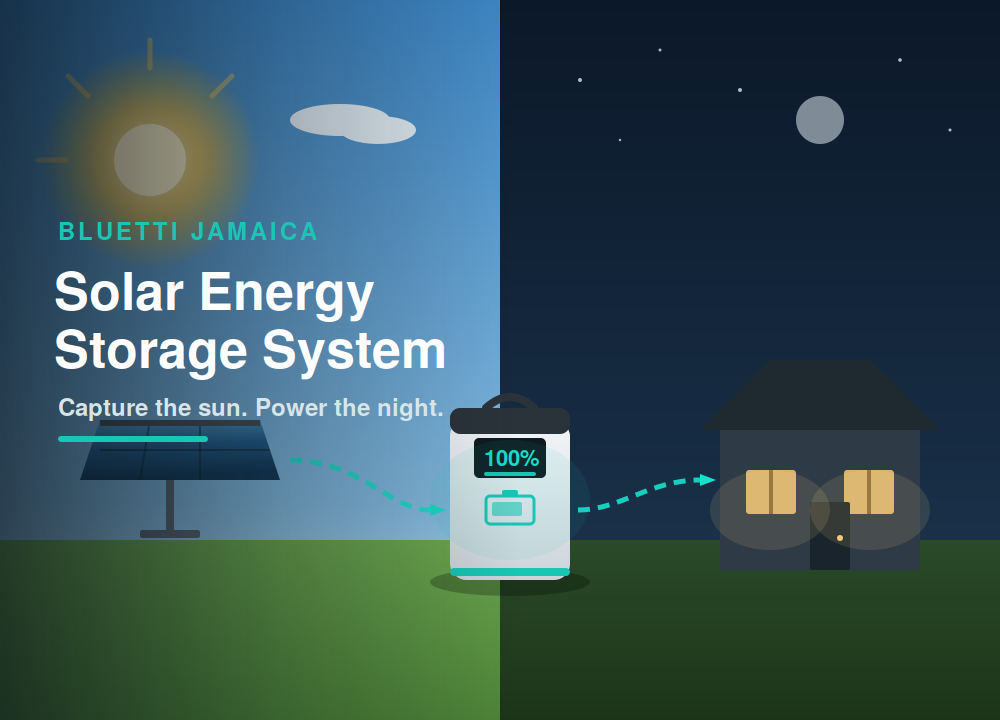
Think of it this way: the panels are the source, the battery is the tank, and the inverter is the tap. Together, they give you control over when and how you use the energy you produce, instead of handing it all to the utility.
Why does Jamaica need energy storage?
Jamaica faces a combination that makes energy storage especially valuable: frequent and unpredictable power outages, some of the highest electricity rates in the Caribbean, and abundant year-round sunshine. Storage connects all three it keeps you powered through outages, lets you use your own solar instead of buying expensive grid power, and makes the most of the sun you’ve already got.
The core gap storage fills is timing. Solar generates most during the middle of the day, but Jamaican households use the most power in the evening and overnight cooking, cooling, lighting, devices. Without a battery, that midday solar is worth less because you can’t use it when you need it most. With storage, you capture the daytime surplus and run on it after dark.
Add to that the reality of JPS outages sometimes hours, sometimes longer and a battery becomes more than a savings tool. It’s your backup.
How does a solar energy storage system work?
During the day, your solar panels generate electricity. What your home uses immediately comes straight from the panels; the surplus charges the battery instead of disappearing to the grid. In the evening and at night, the battery discharges to power your home. If the grid fails, the system switches to stored power automatically often in milliseconds so your essentials stay on.
The flow, step by step:
- Solar panels generate DC electricity from sunlight
- The inverter converts it to AC for your home and manages the energy flow
- Your home uses what it needs in real time
- The battery stores the surplus
- After dark or during an outage, the battery discharges through the inverter to power your home
- The grid acts as a backup or receives any excess, depending on your setup
Types of solar energy storage systems
Solar storage comes in three broad tiers for homes and small businesses, each suited to different needs and budgets. The right choice depends on how much backup you want, how much solar you have (or plan to add), and whether you’re looking for portability or a permanent install.
Portable power stations with solar (entry-level, flexible)
A portable power station paired with foldable or fixed solar panels is the simplest form of solar storage. Units range from a few hundred watt-hours to several thousand, charge from the sun during the day, and power your devices, a fan, lights, a router, or even a fridge for a stretch. They’re not a whole-home solution, but they’re affordable, require zero installation, and you can move them wherever you need them.
Best for: renters, first-time buyers, essential-device backup, camping and outdoor use.
Modular and stackable home battery systems
A step up in both capacity and capability. Modular systems let you start with a base battery and add expansion units as your needs grow scaling from enough for essentials to enough for a significant portion of your home. Paired with a compatible inverter and solar panels, they offer serious backup without committing to a full permanent install upfront.
Best for: homeowners wanting scalable backup, solar self-consumption, and the flexibility to expand later.
Whole-home energy storage systems
The full solution: a hybrid inverter, a large battery bank, and a smart panel that manages your entire home’s energy solar generation, battery storage, grid interaction, and load priority in one integrated system. These can back up an entire household, including heavy appliances, and are designed for years of daily cycling.
Best for: whole-home backup, large solar arrays, maximum energy independence, and small businesses.
How to size a solar energy storage system for your home
Start with how much electricity you use daily, decide how many hours of backup you want, then match battery capacity and solar input to cover both. Most Jamaican households use between 15 and 40 kWh per day, though essential-only backup (fridge, lights, fan, router, phones) is far less.
Understanding kWh capacity vs daily use
A battery’s capacity is measured in kilowatt-hours (kWh). If your home uses 25 kWh a day and you want to cover your essentials (roughly a third of that), you’d need around 8–10 kWh of usable storage to get through a night, and more for a full-day outage. Bigger batteries or expansion packs stretch that further.
A simple sizing approach
- Audit your usage — check your JPS bill for daily kWh, then list what you’d want running during an outage
- Size the battery — match capacity (kWh) to the hours of backup you need for those loads
- Size the solar — enough panel input (kW) to refill the battery during a sunny day, so the cycle repeats
What to look for when buying
Prioritise battery chemistry, capacity and output, expandability, switchover speed, and warranty. These determine whether the system performs reliably over a decade or disappoints in the first year.
Battery chemistry LiFePO₄ vs other types
LiFePO₄ (lithium iron phosphate, also called LFP) is the standard for home storage: safe, stable in heat, and rated for thousands of charge cycles typically 3,000 to 4,000+, compared with 500–1,000 for cheaper lithium-ion chemistries. In Jamaica’s warm climate, LFP’s thermal stability is a genuine advantage.
Capacity, output, and expandability
Capacity (kWh) sets how long you can run; output (kW) sets how much you can run at once. Make sure both match your needs. Expandable systems let you add battery modules later, so you can start smaller and grow a practical path for most households.
Switchover speed (UPS) and backup behaviour
If the grid drops, you want the battery to take over instantly not after a gap that reboots your router or stalls your fridge. Look for a switchover time under 20 milliseconds. Many quality systems operate as a UPS, so sensitive equipment never notices the outage.
Solar input and charging flexibility
Check the maximum solar input the system accepts and whether it supports both new and existing panel setups. Flexible charging AC, solar, and generator means you can keep the battery topped up from multiple sources.
Warranty and cycle life
A good system comes with a multi-year warranty (5–10 years is common for quality brands) and a cycle-life rating that tells you how many full charge-discharge cycles to expect before capacity noticeably drops.
How much does a solar energy storage system cost in Jamaica?
Costs range from under US$500 for a small portable power station with solar to US$5,000+ for a whole-home system before installation, with modular setups sitting in between. What you pay depends on capacity, system type, and how much solar you pair with it.
| Tier | Capacity | Typical use | Rough cost range (USD) |
|---|---|---|---|
| Portable + solar panel | 300–2,000Wh | Devices, lights, fan, router | ~$300–$1,500 |
| Modular / expandable | 2–10 kWh | Essentials + fridge, scalable | ~$1,500–$4,000 |
| Whole-home system | 10–20+ kWh | Full house, heavy appliances | ~$5,000–$15,000+ |
The upfront cost is real, but so is the offset. Between JPS savings, outage protection, and free solar recharging, a well-sized system pays for itself over time faster the more outages you avoid and the more solar you self-consume.
Solar storage vs generator which is better for Jamaica?
For quiet, clean, indoor-safe backup that recharges from the sun, a solar energy storage system wins. For running heavy loads continuously for many hours on demand, a generator still has the edge. For most Jamaican homes, solar storage with a well-sized battery covers the real need — and does it without fuel runs, noise, or fumes.
| Factor | Solar storage | Generator |
|---|---|---|
| Noise | Silent | Loud |
| Fumes / indoor use | Clean, safe indoors | Fumes, outdoor only |
| Fuel | None (solar/grid) | Petrol/diesel, ongoing cost |
| Maintenance | Minimal | Regular servicing |
| Running cost | Very low (free with solar) | Fuel cost every use |
| Recharge | Sun + grid (automatic) | Manual refuel |
| Sustained heavy load | Limited by battery size | Strong, as long as fuel lasts |
Many households find that a solar-charged battery covers their outage needs without the noise, fuel, and upkeep. For very long outages with heavy loads, a generator can complement a battery system but for most people, storage alone does the job.
Common mistakes to avoid
- Undersizing the battery — not enough capacity to cover your actual overnight or outage needs
- Ignoring output (kW) vs capacity (kWh) — a big battery that can’t deliver enough watts at once won’t run your appliances
- Skipping LiFePO₄ — cheaper chemistries cost less upfront but wear out faster, especially in heat
- No UPS for sensitive gear — a slow switchover means your router and fridge stall every outage
- Oversizing without matching solar — a huge battery with too little solar input takes forever to recharge
FAQs
How much battery storage do I need for my home?
It depends on your daily usage and how many hours of backup you want. For essential-only backup (fridge, lights, fan, router), 5–10 kWh is a common starting point. For whole-home coverage, 10–20+ kWh sized to your actual consumption.
Can a solar battery keep my house running during an outage?
Yes, depending on the system size. A well-sized storage system keeps your essentials running through a typical outage, and a larger or expandable system can back up most or all of a home. Solar recharging extends that further each sunny day.
How long does a solar battery last?
LiFePO₄ batteries are commonly rated for 3,000–4,000+ charge cycles, which translates to roughly 10+ years of daily use. Cheaper chemistries degrade faster one reason LFP is the preferred choice for home storage.
Is solar storage worth it in Jamaica?
For most Jamaican homes, yes. Frequent outages, high electricity rates, and abundant sunshine make the payback case stronger than in many countries. The combination of outage protection and JPS bill reduction means the system earns its keep.
Do I need solar panels to use a battery storage system?
Not necessarily you can charge a battery from the grid or a generator. But pairing it with solar gives you free recharging, which is where the real long-term savings come from, and keeps the battery topped up during extended outages.
What’s the difference between a portable power station and a home battery system?
A portable power station is a self-contained, movable unit plug in and go, no install. A home battery system is a larger, often permanently installed setup with a hybrid inverter and expandable battery bank, designed for whole-home energy management.
Can I expand my system later?
Many modern systems are modular you start with a base battery and add expansion units as your needs or budget grow. This makes it practical to start smaller and scale up without replacing what you already have.
Ready to store your own power?
The right solar energy storage system turns Jamaica’s sunshine into electricity you can use any time day, night, or mid-outage. Whether you’re starting with a portable station or planning a whole-home setup, the first step is matching the system to your home and usage. Browse the solar energy storage systems at Bluetti Jamaica, or get in touch and we’ll help you size the right solution.