Most people guess at power needs and buy the wrong size backup. This appliance wattage chart gives you the real running watts for a fridge, fan, AC and microwave in a Jamaican home. Use it to size a battery or inverter before you spend, not after.
What Is an Appliance Wattage Chart?
An appliance wattage chart is a simple table showing how much power each appliance draws, measured in watts (W). Running watts is what the appliance uses continuously. Starting watts, or surge, is the brief spike a motor pulls when it kicks on — a fridge compressor can pull three to six times its running watts for a second or two.
It replaces guesswork and old rules of thumb like “a fridge uses a lot.” With a chart, you add up only what you actually need to keep on during a JPS outage, then match that total to a power station’s output rating.
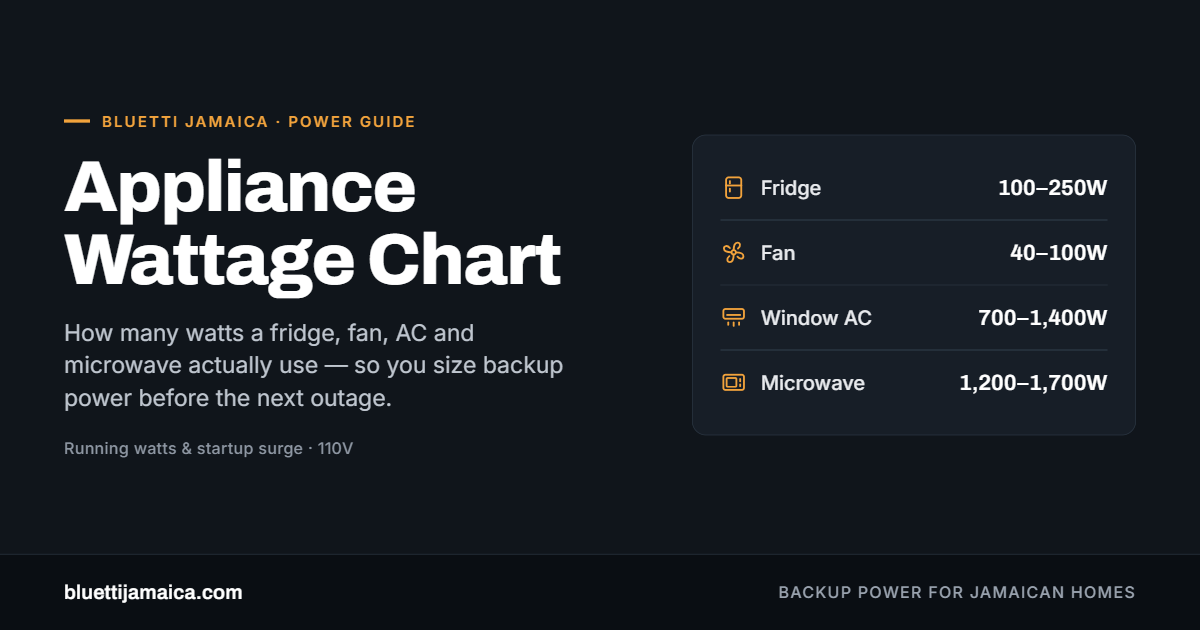
Typical running watts at 110V:
| Appliance | Running watts | Surge watts |
|---|---|---|
| Fridge (standard, 14–18 cu ft) | 100–250W | 600–1,200W |
| Chest freezer | 100–200W | 600–1,000W |
| Standing or ceiling fan | 40–100W | 100–150W |
| Window AC (8,000–12,000 BTU) | 700–1,400W | 1,800–3,000W |
| Inverter split AC (9,000–12,000 BTU) | 500–1,200W | low (soft start) |
| Microwave (1,000W rated output) | 1,200–1,700W draw | 1,700W |
| LED TV (43–55″) | 60–150W | — |
| Wi-Fi router + modem | 10–20W | — |
| Laptop | 45–90W | — |
| LED bulb | 5–15W | — |
| Water pump (½ HP) | 500–800W | 1,500–2,500W |
Key Benefits of an Appliance Wattage Chart
1. Prevents Buying Too Small
A chart shows the total load before you buy, so you don’t bring home a 600W unit that cannot start a 1,200W-surge fridge.
2. Stops You Overspending
Many Jamaican homes only need fridge, fans, lights and Wi-Fi during an outage — roughly 300–500W running. That is a far smaller unit than most people assume.
3. Separates Surge From Running Watts
Motor appliances like fridges, pumps and non-inverter ACs spike on startup. The chart flags which ones need headroom in the inverter rating.
4. Makes Runtime Easy to Calculate
Divide battery capacity in watt-hours by your running watts. A 2,764Wh unit powering a 150W fridge gives roughly 15–18 hours, allowing for conversion losses.
5. Identifies the Power Hogs
AC and microwave dominate almost every load list. Knowing that lets you run them on grid power and reserve the battery for essentials.
Things to Consider Before Buying in Jamaica
- Add the surge, not just the running watts. One fridge plus one pump starting together can exceed 3,000W for a moment.
- Outage length matters. Kingston and Portmore blackouts are often short; rural St. Elizabeth, St. Ann and Westmoreland can run far longer.
- Hurricane season (June–November). Size for multi-day outages if you are in Negril, Ocho Rios or an exposed coastal area.
- High JPS tariffs. Pairing a unit with solar panels lets you recharge in daylight instead of paying for grid power or fuel.
- Heat and humidity. Fridges and ACs work harder in Jamaican conditions, so use the upper end of each wattage range when calculating.
- Shops and farms. Freezers, display coolers and pumps need surge headroom plus long runtime.
How Much Does an Appliance Wattage Chart Cost in Jamaica?
The chart itself is free — the cost is the power station you size with it. On BLUETTI Jamaica, entry units suited to fans, lights and Wi-Fi start at US$299 for the Elite 30 V2 and US$399 for the AC50B. Mid-range fridge-and-essentials units run US$833.13 for the Premium 100 V2 up to US$1,695.99 for the Apex 300, while AC-capable and whole-home systems range from US$2,999 to US$13,798. Prices listed on site in USD; check current listings before ordering.
FAQs
How many watts does a fridge use in Jamaica?
Around 100–250 watts running, with a startup surge of 600–1,200 watts. Always size your inverter for the surge figure, not the running figure.
Can a 1,000W power station run a microwave?
No. A microwave rated at 1,000W output typically draws 1,200–1,700 watts from the wall, so you need an inverter rated above that.
Do fans use a lot of electricity?
No. A standing or ceiling fan uses roughly 40–100 watts, which is less than a single LED TV and cheap to run on battery for many hours.
Are inverter ACs better for battery backup?
Yes. Inverter split units draw around 500–1,200 watts with a soft start, avoiding the 1,800–3,000 watt surge of older window ACs.
What size power station do I need for a fridge and fans?
Roughly 300–500 running watts covers a fridge, two fans, lights and Wi-Fi. Check capacity in watt-hours for runtime, and browse locally stocked units for pickup.
Conclusion
An appliance wattage chart turns backup power from guesswork into arithmetic. Add your running watts, allow for the largest surge, then pick a unit rated above both with enough watt-hours for a realistic outage. Size it once, correctly, and your fridge, fans and Wi-Fi keep running when the grid does not.